Articles & BlogBy Trapper W. Brown11 min read
For anyone who has flipped the switch on a plane, felt the engine roar drop away, and then heard the person in the next seat just as clearly as before.
Noise-cancelling headphones do something that sounds like a trick: they make a place quieter by adding more sound to it. A tiny microphone listens to the noise around you, and the speaker in the ear cup plays a second sound built to wipe out the first.
It is worth knowing how, because the method explains the limits. The same headphones that erase a jet engine do very little about a dropped tray, and the reason is a matter of timing that you can work out with a calculator. This article goes through the physics, the parts, the arithmetic and what two health agencies say about listening.
 An over-ear cup blocks some sound just by covering the ear, and the electronics inside deal with the part it cannot block. Photo by Andre Hunter, CC0, via Wikimedia Commons.
What is sound, physically?
Sound is a pressure wave in the air. Georgia State University's HyperPhysics reference describes it this way: a vibrating object sends out a wave in which one part has a pressure higher than the surrounding air and another part lower, and the wave travels outward at the speed of sound. Your eardrum is pushed in by the high part and pulled out by the low part, and you hear the wobble.
Two numbers describe a steady tone. Frequency, measured in hertz (Hz), is how many of those push and pull cycles arrive each second. A low hum has a small number and a hiss has a large one. Wavelength is the distance from one high pressure crest to the next.
The two are tied together by the speed of sound, which HyperPhysics lists as 344 meters per second in air at 20 degrees Celsius. Wavelength is that speed divided by the frequency.
| Tone | Wavelength in air | One cycle lasts |
|---|---|---|
| 100 Hz (low) | 3.44 m | 10 thousandths of a second |
| 1,000 Hz (middle) | 34.4 cm | 1 thousandth |
| 5,000 Hz (high) | 6.9 cm | 0.2 thousandths |
Low sounds are long and slow. High sounds are short and quick. Everything that follows hangs on that.
How can sound cancel sound?
Pressures add. When two waves arrive at the same place, HyperPhysics explains, they interfere: if the crests line up, the result is louder (constructive interference), and if one wave's crest meets the other's trough, they subtract (destructive interference).
Take that to its end. Suppose a wave arrives at your ear, and at the same instant a second wave arrives that is its exact mirror image: the same size, with low pressure wherever the first has high. The eardrum is pushed and pulled by equal amounts at once, and it does not move. No movement means no sound.
The idea is older than the transistor. An inventor named Paul Lueg filed a United States patent in March 1934, granted in June 1936, titled "Process of Silencing Sound Oscillations." It describes a microphone connected through an amplifier to a loudspeaker that produces sound of opposite phase, so that, in the patent's words, the two sound waves "silence each other or dampen each other." The principle has not changed since. Only the electronics have.
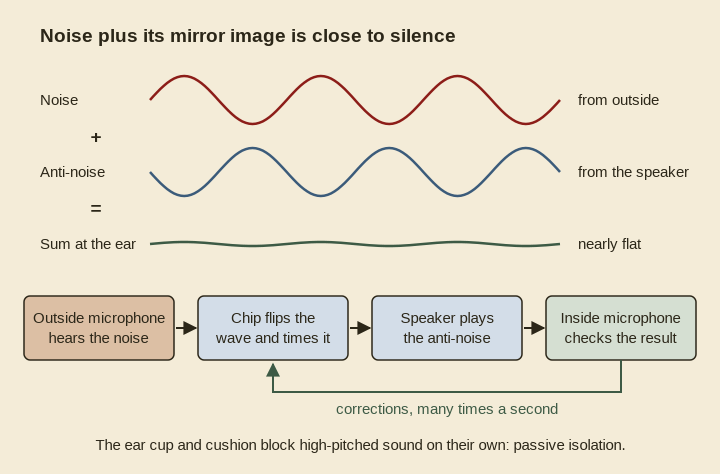 The speaker plays the noise upside down, and a second microphone inside the cup checks how well the two cancelled.
What is inside the ear cup?
An overview from the signal processing department at Helmut Schmidt University in Hamburg lays out the parts of a modern set:
- An outside microphone on the shell. It hears the noise a moment before the noise gets through the cup. Engineers call a design that works from this microphone feedforward, because it acts on the noise ahead of time.
- A speaker, the same one that plays your music. It plays the mirror image, often called anti-noise.
- An inside microphone near the speaker, called the error microphone. It hears what is left over after the two waves meet. A design that works from this microphone is called feedback, because it corrects itself from the result.
- A chip that decides, moment by moment, what the speaker should play.
A set can use both microphones at once, which the Hamburg authors call a hybrid, so that each method covers some of the other's weak points.
The chip has a harder job than "flip the wave." The Hamburg overview points out that to cancel well, both the size and the timing of the anti-noise have to match the noise at one small place, which the authors call the sweet spot. The cup, the cushion and your own ear change the noise on its way in, so the chip must work out what the noise will look like when it arrives, and it adjusts continuously from what the inside microphone reports.
In a digital set the chip does not handle sound directly. It handles numbers: the microphone signal is measured tens of thousands of times a second, processed, and turned back into a signal for the speaker. The article "The Nyquist Theorem: Why Sampling Works" explains why that measuring rate is enough to capture the sound. For this subject, the catch is that every step takes a little time.
Why does a steady low sound cancel best?
Because the anti-noise is always slightly late, and how much that matters depends on the wavelength.
A research paper from Aalborg University in Denmark, published at a 2024 signal processing conference, lists where the delay comes from: converting sound to numbers and back, the processing, and the paths the sound itself travels. In their tests, a delay as small as 0.125 milliseconds (6 samples, at the 48,000 samples a second their system used) was enough for a conventional design to be beaten by one built to predict the sound ahead.
Here is what a delay of that size does. This is a simplified model: two pure tones of equal size, one flipped and 0.125 milliseconds late.
- At 100 Hz one cycle lasts 10 milliseconds, so the anti-noise is late by 1.25 percent of a cycle. The two waves still overlap almost perfectly. About 8 percent of the sound pressure is left.
- At 500 Hz the same delay is 6.25 percent of a cycle. About 39 percent is left.
- At 1,000 Hz it is an eighth of a cycle. About 77 percent is left, which is hardly worth the battery.
- At 2,000 Hz it is a quarter of a cycle. The waves no longer oppose each other, and the total is 141 percent. The "cancelling" has made the tone louder.
| 100 Hz | 8% |
|---|---|
| 500 Hz | 39% |
| 1,000 Hz | 77% |
| 2,000 Hz | 141% |
Source: Worked example in this article
That is the whole story of low versus high. A long, slow wave forgives a small timing error. A short, quick one does not. Real systems are cleverer than this model, but the limit is real: the Aalborg paper puts conventional cancelling at about 1,000 Hz and below, and a second Hamburg paper says the feedback method works on low frequencies "up to 1 kHz."
"Steady" matters for a related reason. If the chip cannot be fast enough, it has to predict. The Aalborg authors note that the usual algorithm acts as a predictor, so its performance depends on how predictable the noise is. An engine drone repeats itself cycle after cycle, so the next thousandth of a second looks like the last. Speech changes constantly, and the authors name it as a sound these systems have difficulty with. A clap or a slammed door gives no warning at all.
There is one piece of help from geometry. In 0.125 milliseconds sound travels about 4.3 centimeters. The outside microphone sits a little ahead of the ear, so the noise itself takes a moment to get past the shell, and the Hamburg authors describe that microphone's signal as time-advanced. The electronics get a small head start, and no more.
What does the ear cup do on its own?
Quite a lot, and at exactly the frequencies where the electronics give up. The second Hamburg paper states it in two sentences: the passive attenuation from the headphone's materials is effective in the mid and high frequency ranges, and the low range is treated actively.
| Passive isolation | Active cancelling | |
|---|---|---|
| How it works | Shell, cushion and seal block the sound | A speaker plays the mirror image |
| Best at | Mid and high pitches | Low pitches, roughly 1,000 Hz and below |
| Needs power | No | Yes |
| Weak spot | Long, low waves pass through | Fast or sudden sounds, and timing errors |
The two halves are a team. The cup takes the hiss and clatter, and the electronics take the rumble that pushes through the cup. It also explains why fit matters. The Aalborg paper notes that an improper fit changes the delays the system is working against, and a gap in the cushion lets in the high sounds that only the seal was going to stop.
What do people get wrong?
"It makes silence." It makes the low, steady part of the noise much quieter. Voices, keyboards, announcements and anything sudden still get through in part, for the reasons above. That is the physics, and it is also why you can still hear someone say your name.
"The anti-noise is extra noise hitting my ear." At the sweet spot the two pressures subtract. The eardrum responds to the total, and the total is smaller.
"It works the same everywhere in the cup." The cancelling is aimed at one small place, the sweet spot by the inside microphone, which is one more reason fit and position matter.
"It is hearing protection." The National Institute for Occupational Safety and Health (NIOSH), part of the CDC, addresses this directly on its hearing protection page. It says active noise cancellation can be added to headphones or earbuds, but that it "should not be considered hearing protection unless labeled with an NRR." NRR is the noise reduction rating printed on the packaging of devices sold as hearing protectors.
"If the noise is cancelled, the volume no longer matters." The music is not cancelled. See the next section.
What do the health agencies say about listening?
What follows is the agencies' own guidance, reported and not added to. It is not medical advice from me, and both pages are linked at the end.
The World Health Organization (WHO), in its safe listening guidance dated 6 March 2026, says "you can safely listen to a sound level of 80dB for up to 40 hours a week," and that at 90 decibels the safe listening time falls to four hours a week. Among its tips, WHO says to keep the volume below 60 percent of maximum, and it says to "use well-fitted, and noise cancelling headphones to reduce the need to raise volume in noisy situations." In WHO's account, the benefit of cancelling is that you do not have to turn the music up to drown out the bus.
NIOSH sets its limit for workplace noise, not for music, but the logic is the same. Its recommended exposure limit is 85 A-weighted decibels (dBA) averaged over an eight-hour workday, and "for each 3 dBA increase in noise level, NIOSH recommends reducing the exposure duration by half." Run that rule forward and 88 dBA allows four hours, 91 allows two and 94 allows one. As a rule of thumb for judging a room, NIOSH says that at 85 dBA you often have to raise your voice to be heard by someone 3 feet away.
What to remember
- Sound is a pressure wave. Two waves that are mirror images add up to nothing at the point where they meet.
- A microphone hears the noise, a chip builds the mirror image, the speaker plays it, and a second microphone checks the result.
- The anti-noise is always a little late. A long, slow wave tolerates that. A short, quick one does not.
- Active cancelling handles low, steady sound, roughly 1,000 Hz and below. The cup and cushion handle the higher pitches passively.
- Per NIOSH, cancelling headphones are not hearing protection unless they carry an NRR label.
- Per WHO, 80 decibels is safe for up to 40 hours a week and 90 decibels for four, and cancelling can reduce the need to raise the volume.
The switch on the ear cup is doing arithmetic on air pressure, thousands of times a second, and losing the race against anything faster than it is. That is why the engine goes away and the flight attendant does not.
Sources (9)
- Georgia State University, HyperPhysics, "Speed of Sound in Air"
- Georgia State University, HyperPhysics, "Interference of Sound"
- U.S. Patent 2,043,416, Paul Lueg, "Process of Silencing Sound Oscillations", granted 9 June 1936
- Helmut Schmidt University, Rivera Benois, Nowak and Zoelzer, "Hybrid Active Noise Control Structures: A Short Overview"
- Helmut Schmidt University, Rivera Benois, Papantoni and Zoelzer, "Psychoacoustic Hybrid Active Noise Control Structure for Application in Headphones", ICSV25, July 2018
- Aalborg University, Iotov and others, "Improving Speech Attenuation in Headphones using Harmonic Model Decomposition and Multiple-Frequency ANC", ICASSP 2024
- CDC NIOSH, "Noise-Induced Hearing Loss", 30 January 2024
- CDC NIOSH, "Provide Hearing Protection", 28 October 2026
- World Health Organization, "Deafness and hearing loss: Safe listening", 6 March 2026