Articles & BlogBy Trapper W. Brown11 min readCurrent to 12 November 2026
For a homeowner who has seen a headline about getting paid to host a computer in the garage. By the end you will know what is real, what is still a pilot, and which questions to ask before anything gets bolted to your wall.
A data center is a building full of computers that other people rent by the hour. The idea in this article is to shrink that building to one box and put the box in a house: on a garage wall, beside the hot water tank, or in the side yard. The company runs paying customers' work on it over the internet. The household gets rent, a lower bill or free heat.
As of 12 November 2026, what can be verified from company pages and named news outlets is thin: one small scheme in Britain that heats water, three American programs announced this year that are pilots or waitlists, and a set of older online marketplaces that pay for time on hardware you already own. This guide describes those arrangements. It does not recommend any of them.
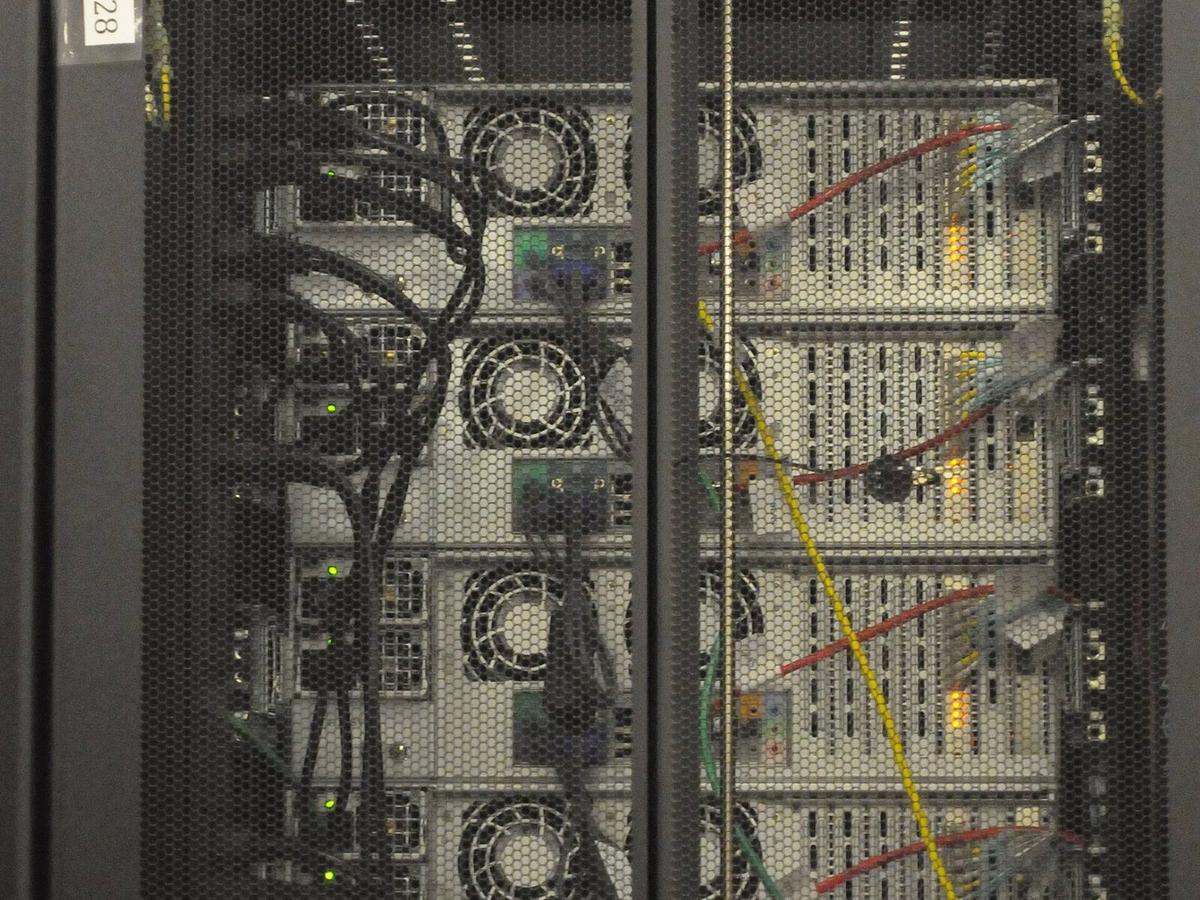 The back of a server rack in a national laboratory's data center. A home unit holds far less, but the fans, the cables and the heat are the same idea. Photo by Derrick Coetzee, CC0, via Wikimedia Commons.
What actually exists today?
Three kinds of arrangement. They differ mainly in who owns the box.
| Kind | Examples | Who owns the hardware | What the household gets | Confirmed status |
|---|---|---|---|---|
| Heat reuse | Heata (UK), Thermify (UK), Qarnot (France) | The company | Hot water or heating | Small or moved on |
| Hosted node | SPAN's XFRA, Sunrun, Nanocenter (US) | The company, where stated | Rent, bill discounts or other perks | Pilots and waitlists, all 2026 |
| Crowd marketplaces | Vast.ai, Salad, Storj and others | You | Pay per hour or per unit stored | Operating now |
Heat reuse. A server turns nearly all of its electricity into heat, and a data center spends money getting rid of it. Heata, a British company, attaches a server to a home's hot water cylinder so the heat warms the water. Its site claims savings of 150 to 350 pounds a year. Fortune reported in 2026 that the units were in about 100 homes. Qarnot, in France, began with computing radiators in homes. TechCrunch reported in January 2023 that it had shifted to "digital boilers" in larger buildings, since nobody needs a radiator all year, and its own site says it was bought by the cloud company Scaleway on 10 July 2026. Thermify was reported by The Register in October 2025 to be trialing a boiler replacement built from 500 small computers in British social housing. Its status in 2026 could not be confirmed. Two earlier attempts ended: the Dutch firm Nerdalize went bankrupt at the end of 2018, and Germany's Cloud&Heat says it is closing its last racks in residential buildings.
Hosted nodes. These are the American versions, and all three are new.
- SPAN, which makes electrical panels, announced XFRA on 13 April 2026. Its page describes an outdoor unit holding 16 graphics processors with its own cooling and a battery, rated at 60 decibels. The first phase is a 100-home trial with builders of new houses, with wider release planned for 2027. Hosts are offered discounted electricity, internet and backup power. Scientific American reported the unit draws about 12.5 kilowatts.
- Sunrun, a solar company, announced a pilot on 8 July 2026 in homes that already have its panels and batteries, according to Electrek. Hosts are to be paid. Terms were not published.
- Nanocenter's site describes leasing a patch of garage wall for three years, paying fixed monthly rent and repaying the electricity, for a unit drawing 1.0 to 1.8 kilowatts. It is a waitlist. A trade outlet, Data Center Knowledge, described a different model for the same company in August 2026, in which hosts finance the equipment. The two accounts disagree, and that alone is a reason to ask for the contract.
Crowd marketplaces. Here you supply your own machine. On Vast.ai, hosts set their own hourly price for a graphics card and are paid weekly in cash. Salad runs jobs on a gaming PC's graphics card and calls its earnings estimates "a projection, not a promise." Storj pays for spare disk space, at $1.35 per terabyte stored per month as of 1 September 2026. The company filed for Chapter 11 restructuring in July 2026 and says the network continues. Some networks pay in their own crypto tokens and not in dollars, and some say plainly that they want professional data centers, not homes.
Why would anyone put servers in homes?
Because the usual way of building is stuck in a queue.
Data centers used about 4.4 percent of American electricity in 2023, and the Department of Energy expects 6.7 to 12 percent by 2028, driven by artificial intelligence. New sites need land, permits and a large grid connection. Lawrence Berkeley National Laboratory found that power plants finishing in recent years had waited a median of more than five years between asking to connect and switching on. That figure is for power plants and not for data centers, but it shows how slowly the grid adds anything new.
Houses are already connected. The pitch is that most have electrical capacity sitting unused much of the day. Spread a few kilowatts across thousands of homes and you have a data center's worth of power without a new substation. SPAN's own page adds a limit: the approach is not meant to replace big data centers.
The other reason is heat. Tests at a national lab found that liquid-cooled servers can hand back 90 to 95 percent of their energy as usable heat.
How do the money and the ownership work?
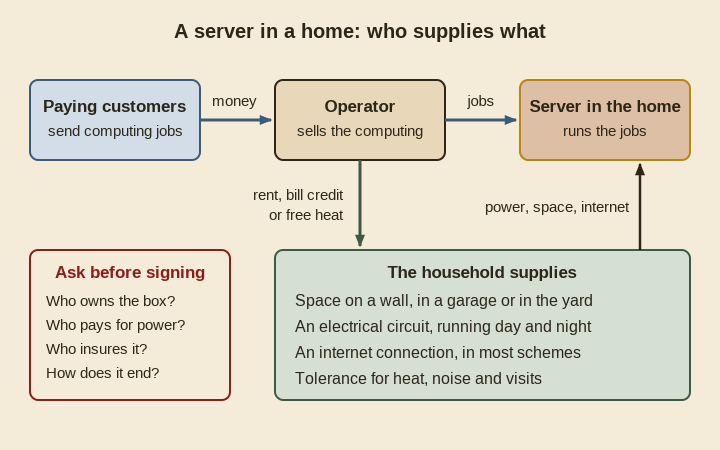 The customer pays the operator. The household is paid for space, power and patience.
A customer pays the operator for computing. The operator pays the household for the things a data center normally buys: space, power and a connection.
Who owns the box decides who carries the risk. When the company owns it, you are a landlord for a square yard of wall. If the hardware goes out of date or the customers vanish, that is the company's loss, unless the contract says your rent depends on it. When you own it, you are running a very small business. You paid for the machine, and nobody promises it will be rented.
Then taxes. The IRS treats rent for equipment or space as income. If you do it as a business it goes on Schedule C; if not, on Schedule 1. Payments in crypto tokens are taxable too. From 2026, a company must send you a Form 1099 once it pays you $2,000 in a year, but smaller amounts are still income.
What does it do to your house?
Electricity. This is the big one. A unit drawing 1.5 kilowatts around the clock uses 13,140 kilowatt-hours a year. The average American home used about 10,400 in 2024. So one modest box can more than double a home's electricity use, and at the 2025 average price of 17.3 cents that is about $2,270 a year. A 12.5 kilowatt unit uses as much as ten or eleven homes. Who pays for that, at what rate, and measured by whose meter, is the first question to settle.
Heat. All of it ends up as heat somewhere. A 1.5 kilowatt unit is a space heater that never switches off. That is welcome beside a water tank in January and unwelcome in a garage in July.
Noise. Ask for the rating in decibels and where it was measured. The one figure published on a company page was 60 decibels for an outdoor unit.
Internet. The work arrives and leaves over a connection. Some operators bring their own fiber or cellular link. If they want yours, read your provider's terms first: one large American cable company's policy forbids running servers or any commercial activity on a home plan. Check upload speed too. One network asks hosts for 75 megabits per second upward, a number worth comparing with your own plan.
What about insurance, fire safety and local rules?
- Wiring. Electrical codes treat a load that runs three hours or more as continuous and require extra margin on the circuit. That means a dedicated circuit installed by a licensed electrician, with a permit. The Consumer Product Safety Commission's standing advice is that extension cords are for temporary use only.
- Insurance. The Insurance Information Institute says a typical homeowners policy covers only $2,500 of business equipment. Ask your insurer, in writing, whether hosting changes your coverage, and ask the operator who insures the unit and any damage it causes.
- Zoning, leases and associations. Towns can limit businesses run from a home, and homeowner associations and leases can restrict outdoor equipment and commercial use. No official guidance on hosted servers was available to cite here, so ask your town's planning office. Renters need the landlord's written consent.
Whose equipment is on your network?
A stranger's computer, doing strangers' work, would sit inside your house. Two risks follow.
The first is to you. Anything plugged into your home network can see other devices on it unless it is walled off. The safest arrangement is a unit with its own internet line that never touches your Wi-Fi. If it must share, put it on a separate guest or isolated network. The site's articles Home Wi-Fi: The Six Router Settings That Matter and IP Addresses, Ports and Your Home Router explain how, and Firewalls, NAT and Port Forwarding explains why you should not open ports to the internet because a setup guide says so.
The second is to the customers whose data is on the machine. A sealed, locked, encrypted unit that you cannot open protects them and also protects you from blame. Ask who may enter your property to service it, with how much notice, and what happens if it is stolen.
A paired example with made-up numbers
Every figure here is invented to show the arithmetic, apart from the 17.3 cent electricity price.
| Household A: company owns the box | Household B: owns a gaming PC | |
|---|---|---|
| Arrangement | Garage wall unit, 1.5 kW, three-year lease | Lists its graphics card on a marketplace |
| Paid | $100 a month rent | $0.20 an hour, rented 40 percent of the time |
| Income per year | $1,200 | About $700 |
| Electricity | 13,140 kWh, about $2,270, repaid by the company | About 2,000 kWh, about $345, paid by the household |
| Left before tax | $1,200 | About $355 |
| Main risk | The company stops paying or repaying | The card sits idle, or wears out |
Household A's result depends entirely on one clause: the electricity being repaid in full and on time. If the repayment ran two months late, the household would be out about $380. Household B risks less and earns less: its $2,500 computer would take seven years to pay for itself.
What should you read in the contract, and what looks like a scam?
In the contract, find these in writing: who owns the hardware; the payment and what can reduce it; how electricity is measured and repaid; the length of the term and how either side can end it; who removes the unit and repairs the wall; who insures it; what happens if the company fails or is sold; and whether any claim is filed against your property.
The warning signs:
- You are asked to buy something first. A "node," a license or a machine that the seller will host for you. The Federal Trade Commission's Business Opportunity Rule requires sellers of such deals to give buyers specific information up front.
- Guaranteed returns. The FTC's line is blunt: "Only scammers will guarantee profits or big returns." In July 2026 the Securities and Exchange Commission filed a complaint against the operator of a hosted crypto mining program that it says raised about $22 million from more than 380 investors with promised monthly returns, and spent about 13 percent of it on mining.
- Payment only in the company's own token, or a requirement to deposit money to start.
- Pressure to sign quickly, or no physical address and no contract to read.
Watch out
A real hosting deal pays you for space and power. If money is flowing from you to the company at the start, you are a buyer or an investor, not a host, and different questions apply.
What to remember
- Putting servers in homes is real but early. As of November 2026 the American programs are pilots and waitlists.
- The arrangements split by who owns the box: the company (you are a landlord) or you (you are a small business).
- Electricity is the largest number. A 1.5 kilowatt unit uses more power in a year than an average home.
- Check four things before agreeing: your internet provider's terms, your insurer, your town or association, and your electrical panel.
- Keep someone else's computer off your home network, or on an isolated one.
- Guaranteed income, upfront purchases and token-only payouts are the classic warning signs.
If an offer does arrive, the useful first move is to ask for the full contract and a sample monthly statement, then sit down with your last year of electric bills beside them.