Articles & BlogBy Trapper W. Brown6 min read
For anyone who walks, drives, shops or commutes, which is everyone.
Does being aware of your surroundings mean treating every stranger as a threat? No. That would be exhausting, and it would not work.
Awareness is a quieter thing. It means knowing what normal looks like where you are, so that the rare thing that does not fit stands out by itself. Most places are safe most of the time, and most people around you are busy with their own day. Awareness lets you relax because you have looked, which is better than relaxing because you have not.
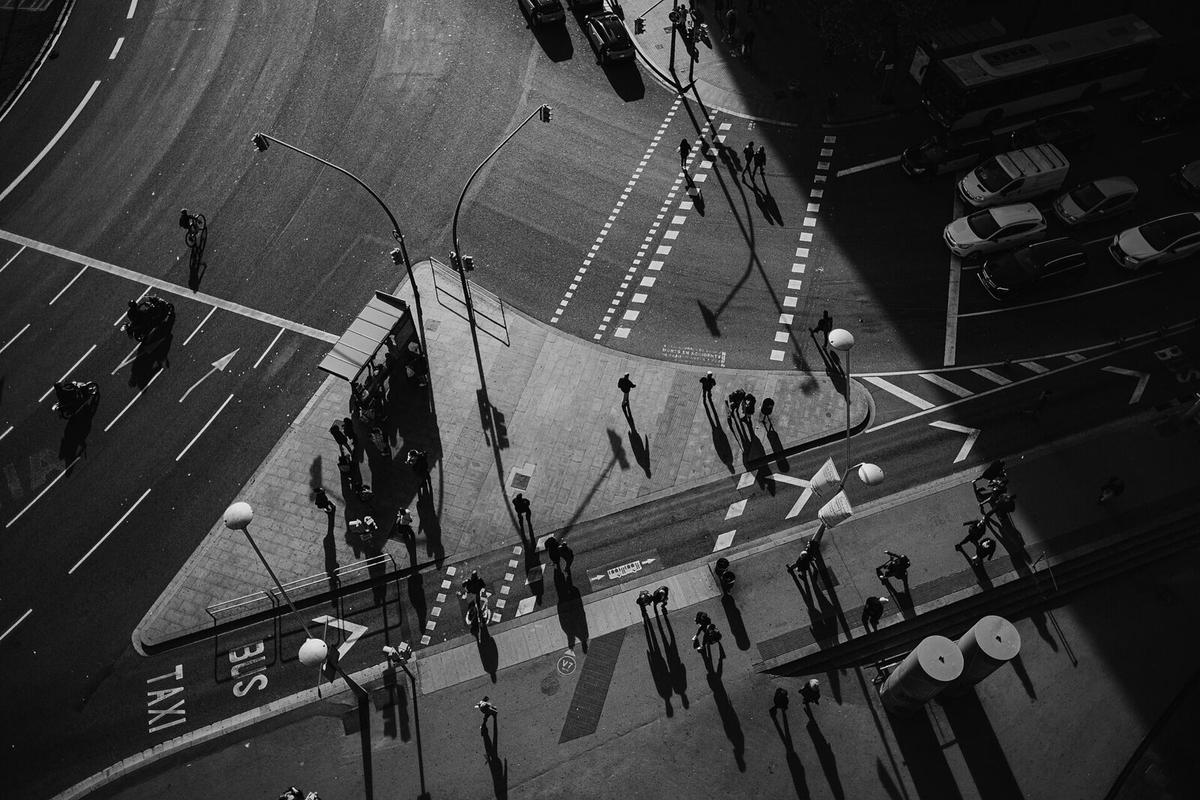 Every street has an ordinary rhythm, and knowing it is most of what awareness means. Photo by Levi Meir Clancy, CC0, via Wikimedia Commons.
What does normal look like here?
Every place has a baseline: its usual pace, noise and mood. A coffee shop in the morning has a line, people looking at phones, a few laptops, the hiss of a machine. A parking garage in the evening has people walking with purpose toward their cars. A train platform has people facing the track and checking the board.
You already read baselines without thinking. You notice when a room goes quiet, when a crowd starts moving one way, when a street that is usually busy is empty. Awareness is doing on purpose what you already do by accident.
So when you arrive somewhere, take a few seconds and look. Where are the ways out? Who works here? What is the general mood? You are not hunting for trouble. You are setting a reference, so that a change means something later.
What counts as not fitting?
What does not fit is behavior measured against the place, and it has nothing to do with what a person looks like.
| The place | The baseline | What might not fit |
|---|---|---|
| Parking lot | People walk to a car and leave | Someone moving from car to car, looking in windows |
| Store entrance | People go in or come out | Someone who watches people leave and then follows one |
| ATM | One person at the machine, others stand back | Someone standing close enough to see the screen |
| Sidewalk | People pass each other and keep going | Someone who matches your pace and your turns |
| Any crowd | A steady hum | A sudden hush, shouting, or people moving away fast |
Each line in that table has an innocent explanation most of the time. The person looking into cars may have forgotten where they parked. The one who matches your turns may live on your street. Noticing is not accusing. It only earns the situation a second look and, if you want it, a little more distance.
Watch out
Do not judge people by race, clothing, age, accent or anything else about how they look. It is unfair to them, and it is also bad security. It points your attention at people who are doing nothing and away from the behavior that matters. Watch what people do.
When should the phone go down?
Nobody can stay alert all day, and nobody should try. Attention is a budget. Spend it at the moments when things change, and take it easy the rest of the time.
Those moments are transitions: going in, coming out, and moving from one kind of space to another. They matter because your hands are full, your mind is on the next thing, and you are passing through a spot you do not control.
| Moment | Why it matters | What to do |
|---|---|---|
| Leaving a building | You step from a known space into an unknown one | Look up and out before you walk through the door |
| Walking to your car | Keys, bags and phone compete for your hands | Keys ready, phone away, a glance around the car |
| Getting in or out of a car | You are still, and focused on the door | Get in, lock the doors, then check your messages |
| Boarding or leaving a bus or train | Crowds press close and then scatter | Know your stop, keep your bag in front of you |
| Paying or using an ATM | Your card and attention are on the machine | Finish, put everything away, then move |
| Arriving home | You relax a few steps too early | Look at the door and the porch before you reach them |
The pattern is the same each time. Phone down, head up, a few seconds of looking, and then you can go back to your day. Headphones count too. One ear free during a transition costs you nothing.
Tip
Make it a small habit instead of a decision. Every time you touch a door handle, look up. Doors are where spaces change, so the habit puts your attention where it is worth the most.
What do you do with an uneasy feeling?
Sometimes you will feel that something is off before you can say why. That feeling is usually your mind noticing a break in the baseline faster than you can put it into words. It is not always right. It is right often enough to be worth a small action.
A small action is all it asks for. You do not need proof, and you do not need to work out what is going on. You need distance, and distance is cheap.
- Cross the street, or change direction.
- Step into a shop or a lobby where there are staff and other people.
- Wait for the next elevator.
- Go back inside and leave a few minutes later, or with someone.
- Move to a different train car or a seat near the driver.
Politeness is what stops most people. We do not want to seem rude or silly, so we get into the elevator anyway. Give yourself permission ahead of time. Leaving costs you a minute. If you were wrong, nobody was harmed, and nobody will remember.
Leaving is also the whole plan. Awareness is for avoiding trouble, not for confronting it.
What comes next?
Once you have distance, decide whether anyone needs to know.
If someone is in danger or a crime is happening, call 911. Say where you are first, then what you saw. If it is something that only seems wrong, tell the people responsible for the place: a store employee, a security guard, a bus driver, a building manager. They know their own baseline better than you do, and they can look into it.
If you report something, describe behavior and facts: what the person did, where, when, which direction they went, and a vehicle and its plate if there was one. Note it from where you are. Do not follow anyone to get a better look.
Then let it go. You noticed, you moved, you told someone if it was needed. That is the job done, and you can carry on with your day.
What you can do today
- At the next place you enter, find two ways out before you sit down.
- Put your phone in a pocket before you walk out of a building.
- Have your keys in your hand before you reach your car or your front door.
- Lock the car doors as soon as you get in, before anything else.
- Take one earbud out when you walk through a parking lot or garage.
- Decide now that you are allowed to leave any place that feels wrong, with no explanation.
What to remember
- Awareness is knowing the baseline and noticing a change in it.
- Watch behavior. Appearance tells you nothing useful.
- Spend your attention at transitions and relax in between.
- An uneasy feeling is a reason to add distance, and distance is enough.
- Report facts to the people responsible, or to 911 in an emergency.
Paranoia tells you everything is dangerous, and it wears you out. Awareness tells you that nearly everything is fine and lets you find the exception. That leaves you calmer, and it leaves you free to enjoy where you are.