Articles & BlogBy Trapper W. Brown7 min readOpinion
Opinion. The police should not be given a built-in way to read end-to-end encrypted messages, because a door built "just for the good guys" is a door, and whoever finds it can use it.
Should the police be able to read encrypted messages? My answer is no. I do not doubt the warrant, the judge or the detective. My objection is to the thing that would have to be built.
To let one party read a message that is locked between two people, somebody has to add a third way in. Once it exists, it is a feature of the system and it works for anyone who gets hold of it. A door built for the good guys is still a door.
 However well a door is made, it is the part of the wall that opens. Photo by the Metropolitan Museum of Art (door by Samuel Yellin, 1929), CC0, via Wikimedia Commons.
What is actually being asked for?
End-to-end encryption means a message is scrambled on your phone and unscrambled only on the phone of the person you sent it to. The company in the middle carries scrambled text and holds no key. The site's article "Modern Encryption: A Map of What Protects You Today" covers how that works.
Because the company has no key, a warrant served on the company produces nothing readable. The request is to change that: keep a spare key somewhere, or build the app so it can quietly add a listener. Engineers call both "exceptional access." I call it a door.
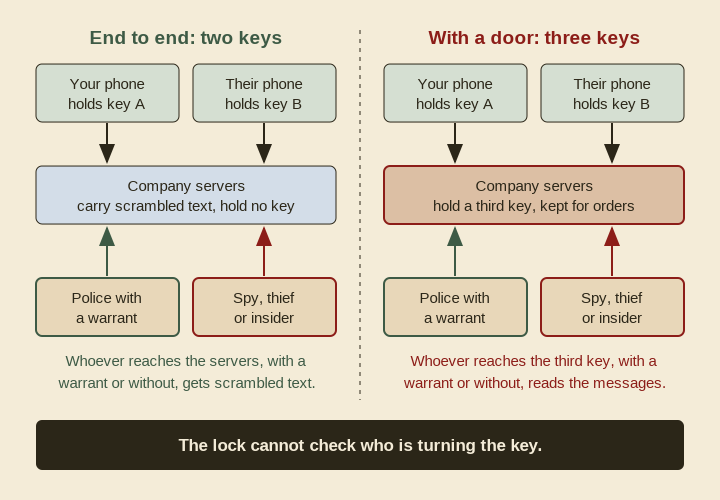 The same message system with and without a way in for investigators.
Has a door like this ever been found by the wrong people?
Yes, and the report comes from the government itself.
Since 1994 a federal law, 47 U.S.C. 1002, has required telephone carriers to build their networks so they can isolate a customer's calls and hand them to the government "pursuant to a court order or other lawful authorization." That is a door with a legal lock on it.
On 13 November 2024 the FBI and the Cybersecurity and Infrastructure Security Agency (CISA) put out a joint statement. Actors tied to the People's Republic of China had broken into "multiple telecommunications companies." Among the things they took, the agencies listed "the copying of certain information that was subject to U.S. law enforcement requests pursuant to court orders." The statement does not go further than that, and neither will I. It is enough. Material that existed because of lawful surveillance ended up in the hands of a foreign espionage campaign.
Then came the advice. On 18 December 2024 CISA published its "Mobile Communications Best Practice Guidance" for senior officials, updated in November 2025. The first recommendation reads: "Only use end-to-end encrypted communications." So after the network with the lawful door was raided, the government told its own people to move to the kind of messaging that has no door. I do not think I can improve on that argument.
The 1994 law also says a carrier is not responsible for decrypting a message the customer encrypted unless the carrier "possesses the information necessary to decrypt the communication." The proposals I am arguing against would remove that exemption.
What the other side gets right
The strongest version of the other side does not come from people who dislike privacy. On 11 October 2020, ministers from the United Kingdom, the United States, Australia, New Zealand and Canada, joined by India and Japan, signed a statement that opens, "We, the undersigned, support strong encryption." They asked companies to enable access to content "where an authorisation is lawfully issued, is necessary and proportionate, and is subject to strong safeguards and oversight."
Their hardest point is about children. The statement says current tools for detecting child sexual abuse material "do not work in end-to-end encrypted environments." The National Center for Missing & Exploited Children says its CyberTipline received 21.3 million reports in 2025. The ministers' point is that reports like these depend on a platform being able to see the content.
They are right that this is a real cost. Some evidence will be out of reach. Some cases will be harder, and some will not be made. Accepting a risk is a deliberate choice that someone signs for, and I am signing for this one.
What I do not accept is that the choice is between a door and nothing. A warrant still reaches the phone itself, the backups that are not end-to-end encrypted, the records of who contacted whom, and the person on the other end of the conversation. CISA's own guidance warns users that messaging services "collect and store metadata that may be used to trace or identify the user." That warning to users is also a description of what investigators can still get.
Why "only with a warrant" does not fix it
A warrant is a rule for people. The door is a piece of software, and it cannot read a warrant.
In July 2015 a group of well-known cryptographers and security engineers published a report called "Keys Under Doormats." Their finding was that requirements like these "are likely to introduce unanticipated, hard to detect security flaws." I think the years since have borne them out.
There is also the question of whose warrant. The same app runs in every country. For example, Apple's support site says the company "can no longer offer Advanced Data Protection in the United Kingdom to new users," and adds, "we have never built a backdoor or master key to any of our products or services and we never will." The page does not say why. On 7 April 2025 the United Kingdom's Investigatory Powers Tribunal published a judgment confirming that the company had brought a case about the government's power to issue "Technical Capability Notices," and it refused the government's request to keep even the existence of the case secret.
As a rule of thumb, a door ordered by one government is there for every government that can compel the company, and for every thief who can find it. A 12 person clinic and an 800 bed hospital system use the same messaging apps as everyone else. So does a family group chat.
What should change, and who should change it
- Legislatures should leave the 1994 exemption alone and stop proposing mandates that require a way in.
- Legislatures and agencies should fund the lawful routes that already work: device forensics under warrant, faster cross-border requests, and more trained investigators.
- Companies should say plainly which of their services are end-to-end encrypted and which are not, backups included, so users and courts both know what exists.
Where I land
- A way in for investigators is a way in. The lock cannot check who is using it.
- The network that had a lawful door was raided, and the government's response was to recommend encryption without one.
- The cost is real: some evidence will be out of reach. I think it is the smaller cost.
- Spend the effort on the lawful routes that do not weaken everyone's lock.
I would like the detective to get the evidence. I would also like the clinic's patient messages, the official's phone and the family chat to stay shut to everyone who never asked a judge for anything. Those two wishes run into each other at exactly one place, and that is why I am against building it.
Sources (8)
- 47 U.S.C. 1002, Communications Assistance for Law Enforcement Act of 1994
- FBI and CISA, "Joint Statement from FBI and CISA on the People's Republic of China (PRC) Targeting of Commercial Telecommunications Infrastructure", 13 November 2024
- CISA, "Mobile Communications Best Practice Guidance", 18 December 2024, version 2.0 dated 24 November 2025
- GOV.UK, "International statement: End-to-end encryption and public safety", 11 October 2020
- National Center for Missing & Exploited Children, "CyberTipline Data"
- Abelson, Anderson, Bellovin and others, "Keys Under Doormats: Mandating insecurity by requiring government access to all data and communications", MIT CSAIL, 6 July 2015
- Apple Support, "Apple can no longer offer Advanced Data Protection in the United Kingdom to new users", 22 September 2025
- Investigatory Powers Tribunal, "Apple Inc v Secretary of State for the Home Department", 7 April 2025