Articles & BlogBy Trapper W. Brown11 min read
For anyone who has looked out the window at 35,000 feet, watched the wing flex, and wondered what exactly is holding all of this up.
You are sitting over the wing. The engines spool up, the seat pushes into your back, and somewhere past the halfway mark of the runway the nose comes up and the ground drops away. A machine far heavier than anything else you ride in is now resting on air.
The short explanation is that the wing pushes air down and the air pushes the wing up. The longer explanation is worth knowing, because the one many of us were taught in school is wrong, and NASA keeps a set of web pages to say so. This article covers the four forces on an airplane, how a wing really makes lift, how a pilot steers, and what a stall is.
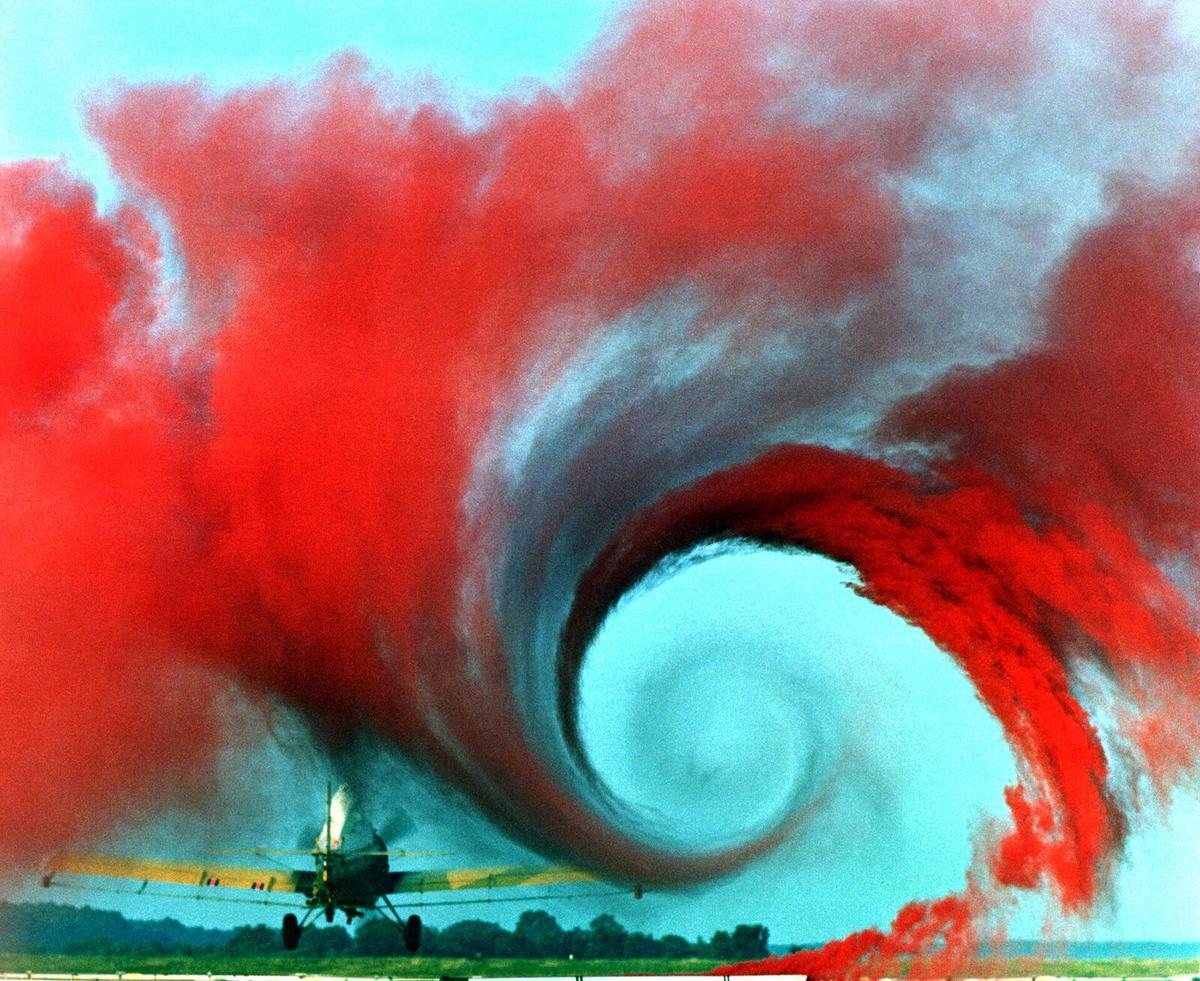 Colored smoke in a NASA test at Wallops Island shows the air a wing leaves behind: pushed down and rolled into a vortex at the tip. Photo by NASA Langley Research Center, public domain, via Wikimedia Commons.
What are the four forces?
NASA's Glenn Research Center, which publishes a long-running beginner's guide to aeronautics, describes four forces on an airplane in flight.
- Weight is gravity. It always points toward the center of the Earth, and it changes during a flight as fuel burns off.
- Lift opposes weight. It comes from the airplane moving through the air, and most of it is made by the wings.
- Drag is the air resisting that motion. It points backward, against the direction of flight.
- Thrust opposes drag. It comes from the engines.
When the four are balanced, the airplane cruises at a steady speed. When they are not, NASA puts it simply: the airplane accelerates in the direction of the largest force.
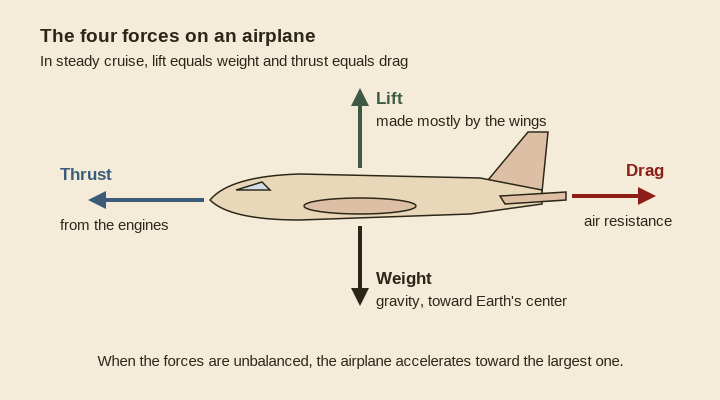 Two pairs of opposing forces. Flying is the business of keeping them in balance.
One point in that list surprises people. The engines do not hold the airplane up. NASA's example is an airliner weighing one million pounds with four engines whose thrust adds up to 200,000: about a fifth of the weight. The engines only have to beat drag. The wings do the lifting, which is why a glider, with no engine at all, flies fine once something has pulled it up to speed. How the engines make that thrust is the subject of a companion piece, "How Jet Engines Work: Suck, Squeeze, Burn, Blow".
How does a wing make lift?
NASA's answer is one sentence long: lift occurs when a moving flow of gas is turned by a solid object. The wing turns the air downward. By Newton's third law (every action has an equal and opposite reaction), the air pushes the wing upward.
Two details matter.
First, both surfaces of the wing do the turning. Air flowing under the wing is deflected down. Air flowing over the top follows the curved surface and leaves the trailing edge heading downward too. NASA says the upper surface contributes more of the turning than the lower one.
Second, lift needs air and it needs motion. NASA's phrasing is "no fluid, no lift" and "no motion, no lift". It does not matter whether the wing moves through still air or the air blows past a still wing, which is why wind tunnels work.
You may have heard this argued as "Bernoulli versus Newton". One camp says lift is a pressure difference: lower pressure above the wing, higher below. The other says lift is the reaction to air being deflected. NASA's position is that both are correct, because they are two ways of adding up the same thing. Speed and pressure in moving air are tied together, so you can total the pressure all around the wing or total the change in the air's motion, and you get the same force. Neither Bernoulli nor Newton ever tried to explain a wing, NASA notes. Their names are labels for the two camps.
What is the explanation NASA says is wrong?
It is usually called the "equal transit time" or "longer path" theory, and NASA calls it one of the most widely circulated incorrect explanations. It goes like this: the top of a wing is curved and therefore longer than the bottom. Two bits of air that split at the front of the wing must meet again at the back. The one going over the top has farther to go, so it must move faster, and faster air has lower pressure, so the wing is sucked upward.
NASA's page takes it apart piece by piece.
- Wings do not need a longer top. A symmetric wing, the same shape top and bottom, makes plenty of lift when tilted. A paper airplane's wing is a flat sheet. Airplanes fly upside down at air shows.
- The air does not meet up again. Nothing forces two neighboring bits of air to rejoin. In reality the air over the top moves much faster than the theory needs and reaches the trailing edge first.
- The numbers come out wrong. If you calculate lift from the equal transit assumption, NASA says, the answer is much less than the lift that is measured.
What the theory gets right is that air over the top does move faster and its pressure is lower. Its mistake is the reason it gives for the speed.
NASA lists two more wrong ideas. The "skipping stone" theory says lift comes from air bouncing off the bottom of the wing, which ignores the top surface. The "Venturi" theory treats the top of the wing as half of a narrowing nozzle, but there is no other half.
How much lift? A worked example
Engineers gather everything into one equation, which NASA gives as:
lift = lift coefficient × air density × speed squared ÷ 2 × wing area
The lift coefficient is a number that stands in for the complicated parts: the wing's shape and its angle of attack, which is the angle between the wing and the oncoming air. Notice that speed is squared. Double the speed and the same wing at the same angle makes four times the lift.
Now an example, with invented numbers for a small airplane. It has a mass of 1,000 kilograms, so it weighs about 9,800 newtons (NASA uses 9.8 meters per second squared for gravity). Its wing area is 16 square meters. NASA's standard value for air density at sea level is 1.229 kilograms per cubic meter.
At 50 meters per second, about 112 miles per hour:
- Speed squared is 2,500. Times 1.229, divided by 2, is about 1,536.
- Times the wing area, 16, is about 24,580.
- To hold up 9,800 newtons, the lift coefficient must be 9,800 ÷ 24,580, or about 0.40.
Slow to 35 meters per second, about 78 miles per hour, and run it again. The same steps give about 12,044, so the lift coefficient must rise to about 0.81. The airplane is 30 percent slower and the wing has to work twice as hard.
The pilot gets that extra lift coefficient by raising the nose, which increases the angle of attack. NASA gives a simple rule for an ideal thin wing at small angles: the lift coefficient is 2 × pi × the angle in radians. By that rule, 0.40 takes about 3.6 degrees and 0.81 takes about 7.4 degrees. A real wing needs somewhat more, partly because the swirling air at the wingtips (the vortex in the photograph above) reduces lift. The pattern holds, though: slower flight means a steeper angle.
How does a pilot steer?
An airplane can rotate three ways around its center of gravity, and NASA names each one.
| Motion | What you see | Control surface | Where it is |
|---|---|---|---|
| Pitch | Nose up or down | Elevator | Hinged rear edge of the small horizontal tail wing |
| Roll | One wingtip up, the other down | Ailerons | Hinged rear edges near the wingtips, moving in opposite directions |
| Yaw | Nose left or right | Rudder | Hinged rear edge of the vertical tail fin |
Each surface works the same way: it changes the shape of the wing or tail it is attached to, which changes the force that surface makes. Because the surface sits some distance from the center of gravity, the changed force twists the airplane.
The first aircraft to show active control around all three axes, NASA says, was the Wright brothers' 1902 glider.
Two other moving parts are easy to spot from a window seat. Flaps slide out and down from the rear of the wing, and slats from the front, for takeoff and landing. They make the wing bigger and more curved so it can produce enough lift at low speed. Spoilers are plates that pop up from the top of the wing to disrupt the flow and dump lift. After touchdown they keep the airplane's weight on its wheels so the brakes can work.
What is a stall?
There is a limit to raising the nose. Air close to a wing's surface forms a thin layer that follows the curve. Tilt the wing too steeply and that layer can no longer follow the upper surface. It breaks away, the smooth downward turning collapses, and lift falls off abruptly. That is a stall. NASA notes that the term dates to the Wright brothers, who were the first to run into it.
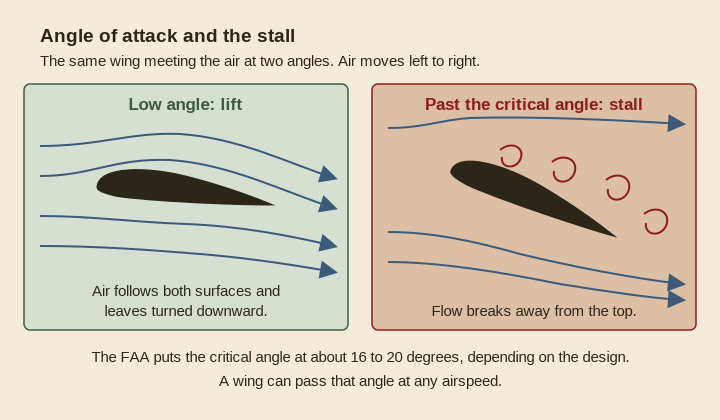 Lift depends on the air following the wing. Past the critical angle, it stops following.
The angle where this happens is called the critical angle of attack. The Federal Aviation Administration's Pilot's Handbook of Aeronautical Knowledge puts it at roughly 16 to 20 degrees, depending on the design, and says a given airplane always stalls at the same angle. Go back to the worked example and you can see how a pilot gets there: each cut in speed demands a steeper angle, and eventually the angle runs out.
Watch out
A stall has nothing to do with the engine. In a car, "stall" means the engine quit. In an airplane it means the wing has exceeded its critical angle. The FAA's Airplane Flying Handbook says this can happen at any airspeed, in any attitude and at any power setting.
Pilots train to recognize a stall and recover from it, and the recovery follows from the cause. The same FAA handbook calls reducing the angle of attack the most important action, so the air can follow the wing again.
What do people get wrong?
- "The curved top makes air go faster because it has farther to go." This is the equal transit theory. NASA calls it incorrect, for the reasons above.
- "The engines hold the plane up." Engines overcome drag. Wings make lift. In NASA's example, the thrust is a fifth of the weight.
- "If the engines stop, the plane drops." An airplane without thrust is a glider. It descends, trading height for the forward speed that keeps air moving over the wings. NASA points out that the Space Shuttle came home as a glider.
- "A stall means the engine failed." It means the wing passed its critical angle.
- "You turn an airplane with the rudder, like a boat." NASA says the rudder is not used to turn. The pilot banks the wings with the ailerons, the tilted lift pulls the airplane sideways, and its path curves. The rudder keeps the nose lined up with that path.
What to remember
- Four forces act on an airplane: lift against weight, thrust against drag.
- A wing makes lift by turning air downward, and both the top and bottom surfaces do the turning.
- The "longer path, equal transit time" story is wrong. Air over the top is faster, but not for that reason.
- Lift grows with the square of speed, so a slower airplane must fly at a steeper angle of attack.
- Past the critical angle, about 16 to 20 degrees per the FAA, the flow separates and the wing stalls, at any airspeed.
- Elevator for pitch, ailerons for roll, rudder for yaw. Turns come from banking.
On your next flight, pick a seat behind the wing and watch it work: flaps out for takeoff, ailerons flicking in the turns, spoilers up the moment the wheels touch. For what happens when a vehicle leaves the air behind and wings stop being useful, see "How Rockets Reach Orbit: Sideways Speed and the Rocket Equation".
Sources (19)
- NASA Glenn Research Center, "Four Forces on an Airplane"
- NASA Glenn Research Center, "What is Lift?"
- NASA Glenn Research Center, "Bernoulli and Newton"
- NASA Glenn Research Center, "Equal Transit Theory Interactive" (incorrect lift theory 1)
- NASA Glenn Research Center, "Skipping Stone Theory Interactive" (incorrect lift theory 2)
- NASA Glenn Research Center, "Venturi Theory" (incorrect lift theory 3)
- NASA Glenn Research Center, "Lift Equation"
- NASA Glenn Research Center, "Weight Equation"
- NASA Glenn Research Center, "Effects of Inclination on Lift Interactive"
- NASA Glenn Research Center, "Air Properties Definitions"
- NASA Glenn Research Center, "Downwash Effects on Lift"
- NASA Glenn Research Center, "Aircraft Rotations"
- NASA Glenn Research Center, "Airplane Parts and Function"
- NASA Glenn Research Center, "Banking Turns"
- NASA Glenn Research Center, "Rudder Interactive"
- NASA Glenn Research Center, "Spoilers Interactive"
- NASA Glenn Research Center, "Flaps and Slats Interactive"
- Federal Aviation Administration, "Pilot's Handbook of Aeronautical Knowledge" (FAA-H-8083-25C), Chapter 5, "Aerodynamics of Flight"
- Federal Aviation Administration, "Airplane Flying Handbook" (FAA-H-8083-3C), Chapter 5, "Maintaining Aircraft Control: Upset Prevention and Recovery Training"