Articles & BlogBy Trapper W. Brown10 min read
For anyone who has watched a launch and wondered why the rocket leans over a minute after liftoff, and why so much machine is needed to put so little into space.
A launch looks like a contest with height. The rocket stands on the pad, the engines light, and it climbs straight up until it is a dot. If you keep watching, though, the dot starts to slide across the sky, and by the time the cameras lose it, it is flying nearly level.
That tilt is the whole story. Space is not far away: NASA says the International Space Station circles at an average height of about 250 miles, which is a morning's drive if your car could point up. What makes orbit hard is speed. The station travels at 17,500 miles per hour, and nearly all of a rocket's size exists to reach that number. This article explains how a rocket pushes, why orbit is sideways speed, and what the famous rocket equation says.
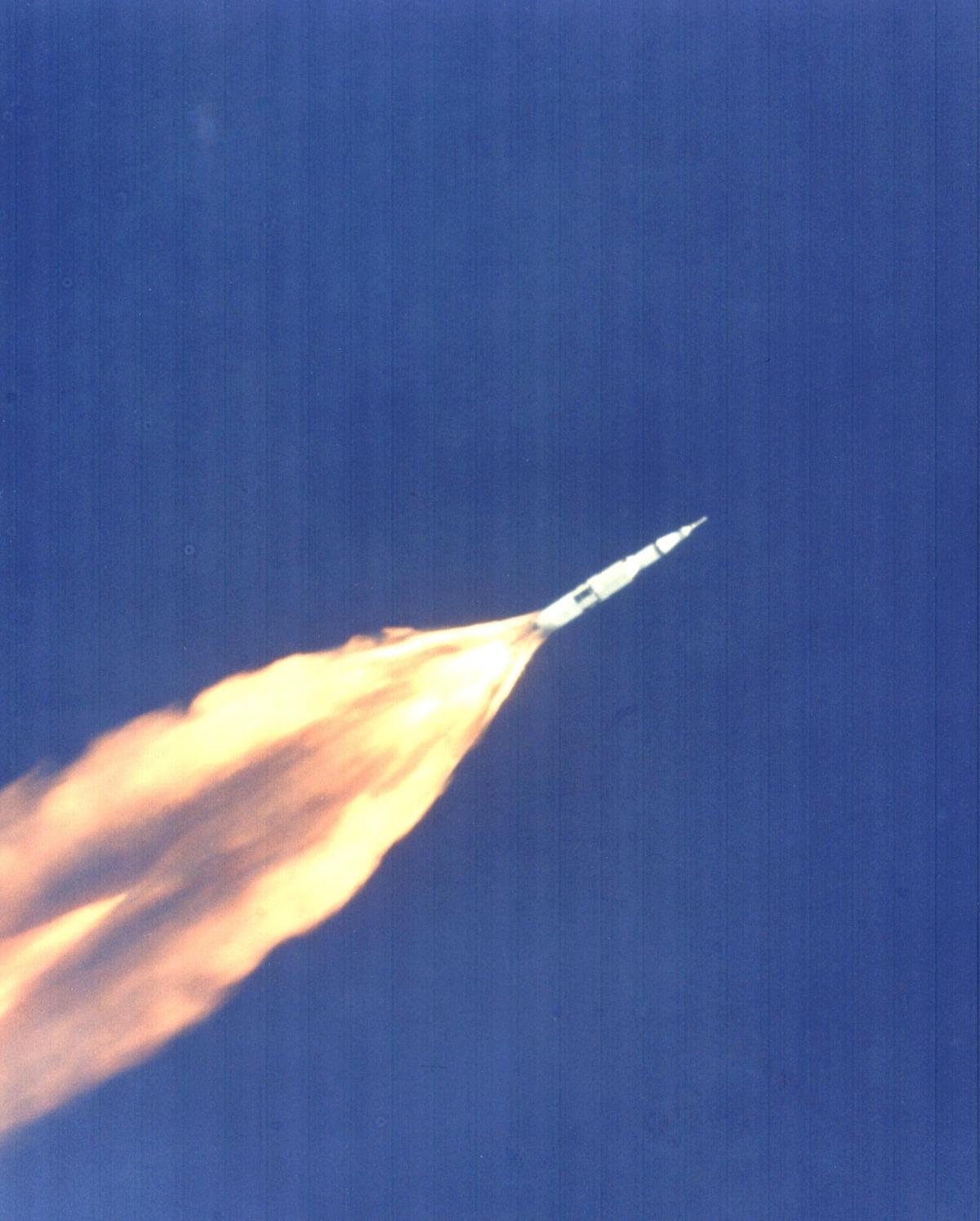 Apollo 11's Saturn V climbing on July 16, 1969, photographed from an Air Force aircraft. It is already leaning toward the horizon. Photo by NASA and the U.S. Air Force, public domain, via Wikimedia Commons.
How does a rocket push?
A rocket engine burns fuel with an oxidizer (a chemical that supplies the oxygen) in a chamber and lets the hot gas rush out through a nozzle. The gas goes one way and the rocket goes the other. That is Newton's third law: every action has an equal and opposite reaction.
A jet engine does something similar, as "How Jet Engines Work: Suck, Squeeze, Burn, Blow" explains, with one difference that matters. A jet takes its oxygen, and most of the mass it throws backward, from the air around it. A rocket carries everything on board. NASA's Glenn Research Center points out that this is why a rocket works in space, where there is no air, and a jet does not.
To leave the pad at all, the thrust must be greater than the weight. NASA's figures for the Saturn V moon rocket show how close that contest is: it weighed 6.2 million pounds fueled and made 7.6 million pounds of thrust at launch. That is about 1.2 pounds of push for each pound of rocket. As propellant burns off, the rocket gets lighter and the same thrust accelerates it harder.
Why is orbit about speed and not height?
NASA explains an orbit as a constant tug-of-war. A moving object wants to keep going in a straight line. Gravity pulls it toward the Earth. When the two are balanced, in NASA's words, the object is always falling toward the planet, but because it is moving sideways fast enough, it never hits.
Isaac Newton pictured this with a cannon on a very tall mountain, and NASA's Basics of Space Flight still uses his drawing. Fire the cannon level and the ball curves down and lands some distance away. Add powder and it lands farther off. Add enough, and the ground curves away beneath the ball as fast as the ball falls. It never lands. It has, as NASA puts it, fallen completely around the Earth.
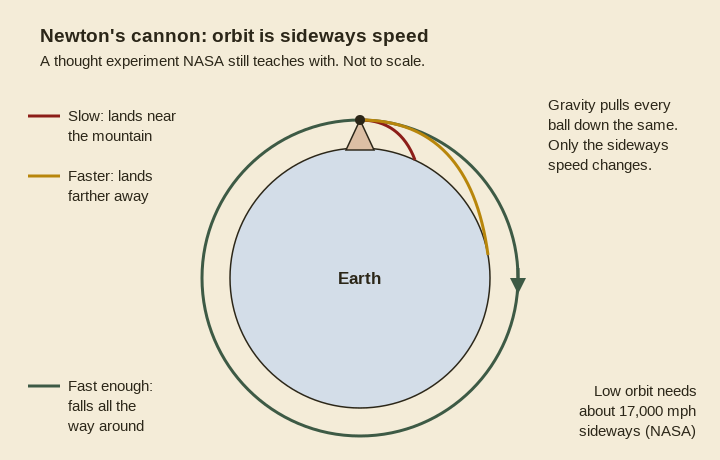 Newton's cannon. The three shots differ only in how fast they leave the barrel.
The speed required is large. NASA gives about 17,000 miles per hour at a height of 150 miles, and its Glenn Research Center works out 17,478 miles per hour for a 100-mile orbit. Lower orbits need more speed, and higher ones need less. One lap of a low orbit takes about 90 minutes.
A quick calculation shows how lopsided the job is. Take one kilogram of anything and compare two tasks, using the station's numbers.
- Lifting it 250 miles. That is about 402,000 meters. Energy is weight times height: 9.8 newtons times 402,000 meters is about 3.9 million joules. (It is a little less in reality, because gravity weakens slightly on the way up.)
- Getting it to 17,500 miles per hour. That is about 7,823 meters per second. Energy of motion is half the mass times the speed squared: about 30.6 million joules.
The speed costs almost eight times as much as the height. A rocket that only went up 250 miles would come straight back down. NASA makes the same point about SpaceShipOne, a privately built rocket plane: it had the altitude to "go into space" but lacked the horizontal velocity to "go into orbit".
Why does the rocket tip over?
Because the speed it needs is sideways. NASA's description of a launch has the rocket rise vertically at first, to get out of the thick lower air quickly. As it climbs it begins to pitch over, and it keeps pitching until the upper stage is flying horizontally. At a planned height and speed the engine shuts off, and the payload is in orbit.
The Earth itself gives a small head start. NASA notes that a rocket sitting on a pad near the equator is already moving at more than 1,650 kilometers per hour as the planet turns, and that this can be applied to the roughly 28,000 kilometers per hour that orbit takes.
What is the rocket equation?
The ideal rocket equation tells you how much a rocket can change its speed. NASA writes it this way:
change in speed = exhaust speed × natural logarithm of the mass ratio
Only two things are in it.
- Exhaust speed is how fast the gas leaves the nozzle. Engineers often quote it as specific impulse, in seconds. Multiply specific impulse by the pull of gravity at the surface and you get exhaust speed.
- Mass ratio is the rocket's mass full of propellant divided by its mass when the tanks are empty.
The logarithm is the cruel part. It grows slowly, so each extra bit of speed costs far more propellant than the last.
Here is NASA's own worked example. Take a specific impulse of 350 seconds and gravity of 32.2 feet per second squared. The exhaust speed is 350 × 32.2, which is 11,270 feet per second. NASA puts the speed change needed for a 200-mile orbit at about 17,000 miles per hour, or roughly 25,000 feet per second.
- Divide the target by the exhaust speed: 25,000 ÷ 11,270 is about 2.22.
- Raise the number e (about 2.718) to that power: the result is about 9.2.
So the full rocket must be about 9.2 times as heavy as the empty one. NASA rounds this to 10 and draws the conclusion: about 90 percent of a rocket bound for orbit is propellant. Structure, engines and payload share what is left, and NASA estimates the payload at only about 1 percent of the weight at launch.
Now ask for twice the speed change, 50,000 feet per second. The mass ratio does not double. It squares, to about 84. That is why the phrase "the tyranny of the rocket equation" appears on NASA's own pages.
Tip
The exhaust speed in this example is about 7,700 miles per hour, and orbit needs about 17,000. A rocket can end up going faster than its own exhaust. The equation allows it, as long as the mass ratio is large enough.
Why do rockets drop pieces?
Once a tank is empty, it is dead weight, and the equation punishes every pound that is still attached at the end of the burn. NASA calls the fix staging: stack a small rocket on top of a big one, and throw the big one away when it is spent.
Here is an example with made-up round numbers, using the same exhaust speed as before. Suppose a rocket weighs 100 tons on the pad, and suppose tanks and engines always weigh one-ninth as much as the propellant they hold.
As a single stage with 1 ton of payload: 89.1 tons of propellant and 9.9 tons of structure. The mass at burnout is 10.9 tons, so the mass ratio is 100 ÷ 10.9, about 9.2. The speed change is about 24,980 feet per second. It just reaches the target, carrying 1 percent payload, which matches NASA's estimate.
As two stages with 6 tons of payload:
- Stage one is 72 tons of propellant and 8 tons of structure. It burns the rocket down from 100 tons to 28 tons. Mass ratio: about 3.57.
- The 8 tons of empty stage one fall away. Twenty tons remain.
- Stage two is 12.6 tons of propellant and 1.4 tons of structure. It burns the rocket from 20 tons to 7.4 tons. Mass ratio: about 2.70.
Add the logarithms of the two ratios and multiply by the exhaust speed, and the total is about 25,550 feet per second. The same 100 tons on the pad, the same engines, and six times the payload.
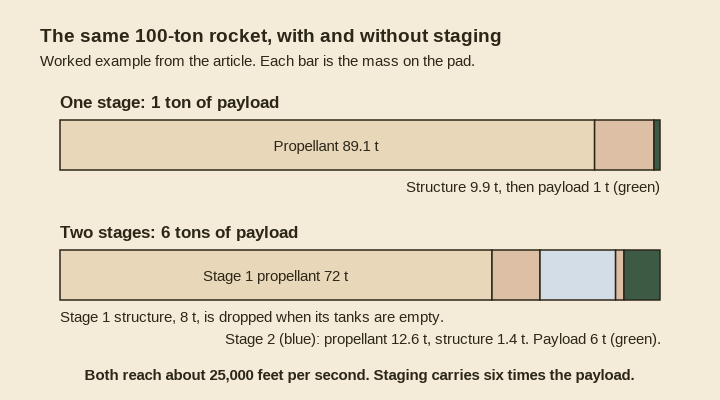 Dropping eight tons of empty tank partway up is worth five extra tons of payload in this example.
The Saturn V did this twice. By NASA's account its first stage lifted the rocket to about 42 miles, its second carried it almost to orbit, and its third finished the job and then pushed the Apollo spacecraft toward the Moon. Of the 2.8 million kilograms on the pad, about 118,000 kilograms, roughly 4 percent, could reach Earth orbit.
One caution about all these numbers. The ideal equation leaves out gravity pulling on the rocket during the climb, and air drag. NASA's fuller version subtracts a term for gravity that grows with the length of the burn. Real rockets must therefore carry more than the ideal figure suggests.
What do people get wrong?
- "Space is hard to reach because it is so high." The height is modest. The speed is the hard part, by a factor of almost eight in the example above.
- "Astronauts float because there is no gravity up there." NASA says about 90 percent of Earth's surface gravity reaches the space station. The crew floats because the station and everyone in it are falling together, all the way around the planet.
- "A rocket needs air to push against." It pushes against its own exhaust, so it works in a vacuum, where there is nothing else to push on.
- "Rockets fly straight up." Only at first. Most of the flight is spent building sideways speed.
- "A bigger fuel tank fixes everything." More propellant needs more tank, and both must be lifted by still more propellant. The logarithm in the rocket equation is that problem written down.
What to remember
- A rocket makes thrust by throwing its own exhaust backward, and carries both fuel and oxidizer, so it works in a vacuum.
- Orbit is falling around the Earth. It takes about 17,500 miles per hour of sideways speed in low orbit.
- Reaching that speed costs almost eight times the energy of climbing 250 miles.
- The rocket equation: speed change equals exhaust speed times the natural logarithm of the mass ratio.
- With NASA's example numbers, about 90 percent of a rocket headed for orbit is propellant.
- Staging drops empty weight on the way up, and it multiplies the payload.
The next time you watch a launch, look for the tilt. The straight-up part is the rocket getting out of the air. Everything after that is a long, hard push toward the horizon. For the machines that never leave the air, see "How Airplanes Fly: Lift, the Four Forces and the Stall".
Sources (12)
- NASA, "What Is an Orbit? (Grades 5-8)"
- NASA, "What Is the International Space Station? (Grades 5-8)"
- NASA, "What Is Microgravity? (Grades 5-8)"
- NASA, "What Was the Saturn V? (Grades 5-8)"
- NASA Science, "Basics of Space Flight", Chapter 3, "Gravity and Mechanics"
- NASA Science, "Basics of Space Flight", Chapter 14, "Launch"
- NASA Glenn Research Center, "Flight To Orbit"
- NASA Glenn Research Center, "Ideal Rocket Equation"
- NASA Glenn Research Center, "Rocket Thrust"
- NASA Glenn Research Center, "Specific Impulse"
- NASA Glenn Research Center, "Booster Staging Interactive"
- NASA Glenn Research Center, "Mass Ratios"