Articles & BlogBy Trapper W. Brown12 min read
For anyone who has heard the fridge hum in the night and wondered what it is doing. By the end you will be able to name the four parts of the loop, work out what a coefficient of performance means, and explain why a heat pump struggles on the coldest night of the year.
Put your hand near the back or the bottom of a running refrigerator and you will feel warm air. The inside of the box is cold and the outside of the box is warm, and those two facts are the same fact. The refrigerator does not make cold. It picks up heat inside the box and drops it in your kitchen.
A heat pump for a house is the same machine, turned around. In winter it picks up heat outdoors and drops it in your living room. The U.S. Department of Energy says so in one line: "Like your refrigerator, heat pumps use electricity to transfer heat from a cool space to a warm space." That one idea, moving heat and not making it, explains why these machines can deliver more heat than the electricity they use, and why they have a weak spot.
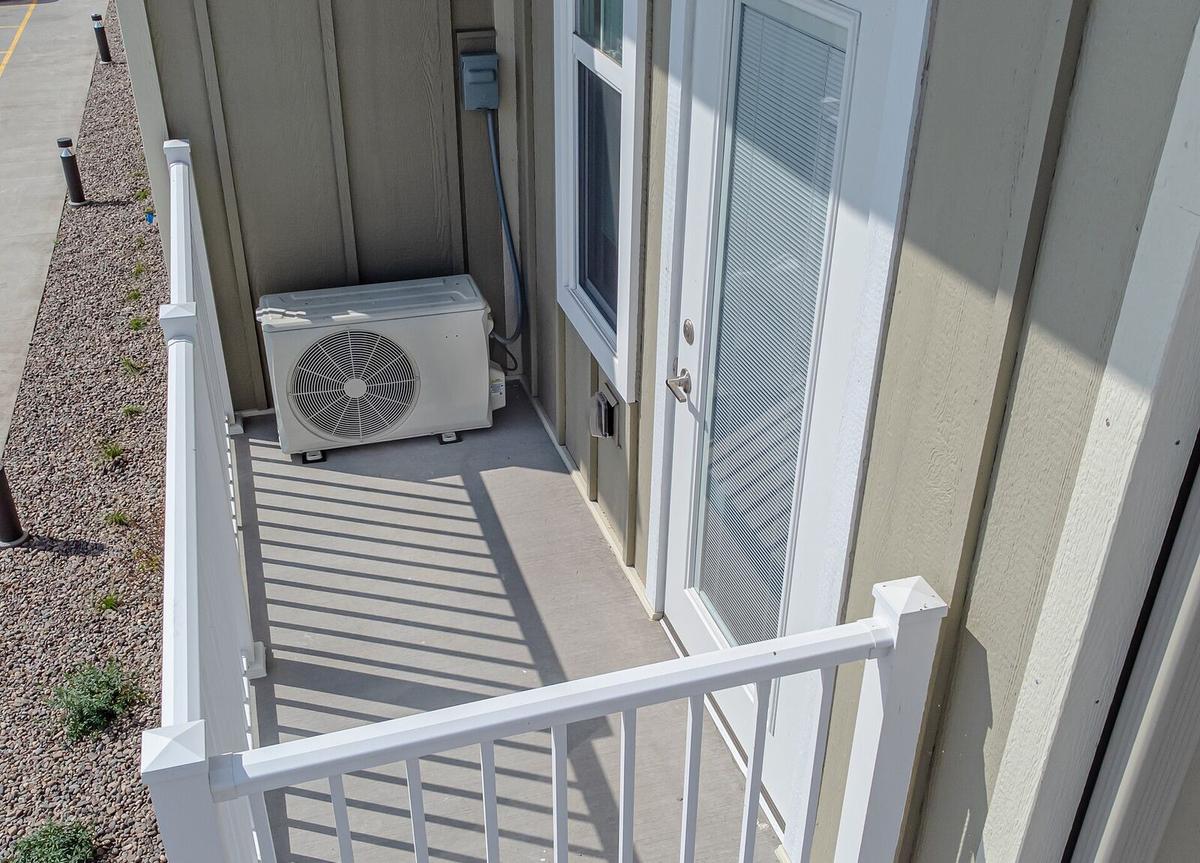 The outdoor half of a small heat pump: a coil, a fan and a compressor in one box. Photo by Wikideas1, CC0, via Wikimedia Commons.
How can heat be moved uphill?
Left alone, heat flows one way: from warm things to cold things. A cup of coffee cools to room temperature and never the reverse. To move heat the other way, from a cold place to a warm one, you have to pay with work. Georgia State University's physics reference puts it this way: heat "will not spontaneously flow from a cold region to a hot region," but "it can be forced to do so by doing work on the system."
The trick that makes it practical is boiling. A liquid that boils soaks up a great deal of heat from its surroundings as it turns to vapor. A vapor that condenses back to liquid gives that heat up again. And the temperature at which a fluid boils depends on its pressure. Lower the pressure and it boils when cold. Raise the pressure and it will condense even when hot.
So take a fluid, called a refrigerant, and send it around a closed loop of pipe. Make it boil at low pressure in the cold place, where it soaks up heat. Then squeeze it and make it condense at high pressure in the warm place, where it gives the heat up. Repeat.
What are the four parts of the loop?
The Building America Solution Center, run by the Pacific Northwest National Laboratory for the Energy Department, lists them: "a compressor, a condenser, a metering device," and "an evaporator coil." The metering device is usually called an expansion valve.
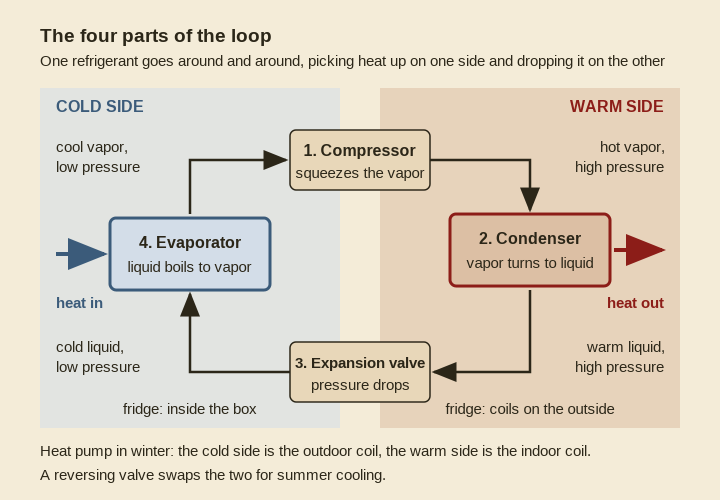 The same four parts sit in a refrigerator, an air conditioner and a heat pump.
Follow the refrigerant once around, using the lab's description.
- Compressor. The refrigerant arrives as a low-pressure vapor. The compressor is a pump driven by an electric motor, and it is the part that hums. It squeezes the vapor "to a higher pressure and therefore a higher temperature."
- Condenser. The hot vapor runs through a coil of tubing with air blowing across it. The air is cooler than the vapor, so heat flows out. The vapor "condenses back into a liquid, releasing heat."
- Expansion valve. The liquid is forced through a narrow opening. It undergoes "an abrupt drop in pressure and temperature." It is now colder than the place you want to cool.
- Evaporator. The cold liquid runs through a second coil. Heat flows into it from the surrounding air, and it boils. The vapor heads back to the compressor, "beginning the cycle all over again."
| Machine | Evaporator (picks heat up) | Condenser (drops heat off) |
|---|---|---|
| Refrigerator | Inside the box | Coils on the back or underneath |
| Air conditioner | Indoor coil | Outdoor unit |
| Heat pump in winter | Outdoor unit | Indoor coil |
A heat pump has one extra part. The lab explains that heat pumps "are equipped with a reversing valve, which allows them to reverse the cycle." Flip the valve and the indoor and outdoor coils trade jobs. The same box heats the house in January and cools it in July.
What does coefficient of performance mean?
A machine that moves heat is rated by how much heat it moves for each unit of electricity it uses. That ratio is the coefficient of performance, or COP. ENERGY STAR, the federal efficiency program, defines it for heating as "the ratio of the average rate of space heating delivered to the average rate of electrical energy consumed by the heat pump."
Here is a worked example. The U.S. Energy Information Administration gives the conversion: 1 kilowatthour equals 3,412 British thermal units (Btu), a common unit of heat.
- An electric space heater or baseboard turns electricity straight into heat. One kilowatthour in, 3,412 Btu out. Its COP is 1.
- A heat pump running at a COP of 3 delivers 3 times 3,412, which is 10,236 Btu, from the same kilowatthour.
- The extra 6,824 Btu did not come from nowhere. The heat pump collected it from the outdoor air. The electricity only paid for the moving.
That is why a COP above 1 breaks no law of physics. The machine is not turning 1 unit of energy into 3. It is using 1 unit to carry 2 more across the wall. Georgia State's reference gives the usual range: "A typical CP for a commercial heat pump is between 3 and 4 units transferred per unit of electric energy supplied." ENERGY STAR says a certified air-source heat pump "can deliver up to three times more heat energy to a home than the electrical energy it consumes."
Tip
Heat pump labels in the United States use a seasonal number, HSPF2, in place of COP. ENERGY STAR defines it as the season's heat in Btu divided by the season's electricity in watthours. Divide an HSPF2 by 3.412 to get an average COP for a whole winter. An HSPF2 of 8.1 works out to about 2.4.
Why does the temperature gap matter?
Physics sets a ceiling on COP, and the ceiling depends on how far uphill you are pushing the heat. The OpenStax university physics textbook gives the formula for an ideal heat pump: the warm temperature divided by the difference between warm and cold. The temperatures have to be measured from absolute zero, in kelvins.
Keep the house at 70°F and work it out for four kinds of weather.
| Outdoor temperature | Gap to 70°F indoors | Ideal ceiling on COP |
|---|---|---|
| 47°F | 23°F | 23.0 |
| 17°F | 53°F | 10.0 |
| 5°F | 65°F | 8.1 |
| -13°F | 83°F | 6.4 |
No real machine gets near those numbers. Its coils have to run colder than the outdoor air and hotter than the indoor air for heat to flow at all, and the compressor and fans have losses. But the trend is real: the bigger the gap, the more work each unit of heat costs.
A refrigerator has it easy by comparison. Its gap is small and steady, since the kitchen stays near the same temperature all year.
Why does a heat pump give less in deep cold?
Three things go wrong at once.
The climb gets steeper. That is the table above. More work for each unit of heat means a lower COP.
The compressor moves less refrigerant. To pick up heat from 5°F air, the refrigerant has to boil at a temperature below 5°F, which means a very low pressure. Low-pressure vapor is thin, so each stroke of the compressor grabs less of it. Researchers at Oak Ridge National Laboratory list "low suction pressure and high pressure ratio at low ambient temperatures" among the problems. For a typical single-speed heat pump, they write, heating output at -13°F "typically decreases to 20% to 40%" of its rated output at 47°F.
The outdoor coil frosts over. A coil colder than the air collects frost. The Solution Center says cold-climate models "are equipped with a built-in defrost cycle to keep the outdoor coils from icing up." During a defrost the machine is melting ice, and the house waits.
And the timing is bad. The house loses heat fastest on the same night the machine has the least to give. The gap is filled by backup heat, usually electric resistance strips with a COP of 1, which the Solution Center says works "at a much lower efficiency."
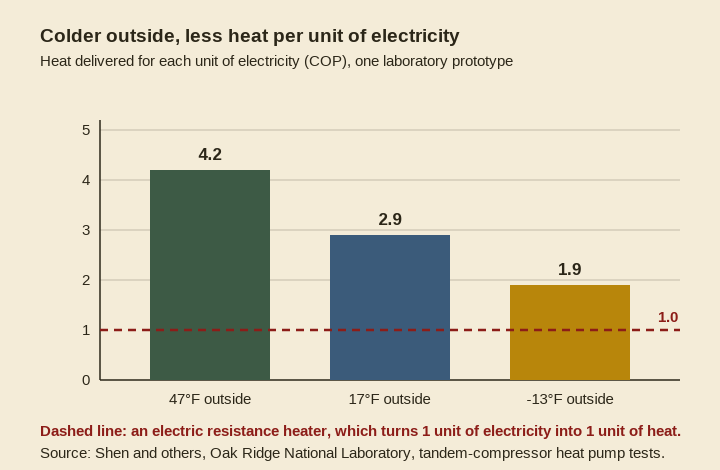 Output per unit of electricity falls with the temperature, but in this Oak Ridge test it stayed above a resistance heater even at -13°F.
Engineers have answers. The Oak Ridge team built a prototype with two compressors that share the work. In the lab it reached a COP of 4.2 at 47°F, 2.9 at 17°F and 1.9 at -13°F, and it held 76 percent of its rated output at -13°F. Run the earlier arithmetic on those figures. To deliver 100,000 Btu, a resistance heater needs about 29.3 kilowatthours. The prototype needs about 7.0 at 47°F, 10.1 at 17°F and 15.4 at -13°F.
There is now a federal yardstick. To carry the ENERGY STAR Cold Climate label, a heat pump must show a "COP at 5° F ≥ 1.75" and a heating capacity at 5°F that is at least 70 percent of its capacity at 47°F. For a unit rated at 36,000 Btu an hour at 47°F, that means at least 25,200 Btu an hour at 5°F. At a COP of 1.75, that takes about 4.2 kilowatts of electricity. A resistance heater would need about 7.4 kilowatts for the same heat.
Watch out
The refrigerant loop is sealed and under pressure, and it is not a home repair. The Solution Center states that "Refrigerant charging must be done by an EPA certified technician."
What is the fluid in the pipes?
It has changed twice, both times for the sake of the atmosphere. Georgia State's reference notes that early refrigerants, sold under names such as Freon, "are potent agents for the destruction of the ozone" in the upper atmosphere. Those were phased out under a treaty, the Montreal Protocol.
Their replacements, called hydrofluorocarbons or HFCs, spare the ozone layer but trap heat. The Environmental Protection Agency says HFCs have "global warming potentials (GWPs) that can be hundreds to thousands of times more potent than carbon dioxide." A 2020 law, the American Innovation and Manufacturing Act, gave the EPA authority to phase them down, and the Kigali Amendment to the treaty aims to cut their production and use by 80 to 85 percent by 2047. The National Institute of Standards and Technology runs a research group that measures candidate replacements, and the same group helped write the efficiency ratings on the labels.
What do people get wrong?
"A refrigerator makes cold." It removes heat and puts it in the kitchen.
"Leaving the fridge door open will cool the room." The heat taken from the air in front of the fridge comes out of the coils behind it, along with the heat from the electricity the compressor used. The room ends up slightly warmer.
"Getting 3 units of heat from 1 unit of electricity is impossible." It would be if the machine were making the heat. It is moving it.
"There is no heat in freezing air." Air at 5°F is about 258 kelvins above absolute zero. There is plenty of heat in it. The hard part is lifting it to 70°F.
"Heat pumps stop working below freezing." Output and efficiency fall, as shown above, but ENERGY STAR tests certified cold-climate models at 5°F and says such a unit "will continue working at temperatures below 5°F," with a backup source for the coldest hours.
What to remember
- A refrigerator, an air conditioner and a heat pump are one machine. They move heat from a cold place to a warm one.
- The loop has four parts: compressor, condenser, expansion valve and evaporator. The refrigerant boils where heat is picked up and condenses where it is dropped off.
- COP is heat delivered divided by electricity used. A resistance heater is 1. A heat pump is often 3 or more in mild weather.
- The bigger the temperature gap, the lower the COP and the smaller the output. That is physics, and frost makes it worse.
- Cold-climate models are tested at 5°F. The ENERGY STAR mark for them requires a COP of at least 1.75 and 70 percent of rated output at that temperature.
- The sealed refrigerant loop is work for a certified technician.
The electricity that drives the compressor has its own story, told in "How the Power Grid Works: From the Power Plant to Your Outlet". For what heating has cost over the decades, see "The Cost of Home Energy Over the Last 50 Years", and for the night the power fails, "Winter Power Outages: Generators, Heaters, Food and Pipes".
Sources (13)
- U.S. Department of Energy, "Pump Up Your Savings with Heat Pumps", 30 May 2023
- Pacific Northwest National Laboratory, Building America Solution Center, "Air Conditioning", last updated 3 January 2025
- Pacific Northwest National Laboratory, Building America Solution Center, "Traditional Split Heat Pumps", last updated 1 August 2017
- Pacific Northwest National Laboratory, Building America Solution Center, "Cold Climate Heat Pump Sizing and Selection", last updated 14 May 2024
- Georgia State University, HyperPhysics, "Heat Pump", read 15 November 2026
- Georgia State University, HyperPhysics, "Heat Transfer from Cold to Warmer Region", read 15 November 2026
- OpenStax, Rice University, "University Physics Volume 2, 4.5 The Carnot Cycle", 2016
- ENERGY STAR, "Heat Pump Equipment Key Product Criteria", read 15 November 2026
- ENERGY STAR, "Air-Source Heat Pumps", read 15 November 2026
- Shen and others, Oak Ridge National Laboratory, "Cold Climate Heat Pumps Using Tandem Compressors", 2016 ASHRAE Winter Conference
- U.S. Energy Information Administration, "Units and calculators explained: British thermal units (Btu)", read 15 November 2026
- U.S. Environmental Protection Agency, "Background on HFCs and the AIM Act", last updated 2 November 2026
- National Institute of Standards and Technology, "HVAC&R Equipment Performance Group", read 15 November 2026