Articles & BlogBy Trapper W. Brown10 min read
You start a video call with someone on another continent. Their face appears, they laugh at the right moment, and neither of you thinks about the ocean between you. If you picture anything, you probably picture a satellite.
The call almost certainly went under the sea. It crossed the ocean as flashes of light inside strands of glass, in a cable lying on the seabed that is about as thick as a garden hose. The International Telecommunication Union (ITU), the United Nations agency for communications, says submarine cables carry approximately 99% of the world's internet traffic. This article explains what is inside one of those cables, why a cable made of glass needs electricity, how ships lay and repair them, what breaks them, and how many there are.
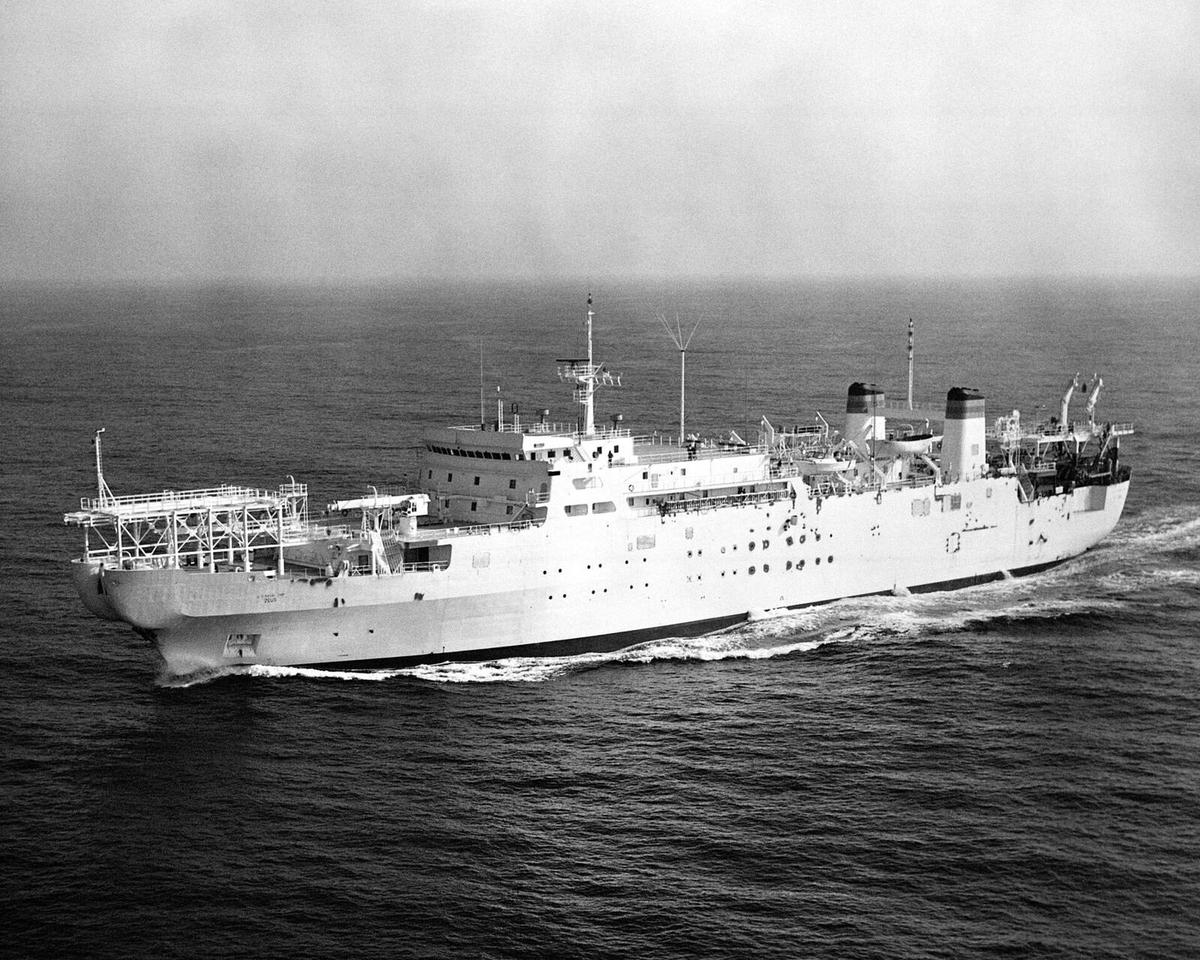 The U.S. Military Sealift Command cable repair ship USNS Zeus during sea trials in 1983. U.S. Navy photo, public domain, via Wikimedia Commons.
How much of the internet goes under the sea?
Nearly all of the part that crosses an ocean. A 2009 report by the International Cable Protection Committee (ICPC) and the United Nations Environment Programme called it a common misconception that most international communications go by satellite, and put the cable share at well over 95%. TeleGeography, a telecom research firm that tracks submarine cables, cites FCC statistics showing that satellites account for 0.37% of all U.S. international capacity.
Distance explains part of it. The ICPC notes that a signal to a communications satellite in high orbit has to climb 35,784 km and then come about the same distance back down, while a call across the Pacific by cable travels about 5,000 miles point to point. Worked out, that is 71,568 km by satellite against roughly 8,000 km by cable: nearly nine times as far. Capacity explains the rest. The ICPC says a single pair of fibers can carry the equivalent of 150 million simultaneous phone calls.
How many cables are there? It depends on who is counting and when.
| Who counted | Figure | As of |
|---|---|---|
| ITU | More than 500 active and planned cable systems | 2024 |
| TeleGeography | More than 600 active and planned cables | 2026 |
| TeleGeography | Over 1.5 million km of cable in service | Early 2026 |
The counts differ because the number changes as cables enter service and old ones retire, and the two sources do not say they count the same way. The ITU adds that nearly 200,000 km of new cable was installed in 2024 alone.
None of this is new as an idea. The first transoceanic cable came into full operation in 1866, linking Ireland and Newfoundland, and carried telegraph messages at seven words a minute. The first fiber-optic cable across an ocean, called TAT-8, joined the United States, the United Kingdom and France in 1988.
What is inside a cable?
Less than you would think. The ICPC and UN report gives the diameter of a deep-ocean cable as 17 to 21 mm, about the size of a domestic garden hose. From the inside out, it holds:
- Glass fibers, each about as thin as a human hair, arranged in pairs. "Fiber Optic Internet: Light in Glass, Explained" covers how light stays inside a strand of glass, and this article will not repeat it.
- Steel wires around the fibers, which give the cable its strength.
- A copper conductor, which carries electrical power along the cable. The next section explains why.
- A polyethylene jacket, a tough plastic that insulates everything from seawater.
Near shore, the cable gets heavier. In water shallower than about 1,500 meters, layers of steel wire armor are added, and the diameter can reach 40 to 50 mm. The armor is there because the shallows are where ships and fishing gear are.
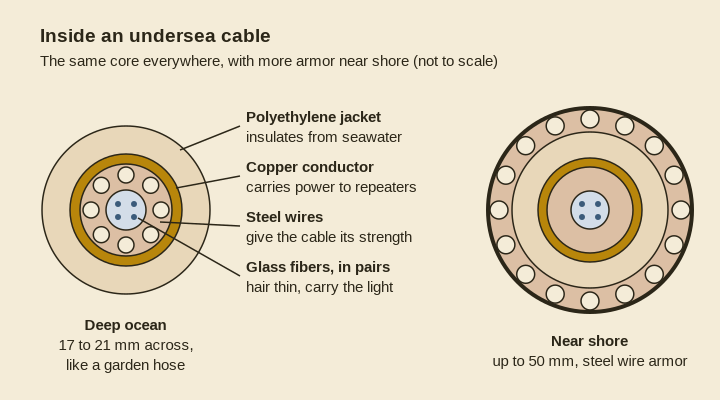 The same thin core runs the whole way, and armor is added where the water is shallow.
Why does a glass cable need electricity?
Light fades as it travels through glass. Over the short runs of a neighborhood fiber network that does not matter. Over an ocean, the signal would vanish long before it arrived.
So every long cable has repeaters spliced into it at intervals: sealed housings on the seabed that boost the light. Early fiber cables used electronic regenerators. Modern ones use optical amplifiers. The ICPC and UN report describes them as strands of glass containing the element erbium, energized by lasers so that they amplify the passing light directly. It gives the typical spacing for this type of repeater as 70 km.
Here is a worked example. Take an ocean crossing of 6,600 km, a round figure chosen only for the arithmetic. At one repeater every 70 km, that is 6,600 divided by 70, or about 94 repeaters on the ocean floor. Every one of them needs power, and there are no outlets down there.
That is the job of the copper. Power feed equipment at the cable stations on shore sends electrical current down the conductor to the repeaters. It also explains a kind of fault that leaves the glass untouched. If something scrapes through the insulation and exposes the copper to seawater, current leaks into the sea. The report calls this a shunt fault: the fibers may be intact, but the repeaters beyond the leak can lose power and the cable can stop working.
How is a cable laid?
Slowly, and after a lot of homework. The route is surveyed first, with sonar that maps the seabed, so the cable can avoid rocky ground, volcanic areas and other hazards. The ITU says a cable can take over two years to go from design to operation.
Then a cable ship loads the cable and repeaters and pays the line out as it sails the route. What happens next depends on depth.
- From the shore down to about 1,000 to 1,500 meters of water, the cable is usually buried. The ship tows a sea plough across the bottom. The plough opens a furrow, feeds the cable into it and lets the sediment fall back. The report says many modern cables are buried more than 60 cm into the sediment in this zone.
- In deeper water, the cable is laid directly on the seabed. That depth is about the present limit of bottom trawl fishing, so less can reach it.
The report gives a practical top laying speed of about 11 to 15 km per hour, which is 6 to 8 knots, with the ship slowing each time a repeater passes through the machinery. The cable is paid out 2 to 3% faster than the ship moves, so it has enough slack to follow the contours of the bottom. At those speeds, the 6,600 km example would take between 18 and 25 days of nonstop sailing at full laying speed, before any slowing for repeaters, ploughing or weather.
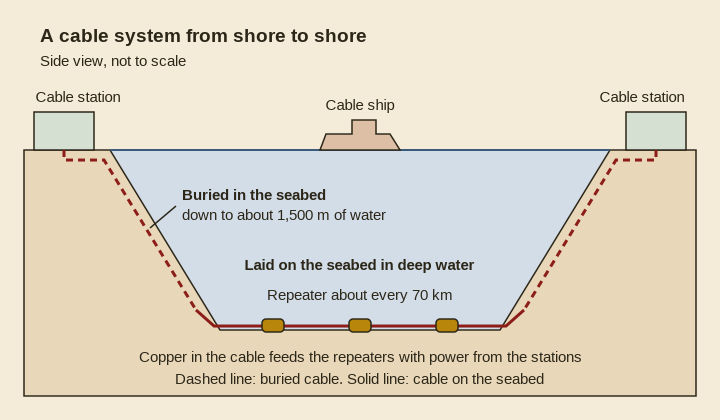 Buried in the shallows, lying on the bottom in the deep, and powered from both shores.
What breaks them?
Mostly people, by accident. The ITU reports that the ICPC recorded over 170 cable repairs worldwide in 2025, which works out to more than three a week. TeleGeography, also citing ICPC data, puts the long-run average at roughly 200 faults a year.
The causes are well studied. The ICPC and UN report found:
- Fishing accounts for nearly half of all reported faults, and ships' anchors are the second major cause.
- Between 65 and 75% of all fiber-optic cable faults happen in water shallower than 200 meters.
- Natural hazards such as earthquakes and undersea landslides make up less than 10% of faults.
- Failure of the cable's own components is about 7%.
TeleGeography gives a similar picture: accidents with fishing vessels and dragged anchors account for two-thirds of faults, and deliberate sabotage is exceedingly rare.
Watch out
A cable fault is not the same as an outage. TeleGeography notes that you rarely hear about most faults because companies spread their capacity across several cables. Be careful with dramatic claims after a news story about a cut, and wait for the cable operator or a regulator to say what happened.
How is a cable repaired?
Faults are common enough that repair is a routine trade, done by ships like the one in the photograph. The report describes the steps.
- Find the fault. The cable is located and the faulted section identified.
- Hook the cable. A repair ship tows a grapnel, a specialized hooked tool, across the cable's path. In shallow water the cable may have to be pulled from 1 to 3 meters under the seabed.
- Cut and lift. The cable is cut and both ends are brought to the surface.
- Splice. On board, a new section is spliced in. The hair-thin fibers have to be aligned and joined perfectly, and the spare cable has to be the correct type, so repair operators keep a stock of it.
- Re-lay and rebury. The repaired section is lowered back and, in shallow water, buried again by a remotely operated vehicle with water jets.
While that happens, traffic takes other routes. TeleGeography describes a "safety in numbers" approach: most companies that use cables spread their capacity across several, so the network keeps running while one is fixed. The ICPC says traffic can be switched almost instantly when a cable fails. "How the Internet Finds a Path: BGP, Route Leaks and Hijacks" explains how the internet chooses among paths.
The law has protected cables for a long time. The National Oceanic and Atmospheric Administration (NOAA) summarizes an 1884 convention, still in force, that makes it a punishable offense to break or injure a submarine cable willfully or through culpable negligence. In the United States, a cable that lands on shore needs an FCC license, and in August 2025 the FCC adopted what it called the first major comprehensive update of its submarine cable rules since 2001.
What do people get wrong?
"The internet goes through satellites." Almost none of the traffic between continents does. TeleGeography calls the satellite share a very small percentage.
"The cables must be huge." A deep-ocean cable is the width of a garden hose. The bulk is near shore, where armor is added.
"Sharks bite through them." The ICPC and UN report records fish bites as a cause of faults on earlier cables. TeleGeography reports that, by ICPC data, fish bites (a category that includes sharks) caused zero cable faults between 2007 and 2014.
"The deep ocean is the dangerous part." It is the safe part. Most faults happen in water shallower than 200 meters, where the fishing boats and anchors are.
Tip
TeleGeography publishes a submarine cable map online. Find your own coast on it and see where the cables that serve you come ashore.
What to remember
- Submarine cables carry approximately 99% of the world's internet traffic, according to the ITU. Satellites carry a small fraction.
- A deep-ocean cable is 17 to 21 mm across: hair-thin glass fibers, steel wires for strength, copper for power and a plastic jacket.
- Repeaters about every 70 km boost the light, and they are powered through the copper from the cable stations on shore.
- Cables are buried in shallow water and laid on the bottom in deep water. Fishing and anchors cause most faults, and most faults are in the shallows.
- There are several hundred cables, with more than 170 repairs in 2025, and repair ships fix them by hooking, lifting and splicing.
The network that feels like it lives in the air is, for the long hauls, a set of garden hoses on the seabed, kept working by ships. Once the signal comes ashore it joins the same fiber, routers and cell towers as everything else, and "How Cell Phone Networks Work: Towers, Handoffs and Bars" picks up the last mile to your phone.
Sources (6)
- International Telecommunication Union, "Submarine cable resilience" backgrounder, last updated April 2026
- Carter L. and others, ICPC and UNEP World Conservation Monitoring Centre, "Submarine Cables and the Oceans: Connecting the World", UNEP-WCMC Biodiversity Series No. 31, 2009
- International Cable Protection Committee, "Frequently Asked Questions"
- TeleGeography, "Submarine Cable Frequently Asked Questions", 2026
- NOAA Office of General Counsel, "Submarine Cables: International Framework"
- Federal Communications Commission, FCC 25-49, "Review of Submarine Cable Landing License Rules and Procedures", Report and Order, released August 13, 2025