Articles & BlogBy Trapper W. Brown6 min readOpinion
Opinion. The password survives because it is cheap for the site and its failure is paid for by the user, and the organizations still relying on it are choosing to.
The password should have been retired about ten years ago. It is still here because it costs a website almost nothing to offer one, and when it fails the bill goes to somebody else. That somebody is you.
I no longer think this is a technology problem. The replacement exists, it is a published standard, and it runs on an ordinary phone. What is missing is a reason for the people who run sign-in pages to spend the money.
 Old, worn out, and still hanging by the door because nobody got around to changing the lock. Photo by lilmedia, CC0, via Wikimedia Commons.
Why is the password still here?
Follow the costs. A password box is the cheapest thing a site can build. Every developer knows how to make one and every customer knows what to do with it.
Now look at what it asks of you. Invent a long secret. Invent a different one for every account. Never leave it where it can be found. And, the hard part, tell a real sign-in page from a careful fake, every time, including at 11 p.m. on a phone. When any of that goes wrong, you are the one on hold with the bank.
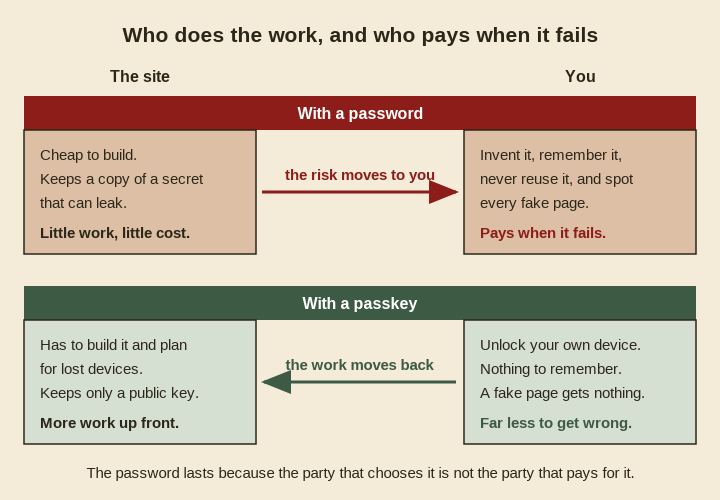 The same sign-in, drawn by who carries the work and who carries the loss.
NIST, the US standards agency, has already conceded how much of the old advice was theater. Its current digital identity guidelines say sites shall not impose rules about mixing character types and shall not make people change passwords on a schedule. A password used on its own must be at least 15 characters. The rituals we nagged people about for a generation did not work, and the only password that holds up alone is one most people cannot remember without a password manager.
Does the replacement work?
Yes. A passkey, in the FIDO Alliance's words, is "an authentication credential based on FIDO standards" kept on your phone, your computer or a hardware security key. Your device holds a private key and unlocks it the way you unlock the device. The site holds only the public half. There is nothing to type, so there is nothing to type into the wrong page. Our article Passwords, Passkeys and MFA: Identity Done Right covers the mechanics.
That last point is the whole case. NIST defines phishing resistance as keeping your secret away from an impostor site "without relying on the vigilance of the claimant." The claimant is you. For once a standard says out loud that being careful is not a control. The same guidelines say a code you type in by hand, including the six digits texted to your phone, shall not be considered phishing resistant, because a fake page can simply pass it along. CISA's page on multifactor authentication ranks text and email codes last, as the form that "provides the weakest protection."
People are using it, too. The FIDO Alliance cites a 2024 survey it commissioned in which 53% of people said they had turned on a passkey for at least one account. The group promotes the standard, so weigh that accordingly. Even so, half of the people asked is well past the early adopters.
What the holdouts get right
The best argument for keeping the password is not laziness, and it deserves a fair hearing.
Recovery is hard. Lose the phone and the question becomes how you prove you are you. The FIDO Alliance's own page says that when the old device is gone, the site can treat the sign-in "as a normal account recovery situation." That is honest. It also means a passkey is only as strong as the recovery path behind it. If the fallback is an emailed link, the email account is the real lock.
Not everyone has the device. For example, a 12 person clinic has a front desk computer that six people sign in to before lunch. An 800 bed hospital system has thousands of shared workstations and nurses who cannot stop to find a phone. At home there is the shared family computer and the grandparent with no smartphone at all.
And lock-in is a fair worry. A synced passkey lives with whichever company runs your phone or your password manager, and people reasonably ask what happens on the day they switch.
All of that is true, and none of it is an argument for the password. It is an argument for doing the replacement properly. Offer passkeys and keep a second strong way in. Let people register more than one device. Support hardware keys for shared desks. Treat recovery as a designed process, with a notice sent to the account holder every time it is used, which NIST's guidelines already require. The hard problems have known answers. The answers cost money, which brings us back to the start.
I have sat in the meeting where passwordless sign-in was moved to next year's budget for the third year running. Nobody in the room argued that passwords were safer. The argument was that nothing bad had happened yet.
Who should move, and who should make them?
Staying on passwords is a decision to accept a risk. Where I come from, accepting a risk is a deliberate act and a named person signs for it. So ask who signed. Usually nobody did. The risk was accepted by default, on behalf of customers who were never asked.
Three groups can change that.
Whoever owns sign-in at an organization should put a date on it: passkeys offered to every customer, and required first for staff and administrators. NIST already tells federal agencies that they shall require phishing-resistant sign-in for staff, contractors and partners. A private company can read the same sentence.
Whoever buys software should make it a condition of purchase. CISA's Secure by Design pledge, which the agency says hundreds of companies have signed, asks software makers to "take ownership of security outcomes of their customers" and to measurably raise the use of multifactor authentication in their products. A buyer needs one question: does every user get passkeys or security keys, at no extra charge?
And the bodies that decide who pays when an account is taken over, such as regulators, card networks and insurers, hold the strongest lever. As a rule of thumb, whoever chooses the lock should pay for the break-in. Move the cost and the engineering will follow faster than any awareness campaign.
Where I land
- The password persists because of who pays for its failure, not because nothing better exists.
- Phishing-resistant sign-in is a published standard that works on ordinary phones and computers.
- Recovery, shared devices and lock-in are real. They are design work, not reasons to wait.
- Keeping the password as the only way in is a risk, and somebody with a name should sign for it.
I do not expect the password box to vanish. It will linger for years as a fallback, the way a spare key lingers under a flowerpot. In the meantime, turn on a passkey wherever one is offered, starting with your email, and keep a password manager for everything else (Password Managers: Picking One and Moving In explains how). And if your bank does not offer one yet, it is fair to ask them why.