Articles & BlogBy Trapper W. Brown6 min readOpinion
Opinion. Running software past its end of support is a risk that someone with authority should have to accept in writing, with a date and a plan, because today almost nobody accepts it at all.
Somewhere in most organizations there is a system running software its maker stopped fixing years ago. Ask who decided that was acceptable and you will usually get a shrug. Nobody decided. The support date passed, the system kept working, and the risk moved in without any paperwork.
That is driving without insurance. The car runs fine. You save the premium every month. Nothing about the drive feels different until the day something hits you, and then the whole bill is yours. I am not arguing that every old system must be replaced tomorrow. I am arguing that someone with authority should have to sign for the risk, with a date and a plan.
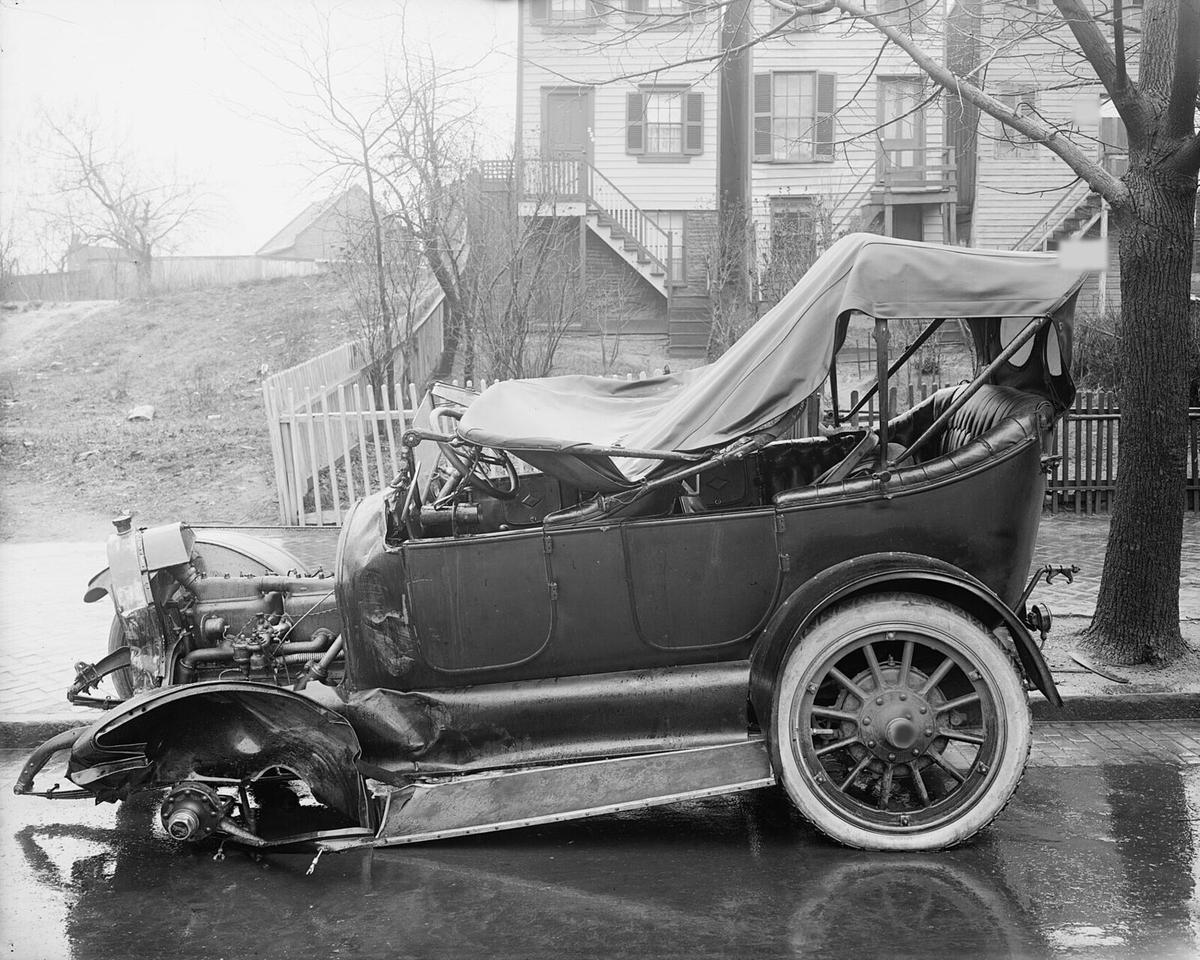 The car ran fine until the moment it did not, and the question of who pays was settled long before the crash. Photo from the National Photo Company Collection, Library of Congress, public domain, via Wikimedia Commons.
How common is it?
More common than the supported kind, at least in one large sample. When the PHP2Shell flaws were disclosed in October 2026, Qualys counted the PHP installations it could see among its own customers. Of 156 million with a known version, 110 million (71%) were on end-of-life branches and 44 million (28%) were on supported ones. Those figures do not count servers confirmed to be vulnerable. They count how many were running something the PHP project had stopped updating. This site covered the event in PHP2Shell: What Happened and Why It Matters.
The difference showed on the day of the fix. Sites on a supported branch had a fixed release to install on 21 October. Branches 8.1 and older got minimal source patches at best, with no official builds. CISA added both flaws to its Known Exploited Vulnerabilities catalog on 26 October, with a due date of 29 October for federal agencies. Three days is tight for a routine update. It is not enough time to plan a migration you have been putting off for four years.
The trap is that end of support is silent. Microsoft's own page on Windows 10, which reached end of support on October 14, 2025, answers the question of whether the PC will stop working with a plain no: support is discontinued, "but the software will continue to function." That is accurate, and it is the whole problem. Nothing breaks. There is no warning light on the dashboard.
CISA is blunter. Its short list of Bad Practices names the use of unsupported or end-of-life software in service of critical infrastructure as "dangerous," says it "significantly elevates risk," and calls it "especially egregious in technologies accessible from the Internet." The list has only three entries. This is the first.
The other side: budgets are real, and some things cannot be upgraded
Here is the objection at its strongest, and I have real sympathy for it. Replacing software costs money that a small organization does not have. A 12 person clinic running an old practice system is choosing between a migration and a second nurse. That is not laziness. And some systems cannot simply be upgraded at any price. An imaging machine may be cleared to run with one specific operating system, and the machine has fifteen good years left in it. An industrial controller may run a production line that cannot stop for a week of testing.
Regulators know this. The FDA's medical device cybersecurity page notes that in November 2023 it contracted with MITRE to produce a report titled Next Steps Toward Managing Legacy Medical Device Cybersecurity Risks. You do not commission a report on managing a problem that could be solved by telling everyone to upgrade.
So the objection is right about the facts. Sometimes the old system stays. Sometimes keeping it is the correct decision.
But look at what that concedes. If keeping it is a decision, then somebody should make it. The objection supports accepting the risk on purpose. It says nothing in favor of accepting it by default, in silence, with no name attached. An 800 bed hospital system that keeps an unsupported imaging workstation because replacing it costs seven figures may be making a sound call. I want to know who made it, what they put around the workstation to protect it, and when they will look at it again.
What does a signature change?
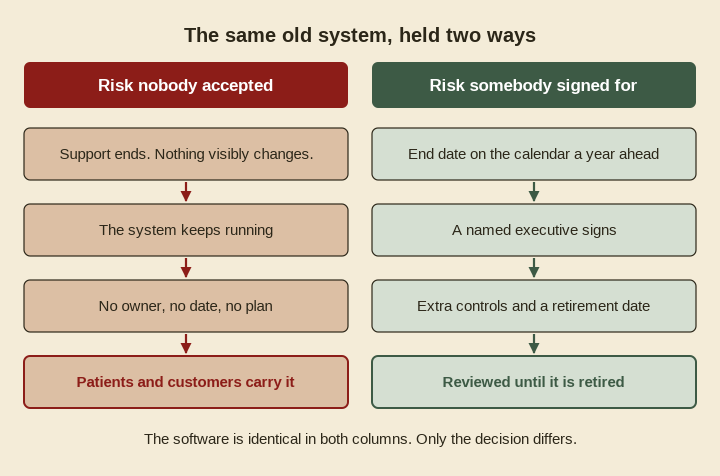 Drift on the left, a decision on the right. The software is the same in both.
A signature changes who is paying attention. More than once I have watched a risk register entry for an unsupported system get renewed year after year with the same sentence and no name beside it. Nobody was lying. Nobody was deciding, either.
The idea is not new. Federal standards have a role for it: NIST's glossary, quoting FIPS 200, defines an authorizing official as the official with the authority "to formally assume responsibility for operating an information system at an acceptable level of risk." Formally, and by one person. Every organization can borrow that. As a rule of thumb, the form fits on one page:
| Line on the form | What it answers |
|---|---|
| System and end-of-support date | What are we talking about, and since when? |
| Why it stays | Cost, a device that cannot change, a vendor dependency |
| What protects it meanwhile | Off the internet, on its own network segment, access limited, watched more closely |
| Retirement date and budget line | When does this end, and who is paying? |
| Name, signature, review date | Who accepted this, and when do they look again? |
The signer should be someone who could have funded the replacement. For example, if the chief financial officer declined the upgrade, the chief financial officer signs. A risk is a business matter, and the person who saved the money should be the person whose name is on the saving.
Who should change it?
Executives and boards should ask one question each quarter: what are we running past end of support, and who signed for each item? An empty list is either very good news or a sign that nobody has looked.
IT and security teams should keep the calendar. End-of-support dates are published years ahead. PHP 8.2, for example, reaches end of life on 31 December 2026, and that date has not been a secret. A date that is on the calendar a year out is a budget request. A date discovered the week after is an incident.
Auditors and cyber insurers should ask to see the signatures, not only the inventory.
At home the paperwork is lighter and the principle is the same. A family with an old laptop that no longer gets updates can decide to keep it for one more year, use it for nothing involving money, and replace it by a set month. That is a decision. Forgetting about it is not.
Where I land
- Software past its end of support keeps working, which is why the risk goes unnoticed.
- In one large sample, end-of-life installs outnumbered supported ones by more than two to one.
- The budget objection is right that some systems must stay. That makes the case for a signed decision stronger.
- One page, one name, one date. If nobody with authority will sign it, the organization has its answer.
Make the list this month. For each system past its support date, write down the date, the reason it is still there, and the name of the person who would have to explain it after a breach. Then take the list to that person.