Articles & BlogBy Trapper W. Brown6 min readOpinion
Opinion. An AI agent should not get broad access to email, files and payments until least privilege and human confirmation are in place, because prompt injection is not solved.
We are giving AI agents the keys to inboxes, file shares and payment systems while the lock that would make that safe does not exist yet. I think that is a mistake, and an old one. This industry has shipped the feature and promised the security later many times. It has never been cheap to fix afterwards.
My position is simple. An agent that reads content from strangers should not also be able to send, delete or spend without a person confirming it. Least privilege and human confirmation come first. Broad access comes after the controls have earned it.
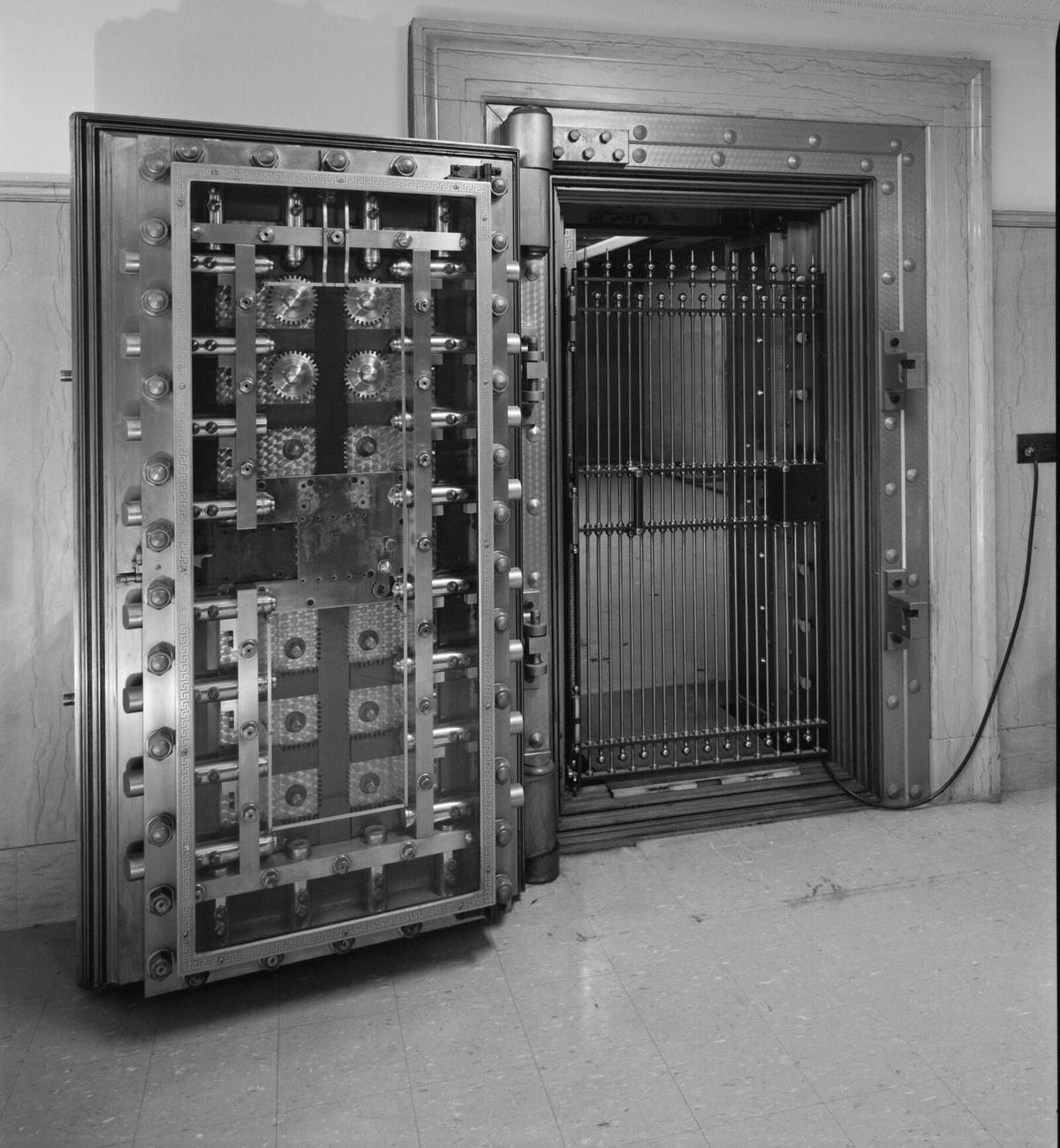 A vault is more than a heavy door: there is a second gate behind it, and a rule about who holds each key. Photo from the Historic American Buildings Survey, Library of Congress, public domain, via Wikimedia Commons.
What exactly is unsolved?
An agent is an AI assistant that can take actions: read your mail, open files, fill in forms, pay an invoice. Prompt injection is the trick of hiding instructions in something the agent reads, a web page or an email, so that it follows the stranger's orders with your access. This site explained the mechanics in Prompt Injection: The New Phishing, Aimed at the Machine.
What matters for this argument is that nobody claims to have fixed it. OWASP, in its 2025 Top 10 for LLM Applications, says it is unclear whether fool-proof methods of prevention exist. NIST, in a January 2025 post on agent hijacking, traced the cause to systems that lack a clear separation between trusted instructions and untrusted data. When its red team wrote new attacks against one model, the success rate of the strongest attack rose from 11% to 81%. A March 2026 NIST post described a public competition with more than 250,000 attack attempts against 13 leading models. At least one attack worked against every one.
The builders say the same about their own work. Anthropic wrote in November 2025 that prompt injection is "far from a solved problem," reported a measured attack success rate of 1.4% for its browser agent on one model, and added that even 1% is a meaningful risk. I respect that candor. I also notice what it means. One success in a hundred attempts sounds small until you remember that sending a hundred emails costs an attacker nothing.
Have we made this mistake before?
Yes, more than once. Software went onto the internet before anyone designed it to face strangers, and we spent the next two decades patching it. Devices shipped with default passwords because that made setup easy. Each time the feature arrived first, the incidents arrived second, and the security arrived third, at several times the price.
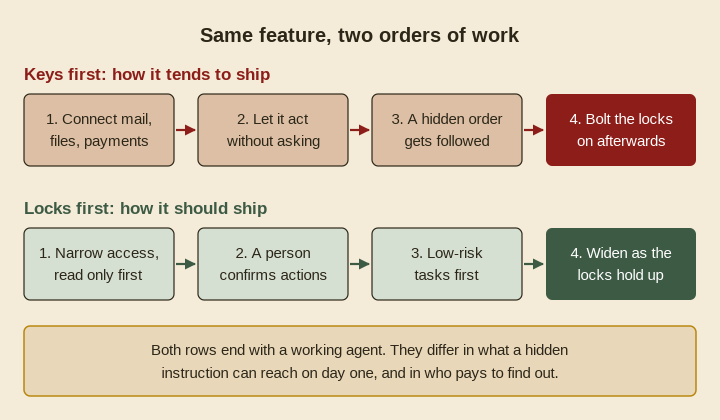 Nobody is arguing about whether to build the agent. The argument is about which row to build it in.
Agents are following the top row of that diagram. I have sat in the meeting where the security review of a new tool was scheduled for after the launch date, and everyone nodded. The reasoning is always the same: get it working, see whether people use it, tighten it up later.
The national cyber agencies have seen where that leads. In May 2026, CISA, the NSA and their partners in Australia, Canada, New Zealand and the United Kingdom published joint guidance, Careful Adoption of Agentic AI Services. It includes a made-up scenario that reads like a forecast. An organization gives a procurement agent broad access to financial systems, email and contract repositories "to reduce friction." An attacker compromises one low-risk tool the agent uses, inherits its privileges, and can then modify contracts and approve payments. No real company is named, because it is an illustration. I would bet money that it will not stay one.
The other side: is waiting not a cost too?
It is, and this is the strongest objection. The productivity is real. An agent that sorts a clinic's referral inbox or reconciles a small company's invoices gives hours back to people who have none to spare. A 12 person clinic does not have a spare employee to do that work. An 800 bed hospital system has competitors, a board and a budget. If the careful organization waits three years, its staff will not wait with it. They will connect a personal tool to a work inbox on their own, with no review at all.
All of that is right. "Wait until it is solved" is not a plan, because nobody can say when that will be.
But I am not asking anyone to wait. I am asking for a different order. The joint guidance does not say "do not adopt." Its key actions say to limit initial use to low-risk, well-defined tasks and to apply strong oversight and human control. It recommends "never granting it broad or unrestricted access, especially to sensitive data or critical systems," and it calls strict adherence to least privilege "critical."
Most of the productivity survives that. An agent that reads the referral inbox and drafts replies for a person to send saves nearly as much time as one that sends them itself. An agent that prepares the payment run and stops for a signature still did the tedious part. What you give up is the last click, and that click is the lock.
What should change, and who should change it?
Builders first, because they set the defaults. OWASP's 2025 list has an entry called Excessive Agency and names three root causes: excessive functionality, excessive permissions and excessive autonomy. Each one is a design choice. Ship the agent with read-only access as the default, with confirmation required for anything that sends, deletes or spends, and make "act without asking" something a customer has to turn on with a warning in front of it.
Buyers next. Before you connect an agent to anything, ask three questions. What can it reach? What can it do without a person? What happens when it reads a hostile email? If the vendor cannot answer the third, you have learned what you needed to know.
Then executives. Connecting an agent to the payment system is a risk decision, and it belongs to the business as much as to IT. Someone with authority should sign for it: this agent, this access, these limits, reviewed on this date. If nobody is willing to sign, that tells you something too.
The same holds at home. A family that lets an assistant read the shared inbox is taking a small risk. A family that lets it pay bills from the checking account without asking is taking a large one, for the sake of one saved tap.
Where I land
- Prompt injection is unsolved, and the people building and testing agents say so in public.
- Shipping access first and controls later is a mistake we have made before, and the bill has always arrived.
- The productivity argument is real. Most of it survives least privilege and a human confirming the actions that cannot be undone.
- Broad access should be earned by the controls and signed for by someone with authority.
Open the settings of whatever agent or assistant you have already connected, at work or at home. Write down what it can reach and what it may do without asking. If the second list is longer than you expected, shorten it this week.