Articles & BlogBy Trapper W. Brown7 min readOpinion
Opinion. When an autonomous weapon kills the wrong people, we should treat it just as we treat a human mistake: the same investigation, the same chain of responsibility and the same law of armed conflict, because a machine does not excuse anyone.
Sooner or later a weapon that chose its own target will kill people it should not have. When that happens, I think the right response is the one we already have for a pilot, a gun crew or a patrol leader who gets it wrong. Open an investigation. Walk up the chain of command. Measure what each person did against the law of armed conflict.
The claim I am arguing against is that the machine changes the question. It does not. Somebody built the weapon, somebody approved it, somebody sent it out and somebody switched it on. "The machine decided" tells you how the mistake happened. It does not tell you who answers for it.
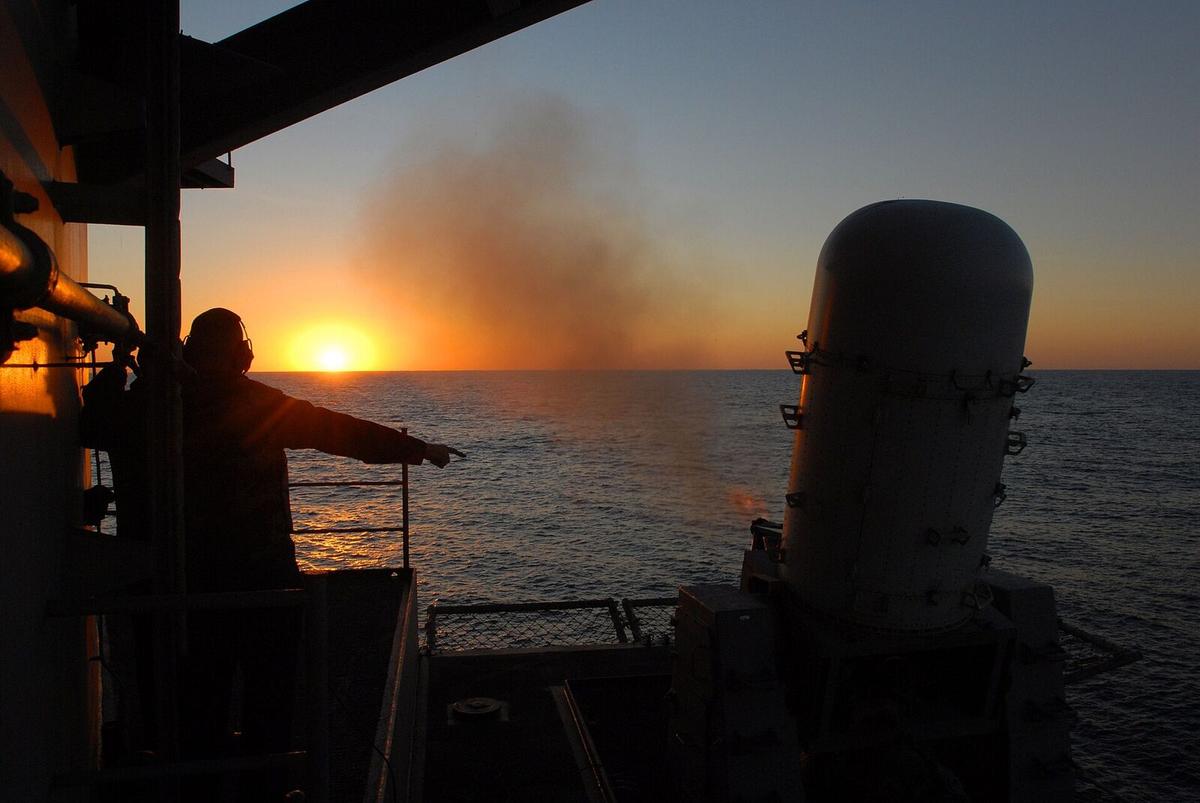 A chief petty officer signals during a live-fire exercise of a ship's close-in weapon system in the Pacific, January 2007. Photo by Mass Communication Specialist 3rd Class Paul J. Perkins, U.S. Navy, public domain, via Wikimedia Commons.
What does the law say today?
It says less about machines than people expect, and more about people.
The Department of Defense Law of War Manual, as updated in July 2023, has a section whose heading is the whole argument: the obligations of distinction and proportionality "Apply to Persons Rather Than the Weapons Themselves." The text goes on: "it is persons who must comply with the law of war." The manual also notes that this is not science fiction. It says the United States has used local defense systems with autonomous capabilities for years, and that a mine is a rudimentary autonomous weapon.
The Pentagon's policy on these weapons, Directive 3000.09 of January 2023, defines an autonomous weapon system as one that, "once activated, can select and engage targets without further intervention by an operator." It then says that people who authorize, direct or operate such systems "will do so with appropriate care and in accordance with the law of war." A second directive, 2311.01 of July 2020, tells every unit commander who hears a credible report of a possible violation to report it up the chain of command immediately. I read both. Neither makes an exception for the kind of weapon involved.
International law points the same way. Additional Protocol I to the Geneva Conventions, in Article 36, obliges a state that adopts a new weapon to determine whether using it would be prohibited. Article 87 requires commanders to prevent, suppress and report breaches. The United States is not a party to that protocol, according to its own manual, but its directive requires a legal review of each system anyway.
Who is in the chain?
Take two mistakes. In the first, a patrol leader at a checkpoint misreads a pickup truck as a threat and orders his gunner to fire. In the second, a loitering munition (a small armed drone that circles and waits) is launched over the same road with instructions to attack vehicles that match a profile, and it picks the same truck.
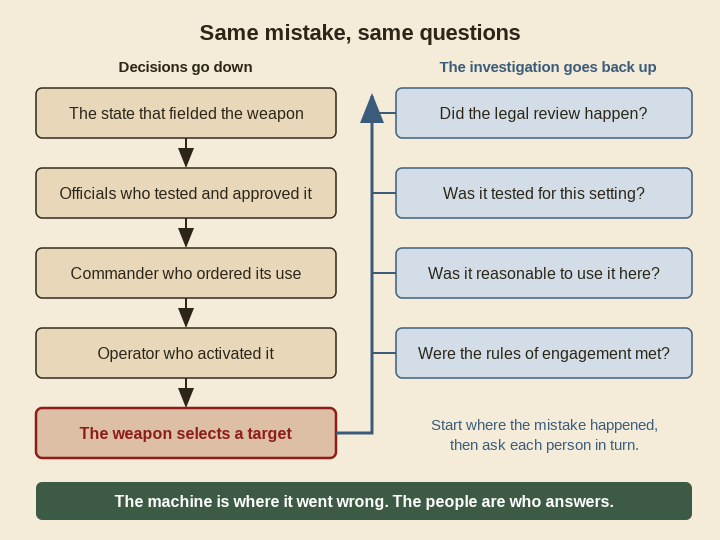 The weapon sits at the end of a chain of human decisions, and an investigation runs back up that chain.
| Question after the strike | Patrol leader | Loitering munition |
|---|---|---|
| Is there an investigation? | Yes | Yes |
| Was force used with appropriate care? | Asked of the leader | Asked of whoever launched it and whoever ordered that |
| Was the weapon lawful and tested? | Rarely in doubt for a rifle | Asked of those who reviewed and fielded it |
| Is the state responsible for what its forces did? | Yes | Yes |
The right-hand column has more people in it than the middle one. With a rifle, almost nobody asks who approved the rifle. With an autonomous system, the people who tested it, set its limits and decided it was fit for that road at that hour are part of the chain. Directive 3000.09 requires the system to stay within a time and an area "consistent with commander and operator intentions." Someone chose those limits. That person has a name.
The strongest case against me
Is there a real gap? The best argument that there is comes from a 2015 report by Human Rights Watch and Harvard Law School's International Human Rights Clinic. Criminal law needs a guilty mind. A machine has none, so there is no underlying crime for a commander to be responsible for, and the report concludes that "command responsibility would never be available." If the weapon did something nobody intended and nobody could foresee, no court could convict anyone. The International Committee of the Red Cross takes a related view. In May 2021 it recommended new binding rules, including that "Unpredictable autonomous weapon systems should be expressly ruled out."
This argument gets something right. Some machine failures will be honest surprises, and criminal law will not reach them. But that is also true of people. The law of armed conflict punishes crimes. An honest, reasonable mistake by a human being often ends in an investigation and no prosecution. Treating a machine's error like a human one means accepting that outcome too, and I do.
What the argument misses is where the responsibility goes. If nobody could predict what the weapon would do, then sending it out was the decision to examine. And the state never drops out. Article 91 of Additional Protocol I says a party is "responsible for all acts committed by persons forming part of its armed forces."
What should change, and who should change it
The countries that belong to the Convention on Certain Conventional Weapons meet in Geneva from 16 to 20 November 2026. Their expert group adopted a final report on 4 September with elements of a possible instrument on these weapons. The UN General Assembly has already pointed at the goal. Its resolution of 1 December 2025, adopted 164 to 6 with the United States among the six, stresses "the role of humans in the use of force to ensure responsibility and accountability."
I would ask those diplomats, and any defense ministry, for three plain things:
- A named person who authorizes each use, written down before launch.
- Records good enough to investigate with: what the system was told, what it sensed, what it did.
- The same reporting and investigation rules as any other strike, in writing, with no separate track for machines.
For example, a platoon with one autonomous sentry and an air force with a thousand drones would follow the same rule. Only the paperwork is bigger.
Where I land
- The law of armed conflict binds people. No weapon has ever carried a legal duty.
- An autonomous weapon lengthens the chain of responsibility. It adds testers, reviewers and whoever set the limits.
- Some errors will end with no one convicted, as some human errors do. That is not the same as no one answering.
- If nobody can say what a weapon will do, fielding it is the act to investigate.
None of this needs a new theory of machine guilt. The investigators already know how to start at the place where the mistake happened and walk back up the chain, asking each person what they knew and what they did about it.
Sources (9)
- U.S. Department of Defense, "Law of War Manual", June 2015, updated July 2023
- U.S. Department of Defense, Directive 3000.09, "Autonomy in Weapon Systems", 25 January 2023
- U.S. Department of Defense, Directive 2311.01, "DoD Law of War Program", 2 July 2020
- Protocol Additional to the Geneva Conventions of 12 August 1949 (Protocol I), 8 June 1977
- Human Rights Watch and Harvard Law School International Human Rights Clinic, "Mind the Gap: The Lack of Accountability for Killer Robots", 9 April 2015
- International Committee of the Red Cross, "ICRC position on autonomous weapon systems", 12 May 2021
- UN Office at Geneva, "Seventh Review Conference of the High Contracting Parties to the Convention on Certain Conventional Weapons (CCW)", November 2026
- UN General Assembly, resolution 80/57, "Lethal autonomous weapons systems", 1 December 2025
- United Nations, meetings coverage GA/12736, 1 December 2025