Articles & BlogBy Trapper W. Brown6 min readOpinion
Opinion. If automation ever makes a basic income necessary, it should be built as an ownership dividend drawn from more than one source, because whatever pays everyone's rent becomes the most valuable switch in the country.
The argument about a universal basic income is nearly always about work. If a check arrives every month, will people quit their jobs? It is a fair question, and it has mostly been answered: a little, not a lot. I also think it is the less important question.
The one I would ask first is the one my trade asks about any system. What does it depend on, and who can turn it off? I do not know whether automation will ever make a basic income necessary. If it does, the payment will be covering rent for a very large number of households, and whatever does that is the most valuable switch in the country. I would want it built so that no single hand can reach it.
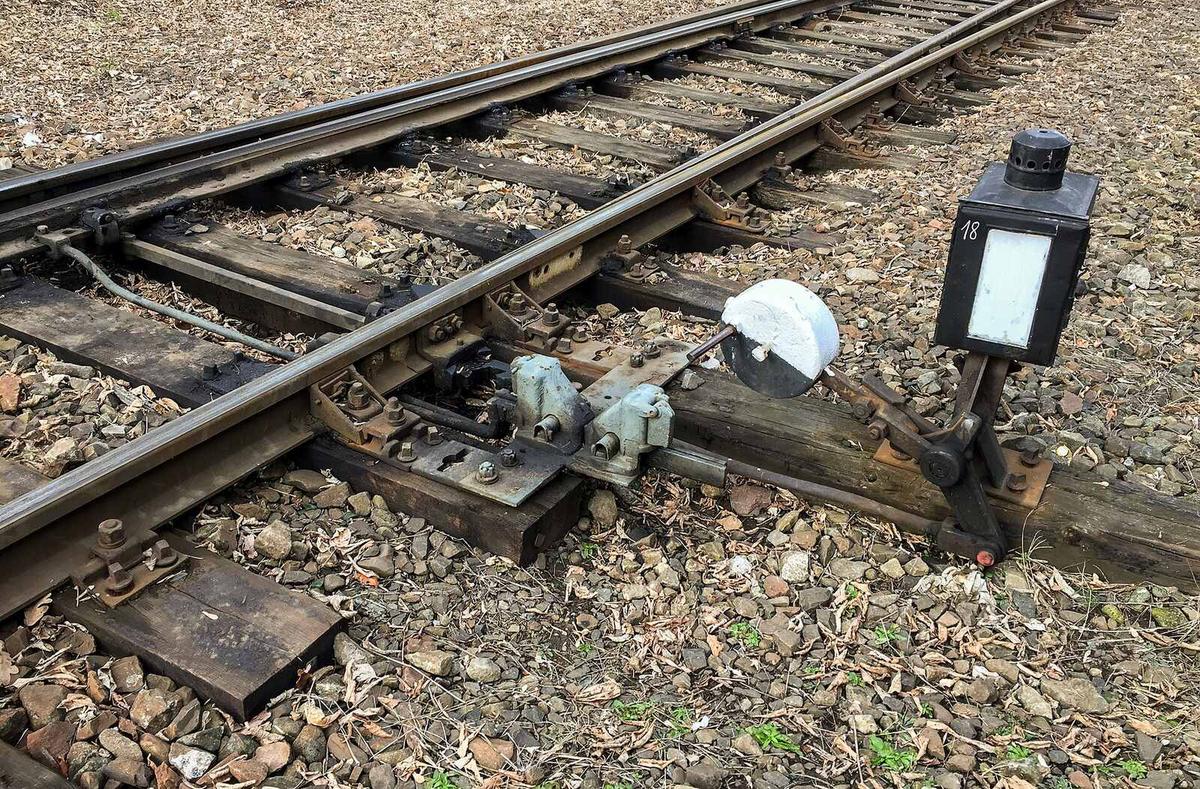 One lever, and everything behind it goes one way or the other. Photo by PIVISO, CC0, via Wikimedia Commons.
Will people stop working?
Here is what the studies say, without the spin either side adds.
The largest American experiment is described in a National Bureau of Economic Research working paper by Vivalt, Rhodes, Bartik, Broockman, Krause and Miller, first issued in July 2024. It gave 1,000 low-income people $1,000 a month for three years, no strings attached, and compared them with 2,000 people who got $50 a month. Labor market participation fell by 4.2 percentage points. People worked 1 to 2 fewer hours a week. Their income apart from the payment fell by about $1,900 a year. The authors call this "a moderate labor supply effect." That is not nothing, and it is not a nation on the couch.
The longest running example is Alaska. A 2018 NBER working paper by Jones and Marinescu looked at the state's yearly dividend and found that it "had no effect on employment," while part-time work rose by 1.8 percentage points.
So the cost is a few points of work. Whether that is worth it is a question about values, and people can argue it honestly. My problem is with the plumbing.
What does it depend on, and who can turn it off?
Picture the simplest version: one government payment, from one budget, checked against one list of who qualifies, sent over one payment system. It is easy to explain, which is a real virtue. It is also a single point of failure and a single point of control.
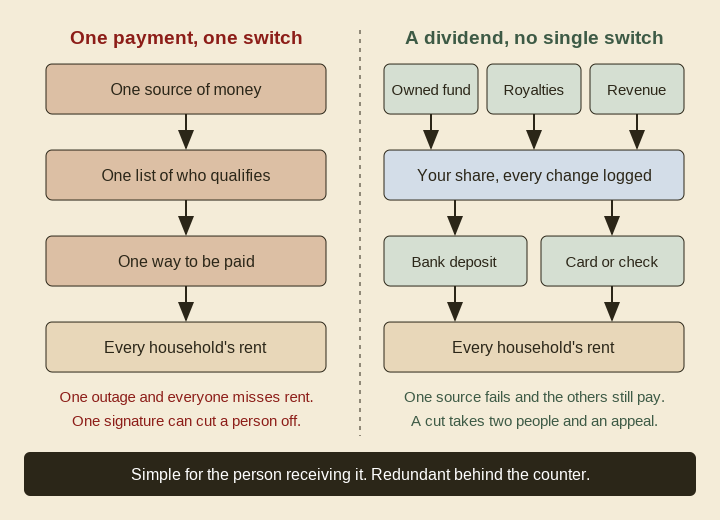 The same monthly payment, drawn the way a risk review would draw it.
Take failure first. A family that misses one paycheck calls the landlord and works something out. A country where one system misses one payment day has a national missed rent day. I have sat in reviews where someone asked what else depended on a system everyone assumed would never go down, and nobody in the room could answer.
Then control. "Universal" lasts until the first time someone wants a bargaining chip and adds a condition. I do not mean any one party or era. Whoever holds the list will sooner or later be asked to use it, and each request will sound reasonable on its own.
It would also be the largest fraud target ever built. In September 2023 the Government Accountability Office estimated that fraud in pandemic unemployment insurance was likely between $100 billion and $135 billion, or about 11 to 15 percent of the benefits paid from April 2020 to May 2023. The GAO wrote that the "need to quickly implement the new programs increased the risk of fraud." The Department of Labor thought the estimate was too high, and the GAO itself says the full amount will likely never be known. Even so, the lesson holds. When a payment goes to nearly everyone and is stood up in a hurry, the only lock on the money is a claim to be a particular person.
Is a dividend different from an allowance?
I think so, and Alaska is the evidence. In 1976 Alaskans voted to amend their constitution so that at least twenty-five percent of the state's mineral royalties and related income go into a permanent fund. The first dividend, $1,000, went out in 1982. The state's own table shows one paid every year since.
The amount moves a great deal: $3,284 in 2022 and $1,000 in 2025. So this is no guarantee of comfort. But notice what has not happened in more than forty years, which is the dividend going away. People treat a dividend as theirs, a share of something they own. They treat an allowance as something granted, and what is granted can be withdrawn. That difference decides how hard the payment is to take away.
What the simple version gets right
The whole virtue of a basic income is that it is simple: one payment, no caseworker, no forms proving you deserve it. And the fear that people will waste the money does not hold up well. The NBER study found spending rose broadly, led by the ordinary goods and services people use up. My design adds machinery, and machinery is where the caseworkers come back in.
That objection is right about the front of the counter. The person receiving the money should see one payment and nothing else. Behind the counter is a different matter. For example, a 12 person clinic keeps a second way to run payroll, and an 800 bed hospital system has two power feeds and a generator. Nobody calls that bureaucracy.
So build it the way you would build anything people cannot live without:
- More than one source of money, so a bad year for one does not stop the payment.
- More than one way to be paid.
- No single official able to switch a person off.
- A log of every change to a person's record, and an appeal that a human being answers.
What money does not replace
One honest limit. Work gives people more than pay. It gives them a place to be and some standing with their neighbors. A payment answers "how do I eat." It does not answer "what do I do on Tuesday," and no design of mine fixes that.
Where I land
- People on a basic income work a little less. That question is mostly settled.
- One payer, one list and one payment system is a single point of failure and of control.
- A dividend from something owned is harder to take away than an allowance that is granted.
- Keep it simple for the person and redundant behind the counter.
I would rather we never need any of this. If we do, the first design meeting should have someone in it whose job is to ask who holds the switch, and to keep asking until the answer is "nobody, alone."