Articles & BlogBy Trapper W. Brown10 min readOpinion
Opinion. Nuclear power is the best source we have of reliable, low-carbon electricity at scale, and we should keep and build it alongside wind and solar while being honest about what can go wrong.
I think nuclear power is the best choice available for the hardest part of the electricity problem: power that is there at 3 a.m. in January, in very large amounts, without burning anything. The record on safety, carbon and land supports that. I will lay it out.
I also think nuclear's supporters lose people by waving the risks away. The risks are real. They are mostly different from the ones people fear, and none of them is a reason to keep burning coal and gas.
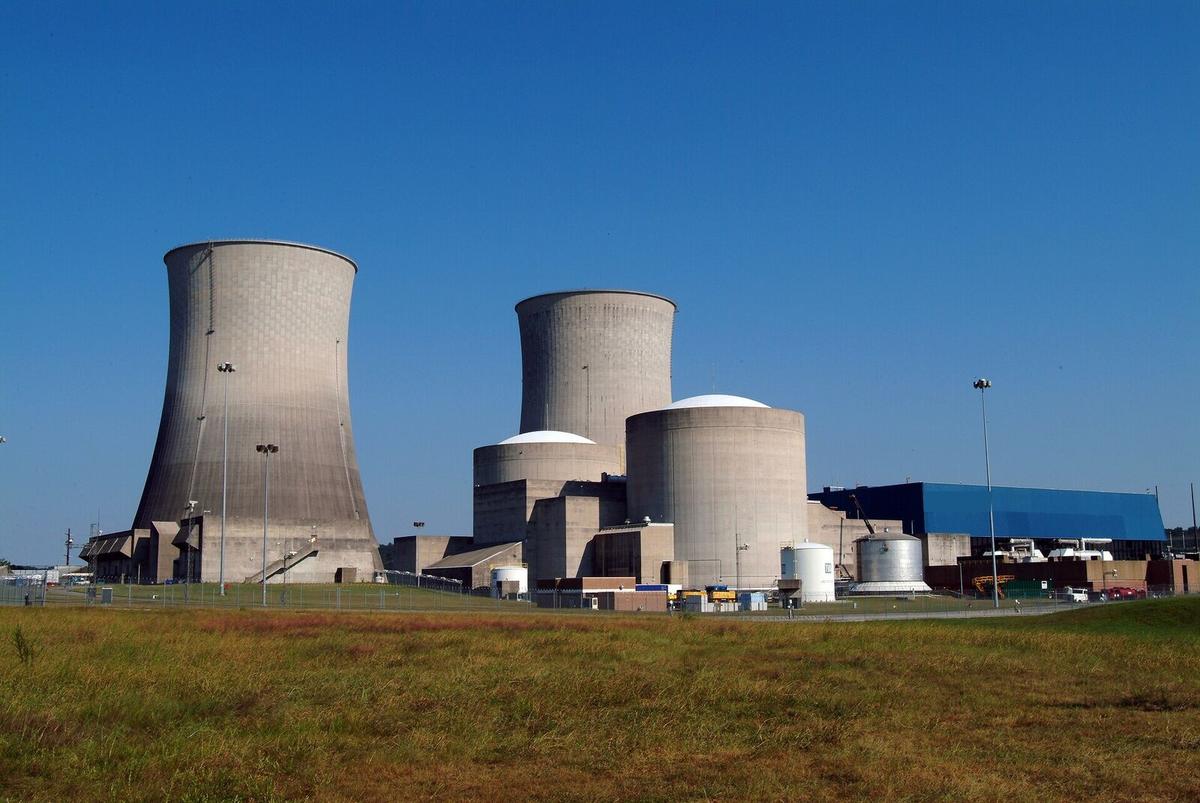 The Watts Bar Nuclear Plant in Tennessee. The big curved towers only cool water. The reactors are in the smaller domed buildings. Photo by the Tennessee Valley Authority, public domain, via Wikimedia Commons.
What do I mean by best?
"Best" needs pinning down, or the argument turns to mush.
I do not mean cheapest to build. It is not, and the numbers below say so plainly. I do not mean "instead of renewables." Wind and solar are cheaper per unit of energy and faster to put up, and we should build a great deal of both.
I mean this: among the ways to make electricity that are low in carbon, nuclear is the best one we have for steady output at very large scale on a small piece of land. A grid needs some of that. Today most grids get it by burning gas or coal. Nuclear is the proven way to get it without the smoke.
The United States already leans on it. The Department of Energy counts 94 commercial reactors in 28 states, which made nearly 782 billion kilowatt-hours in 2024. The Energy Information Administration (EIA) put nuclear at 18.6% of US generation in 2023.
What does the record say?
Start with deaths, because fear is where this argument usually begins. Our World in Data compiles deaths per terawatt-hour of electricity, counting both accidents and air pollution. A terawatt-hour is roughly what 150,000 Europeans use in a year. The figures draw on a 2007 study in The Lancet by Markandya and Wilkinson and a 2016 accident database by Sovacool and colleagues. Coal: 24.6 deaths. Oil: 18.4. Gas: 2.8. Hydropower: 1.3. Wind: 0.04. Nuclear: 0.03. Solar: 0.02.
Read that list twice. The nuclear figure already includes Chernobyl and Fukushima, with the Fukushima evacuation deaths counted in. Nuclear, wind and solar sit together at the bottom, hundreds of times safer than coal. The dangerous way to make electricity is the ordinary one, and it kills quietly through lungs and hearts.
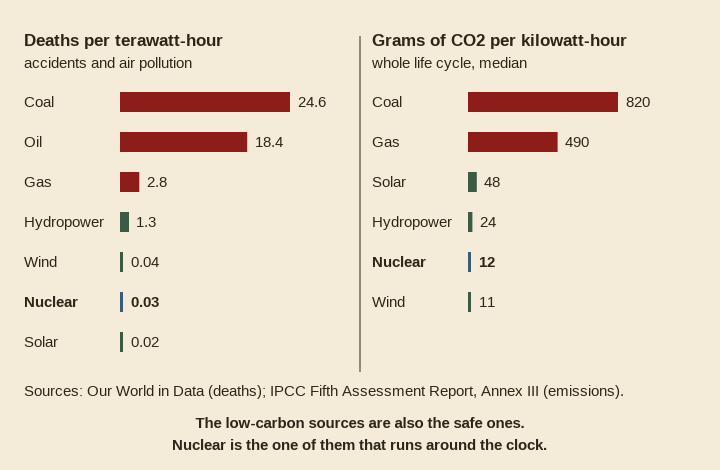 Two measures, one pattern: coal, oil and gas at the top, nuclear, wind and solar at the bottom.
Carbon tells the same story. The Intergovernmental Panel on Climate Change published lifecycle figures in its Fifth Assessment Report, counting mining, construction and fuel as well as operation. The median values, in grams of carbon dioxide equivalent per kilowatt-hour: coal 820, gas 490, utility solar 48, nuclear 12, onshore wind 11. Nuclear and wind are level. Both are about a fortieth of gas.
Land is where nuclear stands alone. Our World in Data, working from a 2021 United Nations life-cycle study, found nuclear uses the least land per unit of electricity of any source. Ground-mounted solar needs 18 to 27 times more, though rooftops and shared farmland soften that.
Then there is steadiness. A capacity factor is the share of its maximum possible output that a plant actually delivers over a year.
| Nuclear | 91.1% |
|---|---|
| Hydropower | 34.4% |
| Wind | 33.8% |
| Solar photovoltaic | 24% |
Source: EIA Electric Power Monthly, Table 6.07.B, data through August 2026
That is not a criticism of wind and solar. The sun sets, and nobody is to blame. It does mean that a gigawatt of nuclear and a gigawatt of solar are not the same amount of electricity, and that the nuclear output arrives on a schedule people choose.
What about the three accidents everyone can name? The official record is less apocalyptic than the memory.
Three Mile Island, 1979: a reactor in Pennsylvania partly melted. The Nuclear Regulatory Commission (NRC) says the roughly 2 million people nearby received an average dose of about 1 millirem above background, and that the release had no detectable health effects on workers or the public.
Chernobyl, 1986: the worst there has been. The United Nations scientific committee on radiation, UNSCEAR, records that 134 workers suffered radiation sickness and 28 of them died within three months. By 2005 there were more than 6,000 thyroid cancers among people exposed as children, many of them most likely caused by the accident. A World Health Organization (WHO) panel estimated in 2005 that up to 4,000 people among the most exposed could eventually die from it. UNSCEAR found no evidence of any other major effect on public health from radiation. About 335,000 people were evacuated or relocated.
Fukushima, 2011: UNSCEAR's chair said in 2021 that no adverse health effects among residents had been documented that could be directly attributed to radiation. The harm came from somewhere else, and I will come to it.
What are the real risks?
Here is the list I would give a skeptic, without rounding anything down.
Cost and schedule. The two new reactors at Plant Vogtle in Georgia are the most recent ones built in the United States. According to the EIA, construction began in 2009, the units were due in 2016 and 2017, and the estimate was $14 billion. Unit 3 entered service in July 2023 and Unit 4 in April 2024. The owner's estimate of the total is now more than $30 billion. That is seven years late and more than double. Any honest case for building more has to begin there.
Waste with no permanent home. The volume is small. The Energy Department says all the spent fuel from US commercial reactors since the 1950s, about 90,000 metric tons, would cover one football field to a depth of less than 10 yards. It is stored safely for now, in pools and steel-and-concrete casks, at more than 70 sites in 35 states. But "for now" has lasted decades. The NRC says the licensing hearing for the proposed repository at Yucca Mountain in Nevada remains suspended. The Government Accountability Office describes an impasse since 2010 and says taxpayers have paid billions in damages to utilities for the government's failure to take the fuel. This is a political failure and not a technical one. On 22 October 2026 Finland's government granted the world's first operating license for a deep repository for spent fuel, more than 400 meters down in bedrock. The operator says disposal will begin after final tests and gives no date yet.
Accidents are rare and large. The death rate per unit of energy is tiny. The disruption when one happens is not. Chernobyl emptied a region. At Fukushima the evacuation itself did the damage: the WHO reported a sharp increase in deaths among elderly people moved to temporary housing, and Japan's government has counted about 2,300 deaths related to the evacuation. Whether a smaller or slower evacuation would have saved lives is argued over. What is not in doubt is that fear and displacement have a body count of their own.
Weapons. The technology that enriches uranium for fuel can, taken further, make material for a bomb. That is why international inspections exist, and why exporting reactors is a foreign policy question as much as an energy one.
War. A reactor needs outside power to keep cooling its fuel even when shut down. On 6 November 2026 the International Atomic Energy Agency reported that the Zaporizhzhya plant in Ukraine was still relying on a single external power line. "A reliable external power supply is essential for nuclear safety," its director general said. No reactor was designed with a front line in mind.
Water and heat. Nuclear plants, like coal and gas plants, boil water and need cooling. The US Geological Survey estimates that thermal power plants in the lower 48 states withdrew about 59.9 billion gallons of fresh water a day in 2020, though only about 4% of what they withdrew was consumed. A hot, dry summer can force a plant to cut output just when air conditioners want it most.
Digital control systems. A reactor is run by the same kind of industrial computers as a water plant. The article What SCADA Systems Are and How They Are Vulnerable explains why those are hard to secure.
What the other side gets right
The strongest argument against me is about money and time, and it is a good one.
Lazard, an investment bank, publishes a yearly comparison of what new power plants cost over their lifetimes, without subsidies, per megawatt-hour. Its July 2026 edition says unsubsidized renewables remain "the most cost-competitive form of new-build generation."
| New-build source, no subsidies | Cost per megawatt-hour |
|---|---|
| Onshore wind | $37 to $99 |
| Utility-scale solar | $40 to $98 |
| Solar with battery storage | $61 to $156 |
| US nuclear (based on Vogtle) | $175 to $255 |
Even solar with batteries attached undercuts new nuclear. And speed matters. The EIA reports that US grid battery capacity grew by an average of 70% a year over the last three years, reaching nearly 52 gigawatts by mid-2026. A solar farm can be built in the time it takes to finish the paperwork for a reactor. If the goal is to cut the most carbon per dollar this decade, the critics are right: build wind, solar and batteries first, and build them fast.
Here is where I part ways. Those figures price energy, not availability. The batteries on today's grid shift power by hours. They do not cover a still, dark week in winter. As the cheap sources grow, the hard part of the problem becomes the firm remainder, and that is the part gas fills today. Lazard's own report puts the cost of running an existing, paid-off nuclear plant at $26 to $36 per megawatt-hour, which is among the cheapest clean power there is. So the cheapest move of all is to not close the reactors we have. And Lazard's range assumes, on the advice of industry experts, that the fourth Vogtle unit cost about 30% less than the third. First-of-a-kind is expensive. That argues for building the same design again, not for building nothing.
Who should change what?
People who care about climate should stop treating reactor closures as wins. When a working plant shuts, something has to fill the gap, and on most grids today the thing that can run on demand is gas.
Utility regulators should stop letting customers carry all the risk of a late project. If a builder's overrun lands on ratepayers, expect overruns. Fixed designs, firm prices and shared penalties are how other large projects get built.
Congress should break the waste impasse. The Government Accountability Office has said a consent-based process for choosing a site could do it. Finland shows it can be done when a community agrees to host.
The industry should build one design many times and stop reinventing the reactor for every site. It should also stop saying "perfectly safe." The honest phrase is "safer than what it replaces," and the data backs that one.
Where I land
- Nuclear is the best available source of steady, low-carbon electricity at scale. It is not the cheapest to build.
- By deaths, carbon and land, it belongs with wind and solar at the safe end, far from coal and gas.
- The real risks are cost overruns, the lack of a permanent US waste site, rare but large accidents, weapons and war.
- Keep every safe reactor running, build wind and solar as fast as possible, and build new nuclear where a repeated design can hold its price.
My position would change if storage that lasts for weeks became cheap, or if the next few reactors ran as late as Vogtle did. Until one of those happens, I would sooner argue about how to build reactors well than about whether to build them.