Articles & BlogBy Trapper W. Brown7 min readOpinion
Opinion. My hunch was that openness to ideas leads smart people into conspiracy theories; the research says openness has almost nothing to do with it, and that fear, distrust and the wish to see what others miss do far more of the work.
Why do smart people believe conspiracy theories? My hunch, before I looked anything up, was this: because they are generally open to ideas that are not their own. A curious mind lets more in, and some of what gets in is wrong. I liked that answer. It is kind to everyone involved.
Then I read the research, and the hunch did not hold. Openness turns out to have almost nothing to do with it. What the studies point to is less flattering to intelligence and, I think, more sympathetic to the people who believe.
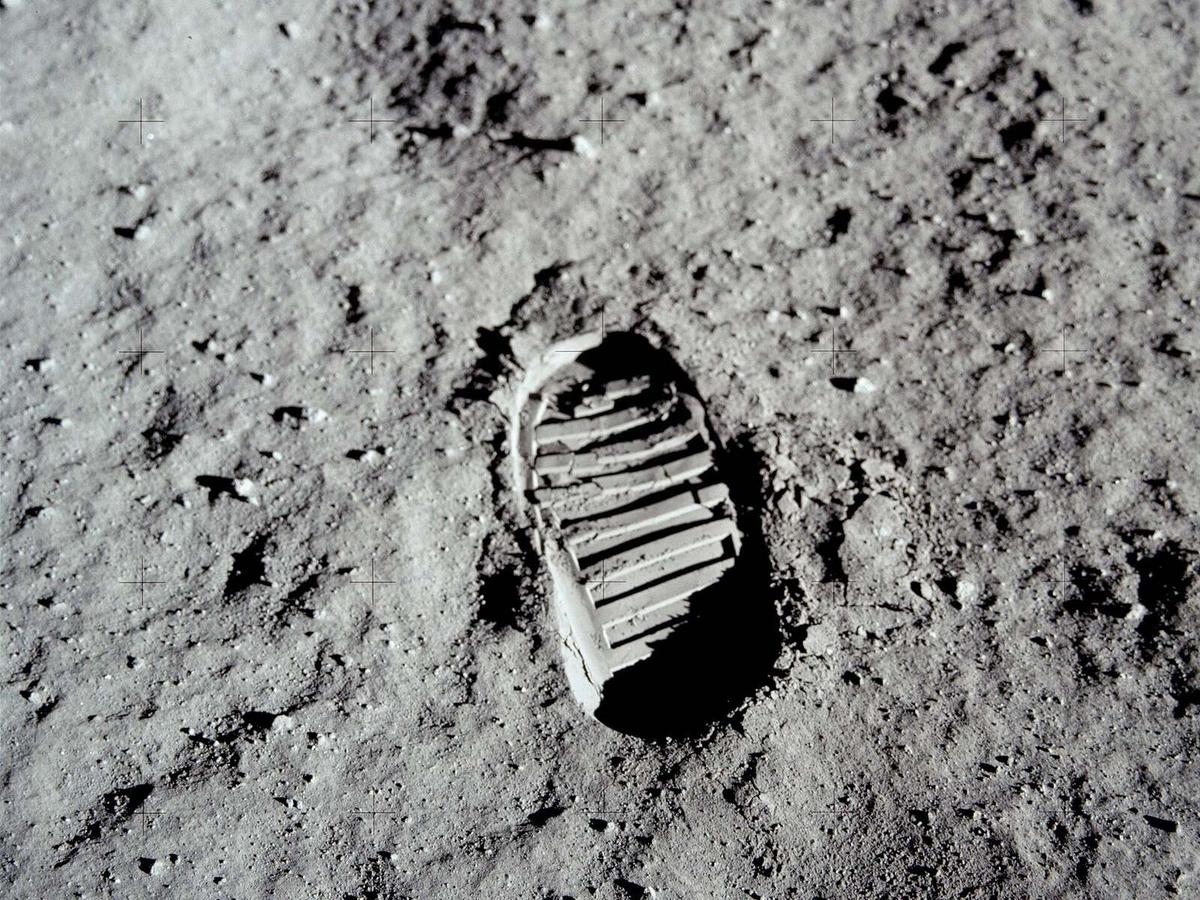 A photograph settles a question only for someone who trusts the people who took it. Apollo 11 bootprint, photo by NASA and Buzz Aldrin, public domain, via Wikimedia Commons.
What did the hunch predict, and what did the studies find?
Psychologists measure openness as one of five broad personality traits: curiosity, imagination, a taste for new ideas. If my hunch were right, people who score high on it should believe more conspiracy theories.
Some early single studies did find that. Then the results were pooled. In 2019 Goreis and Voracek, writing in Frontiers in Psychology, combined 13 studies covering 12,086 people. The correlation between openness and conspiracy belief was 0.02. A correlation runs from 0 (no link) to 1 (the two always move together), so 0.02 is nothing. In 2023 a much larger review in Psychological Bulletin by Bowes, Costello and Tasimi pulled together 170 studies and 158,473 participants. Openness again came out at 0.02, the only one of the five traits with no significant link at all.
It gets worse for the hunch. There is a second kind of openness: the willingness to change your mind when the evidence changes. Researchers call it actively open-minded thinking. In the 2023 review it pointed the other way, at -0.25. People who hold that beliefs should follow evidence believe fewer conspiracy theories, which is also what a 2020 set of three studies with 1,692 participants found.
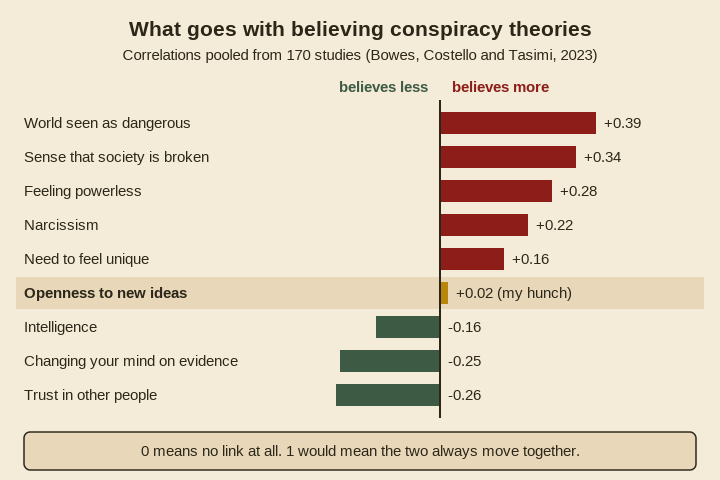 Openness, the trait my hunch rested on, is the shortest bar on the chart.
So does being smart protect you?
A little. In the same review, measured intelligence had a correlation of -0.16 with conspiracy belief, and the habit of checking a gut answer before trusting it came in at -0.17. A 2017 study by van Prooijen found that people with more education believe less, partly because they are less drawn to simple answers for complicated problems and partly because they feel less powerless.
Those are real effects and small ones. For example, picture a 12 person book club and an 800 person engineering firm. A correlation of -0.16 says the firm will have a somewhat lower share of believers. It does not say the firm will have none, and with 800 people it will have plenty.
Here is the part I did not expect. Being clever can make a belief harder to shake once you hold it. In one experiment, Kahan and colleagues showed people the same table of numbers in two costumes: once as a skin rash treatment, once as a politically charged policy. People who were good with numbers got the skin rash version right far more often. On the charged version, answers split along political lines, and the split was widest among the people best with numbers. A separate 2012 study by West, Meserve and Stanovich found that cognitive ability did nothing to help people see their own biases, and if anything the smarter subjects were a little worse at it.
Neither study was about conspiracy theories, so I am borrowing them. What they describe is the machinery. A strong mind is a good lawyer, and it works for whoever hired it.
What pulls people in?
The 2023 review lists what does go with belief, and IQ is not near the top.
| What was measured | Correlation with conspiracy belief |
|---|---|
| Believing the world is a dangerous place | 0.39 |
| Sensing that society has broken down | 0.34 |
| Feeling powerless | 0.28 |
| Narcissism | 0.22 |
| Need to feel unique | 0.16 |
| Openness to new ideas | 0.02 |
| Intelligence | -0.16 |
| Actively open-minded thinking | -0.25 |
| Trust in other people | -0.26 |
In 2017 Douglas, Sutton and Cichocka sorted the motives into three: wanting to understand, wanting to feel safe and in control, and wanting to think well of yourself and your group. A conspiracy theory offers all three at once. It explains, it names someone to blame, and it makes the believer one of the few who can see. Imhoff and Lamberty tested that last part directly. People prone to conspiracy thinking liked an invented theory more when they were told only a minority believed it.
None of that requires a slow mind. A frightened, distrustful, proud person can be very bright.
What did my hunch get right?
Something, I think. A person has to be willing to consider an odd idea before adopting one. The hunch was also right to refuse the lazy answer, which is that believers are stupid.
Suspicion has earned its place. From 1932 to 1972 the U.S. Public Health Service ran a study at Tuskegee on 600 Black men, 399 of whom had syphilis. The CDC's own history says the men were never asked for informed consent and were not offered penicillin when it became the standard treatment. It took a news story to end it. A person who distrusts institutions is not always wrong.
Belief is also not spreading the way people assume. A 2022 study in PLOS ONE tracked 46 conspiracy theories among Americans, some for half a century, and found no systematic rise.
And believers can be reached. A 2024 paper in Science reported that evidence-based conversations with an AI chatbot cut belief by about 20 percent among 2,190 believers. In June 2026 the journal attached a notice of concern after the authors reported data handling errors, and it published a correction in October. The authors say the result stands. I would hold the exact number loosely and keep the direction.
Where I land
- My hunch was wrong on the data. Openness to ideas has almost no link to conspiracy belief.
- The openness that matters, changing your mind when the evidence does, goes with believing less.
- Intelligence and education help a little. They make nobody immune, and a sharp mind defends a wrong belief well.
- What pulls people in is fear, distrust, powerlessness and the pleasure of seeing what others miss. Mocking a believer feeds all four.
So who should change what? The most work falls on institutions that want to be believed. Trust was the strongest protection in that table, and it is earned by admitting mistakes before a reporter finds them. For the rest of us, the same review found that humility goes with believing less. As a rule of thumb, I would stop asking whether I am smart enough to avoid being fooled. The better question is what evidence would change my mind, and whether I can name any.
Sources (13)
- Goreis and Voracek, "A Systematic Review and Meta-Analysis of Psychological Research on Conspiracy Beliefs", Frontiers in Psychology, 11 February 2019
- Bowes, Costello and Tasimi, "The conspiratorial mind: A meta-analytic review of motivational and personological correlates", Psychological Bulletin, 2023
- Bowes, Costello and Tasimi, "The conspiratorial mind", authors' manuscript, PsyArXiv
- Pennycook, Cheyne, Koehler and Fugelsang, "On the belief that beliefs should change according to evidence", Judgment and Decision Making, July 2020
- van Prooijen, "Why Education Predicts Decreased Belief in Conspiracy Theories", Applied Cognitive Psychology, 2017
- Kahan, Peters, Dawson and Slovic, "Motivated numeracy and enlightened self-government", Behavioural Public Policy, May 2017
- West, Meserve and Stanovich, "Cognitive sophistication does not attenuate the bias blind spot", Journal of Personality and Social Psychology, September 2012
- Douglas, Sutton and Cichocka, "The Psychology of Conspiracy Theories", Current Directions in Psychological Science, December 2017
- Imhoff and Lamberty, "Too special to be duped: Need for uniqueness motivates conspiracy beliefs", European Journal of Social Psychology, 2017
- CDC, "The Untreated Syphilis Study at Tuskegee Timeline"
- Uscinski and others, "Have beliefs in conspiracy theories increased over time?", PLOS ONE, 2022
- Costello, Pennycook and Rand, "Durably reducing conspiracy beliefs through dialogues with AI", Science, 13 September 2024
- AAAS, press notice on the Editorial Expression of Concern, 11 June 2026