Articles & BlogBy Trapper W. Brown10 min read
For anyone who runs, or works in, a small business, a clinic, a nonprofit or a town office and has been handed a cyber insurance application. This article describes what official sources say about these policies, read on 15 November 2026. It is not insurance advice and it names no insurer.
Cyber insurance is a kind of business insurance. The National Association of Insurance Commissioners (NAIC), the body through which state insurance regulators work together, describes it as coverage designed to help an organization respond to certain technology and data losses. In plain terms: if criminals lock your files, steal your customer list, or knock your systems offline, a cyber policy may pay some of the bills.
There are two reasons to understand it even if you never buy one. First, the application is a security questionnaire, and its questions show what insurers think prevents losses. Second, what the policy leaves out is as important as what it covers. The site's article "How Insurance Works" explains premiums, deductibles, limits and underwriting in general. This one covers what is particular to cyber.
 A National Guard network defense team at a 2015 exercise: an insurer's questionnaire asks, in effect, how much of this work an applicant does. Photo by Staff Sgt. George Davis, Ohio National Guard, public domain, via Wikimedia Commons.
Why does cyber need its own policy?
Because the policies a business already has usually do not cover it. A fact sheet the Environmental Protection Agency (EPA) wrote for water utilities in October 2024, with the Cybersecurity and Infrastructure Security Agency (CISA) and others, puts it this way: "Standard general liability policies typically have limited coverage for cyber incidents", and "In general, if cyber coverage is not explicitly included in your policy language, it is excluded."
Cyber coverage is sold in two forms. A stand-alone policy is its own contract. An endorsement is an add-on to another business policy. The NAIC says an endorsement often gives narrower protection or lower limits than a stand-alone policy. Its report on 2025 shows how common endorsements are: nearly two-thirds of the cyber policies in force were endorsements, yet they brought in about 4% of the premium.
Most of this market serves organizations. North Carolina's Department of Insurance says most cyber liability insurance is designed for businesses and government agencies, and that individuals may instead be interested in identity fraud coverage.
What does first-party coverage pay for?
"First party" means you, the policyholder. The Federal Trade Commission (FTC), in guidance for small businesses that it credits the NAIC with helping to develop, says first-party coverage "typically includes your business's costs related to":
- legal counsel to determine your notification and regulatory obligations
- recovery and replacement of lost or stolen data
- customer notification and call center services
- lost income due to business interruption
- crisis management and public relations
- cyber extortion and fraud
- forensic services to investigate the breach
- fees, fines, and penalties related to the cyber incident
The EPA fact sheet adds that a policy may also cover revenue lost when a company you depend on is interrupted.
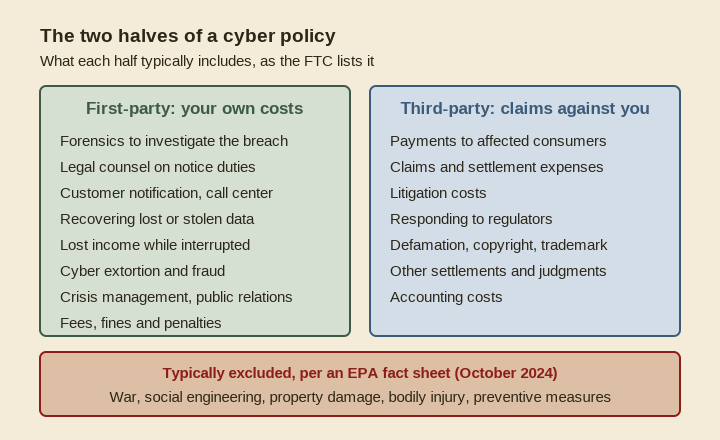 First-party coverage pays your own bills, third-party coverage answers other people's claims, and a third list sits outside both.
What does third-party coverage pay for?
"Third party" means someone else: a customer whose data was exposed, a business partner, a regulator. The FTC says third-party coverage "generally protects you from liability if a third party brings claims against you" and typically includes:
- payments to consumers affected by the breach
- claims and settlement expenses relating to disputes or lawsuits
- losses related to defamation and copyright or trademark infringement
- costs for litigation and responding to regulatory inquiries
- other settlements, damages, and judgments
- accounting costs
The FTC also tells readers to consider whether the insurer will defend them in a lawsuit or regulatory investigation, and gives the phrase to look for: "duty to defend."
Here is how the halves divide in practice. The numbers are invented for illustration. A dental office with six employees is hit by ransomware, software that locks files until a ransom is paid. It spends $40,000 on forensic investigators, $25,000 restoring data, $15,000 notifying patients, and loses $60,000 of income while closed. Those four bills, $140,000 in all, are first-party costs. Six months later some patients sue. The legal defense and any settlement are third-party costs.
A parts distributor with 300 employees has the same kinds of bills at a larger scale. On large accounts, the NAIC report says, fewer claims occurred in 2025 but the average cost of each rose sharply.
What is commonly left out?
The EPA fact sheet says cyber insurance "will typically not cover losses associated with or incidents derived from":
| Listed exclusion | The fact sheet's note |
|---|---|
| Social engineering | "may be excluded and/or it may be an optional add-on" |
| Property damage | Example given: a cyber event causing physical damage to a building |
| Value of intellectual property | None |
| War | None |
| Cost for proactive preventive measures | Examples given: training staff, setting up a virtual private network |
| Bodily injury | None |
| Upgrades and improvements | None |
| Loss due to the outage of public utilities you rely on | Example given: the local power company |
Social engineering means tricking a person, for example with a fake invoice or a fake message from the boss, into sending money or giving up a password. The NAIC says the same thing in its own words: social engineering and funds transfer fraud may be excluded, limited by a sublimit, or handled under a separate crime policy. A sublimit is a smaller cap inside the policy for one kind of loss.
A second invented example shows why that matters. Suppose the dental office's policy has a $1,000,000 limit and a $100,000 sublimit for funds transfer fraud. A bookkeeper is fooled into wiring $250,000 to a criminal. If the policy covers the loss at all, the sublimit caps the payment at $100,000, less any deductible, however large the main limit is.
On ransomware, the NAIC says it may be covered, subject to the policy's terms and exclusions. Two government positions sit beside that. The EPA fact sheet says "The U.S. government strongly discourages the payment of ransoms." New York's Department of Financial Services, the state's insurance regulator, told insurers in a 2021 circular letter that it "recommends against making ransom payments." The site's article "Should Paying a Ransomware Ransom Be Illegal?" sets out that argument.
The war exclusion deserves a sentence of its own. The NAIC report says war exclusions have been widely applied in cyber policies since 2023, that triggering one usually means proving a link between an attack and a state-backed attacker, and that the wording differs from one insurer to the next.
What does the application ask?
Underwriting is the insurer's process of deciding whether to offer a policy and at what price. For cyber, it works through a questionnaire about your security. The EPA fact sheet says these questionnaires "are not harmonized across the industry, but insurers typically inquire about" a list that begins with multifactor authentication, security awareness training and data backups.
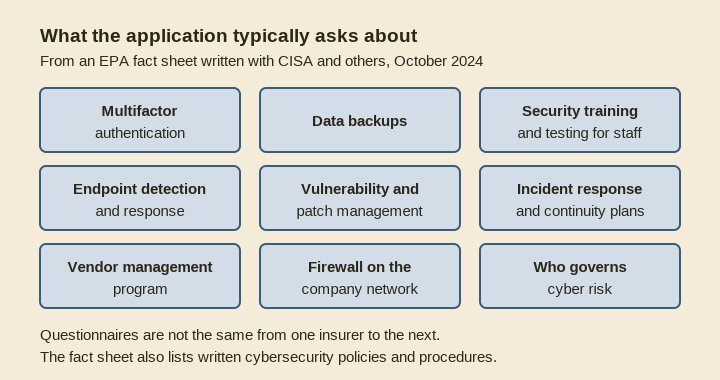 The questionnaire is a list of the controls insurers connect with fewer and smaller claims.
Multifactor authentication is the first item. CISA describes it as providing "a combination of two or more authenticators to verify your identity", such as a password plus a code from your phone. The site's article "Passwords, Passkeys and MFA: Identity Done Right" covers how it works, and "Backups That Work: The 3-2-1 Rule" covers the third item.
The State of Indiana publishes a toolkit with sample questions it calls typical of a cyber insurance application. In paraphrase, they include:
- Does the applicant require multifactor authentication for cloud services, for administrator accounts, and for web-based email?
- Does it apply critical and high-level security patches within 30 days of release?
- Does it use any software its maker has retired, and if so, is that software kept apart from the rest of the network?
- Does it run endpoint detection and response on all its computers?
- Does it hold regular security awareness training?
The question about retired software is the subject of the site's article "Running End-of-Life Software Is Driving Without Insurance".
Regulators expect insurers to ask. New York's 2021 letter tells insurers to gather information on each applicant's governance, vulnerability management, access controls, encryption, endpoint monitoring, incident response planning and vendor security. It also says insurers should price policies on how effective each applicant's security program is. The EPA fact sheet lists what moves a premium: "your cyber controls, risk profile, claims history, coverages, limits, and deductible", along with the general level of cyber threats.
What happens when there is an incident?
The EPA fact sheet's answer to "What do we do if we are breached?" is short: "Contact your insurance company immediately, as they may have a preferred list of vendors you can use under the policy." It adds that the insurer's contact information belongs in your incident response plan. Among the things the FTC tells small businesses to consider is whether the insurer offers a breach hotline that is available every day of the year at all times.
Timing is a policy term. The NAIC's list of questions a business should ask before buying includes how quickly an incident must be reported and what security practices the policy requires. New York's letter says cyber policies should require victims to notify law enforcement.
For the first hour itself, see the site's articles "Ransomware: What It Is and What to Do in the First Hour" and "The First Hour: The Incident Response Lifecycle".
How big is the market, and who watches it?
The NAIC's report on the 2025 reporting year gives the U.S. numbers:
- Total direct written premium of about $9.46 billion, up 3.5% from 2024. Of that, insurers based in the United States wrote $7.46 billion and non-U.S. insurers wrote about $2.0 billion.
- 5.84 million domestic policies in force, up 33%.
- 56,323 reported claims, up 20%.
- A loss ratio of 53 in 2025, up from 48.7 in 2024. A loss ratio is, roughly, claim costs as a percentage of premium.
| 2020 | $2.75B |
|---|---|
| 2025 | $7.46B |
Source: NAIC, Report on the Cybersecurity Insurance Market, 2025 reporting year
Insurance in the United States is regulated by the states. The NAIC says state regulators oversee insurers' financial strength, review rates and policy language, and protect policyholders, and that the NAIC itself supports that work without being a regulator. Your state's insurance department is the place to take a question or a complaint about a policy or an insurer.
The NAIC also answers the question in this article's first paragraph directly. Asked whether having cyber insurance means an organization is protected from attacks, it says no: insurance can help an organization recover financially from certain covered events, and it cannot prevent an attack.
What to remember
- First-party coverage pays your own costs after an incident. Third-party coverage answers claims that others bring against you. The FTC lists what each typically includes.
- An EPA fact sheet written with CISA lists typical exclusions: social engineering, property damage, the value of intellectual property, war, preventive measures and bodily injury.
- The NAIC says social engineering and funds transfer fraud may be excluded, capped by a sublimit, or left to a separate crime policy.
- Applications typically ask about multifactor authentication, backups, training, endpoint detection, patching, and response plans.
- The NAIC counted about $9.46 billion in U.S. cyber premium, 5.84 million domestic policies and 56,323 claims for 2025.
- Policies differ. The policy's own wording decides what is covered, and your state insurance department regulates the companies that sell it.
A practical exercise that costs nothing: read the Indiana sample questions and answer them for your own organization. Whatever you decide about insurance, the list of questions you could not answer "yes" to is a work plan.
Sources (9)
- FTC, "Cyber Insurance" (Cybersecurity for Small Business), read 15 November 2026
- NAIC, "2026 Report on the Cybersecurity Insurance Market" (resource page with questions and answers), read 15 November 2026
- NAIC, "Report on the Cybersecurity Insurance Market, 2025 Reporting Year", 2026
- NAIC, "NAIC Report Finds Cyber Insurance Market Has Nearly Tripled Since 2020 as Cyber Risk Grows", 21 October 2026
- EPA, "Cyber Insurance for Drinking Water and Wastewater Systems" (EPA-810-F-24-031), October 2024
- New York State Department of Financial Services, "Insurance Circular Letter No. 2 (2021): Cyber Insurance Risk Framework", 4 February 2021
- North Carolina Department of Insurance, "Consider cyber insurance to protect against hackers", 24 September 2025
- State of Indiana, Indiana Cybersecurity Hub, "Cyber Insurance Underwriting", read 15 November 2026
- CISA, "More than a Password" (multifactor authentication), read 15 November 2026