
Loading
Warhawk Division is a gaming community. This is a unit document, not a government or military publication.Warhawk Division is an independent gaming community, for entertainment purposes only. It is not affiliated with, sponsored by, or endorsed by Bohemia Interactive, the United States Department of Defense, or any military organization. Arma Reforger is a trademark of its respective owner. Printed from warhawkdivision.com.
Week 1 content
0 of 13 done
Slide 1 of 14
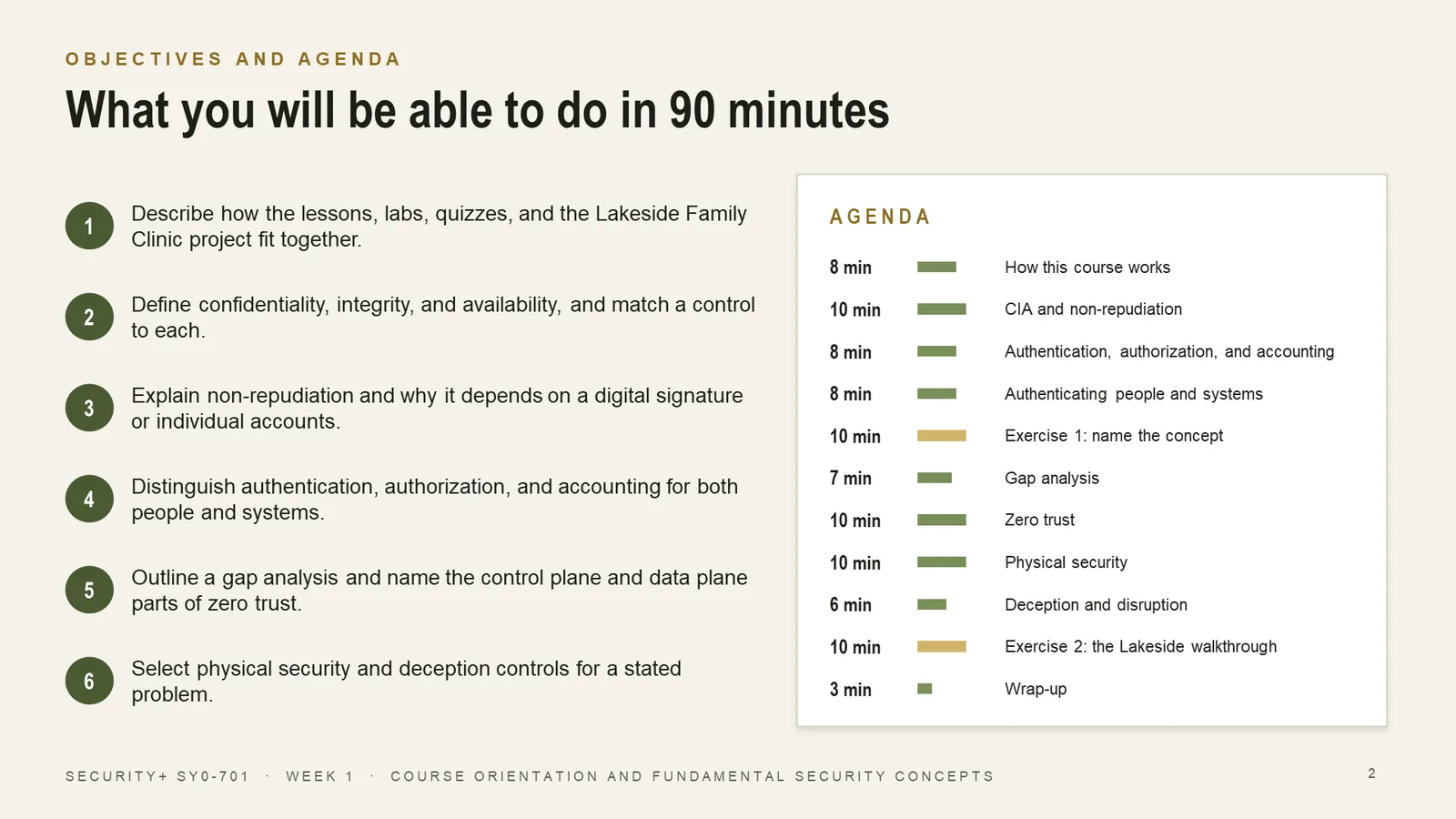
Exam objectives: 1.2 Summarize fundamental security concepts.
8 min
This course prepares you for the CompTIA Security+ SY0-701 exam and, more to the point, for an entry-level security job. The exam has five domains, and we work through them in order: general security concepts, threats and vulnerabilities, security architecture, security operations, and program management and oversight. Each week covers one or two exam objectives.
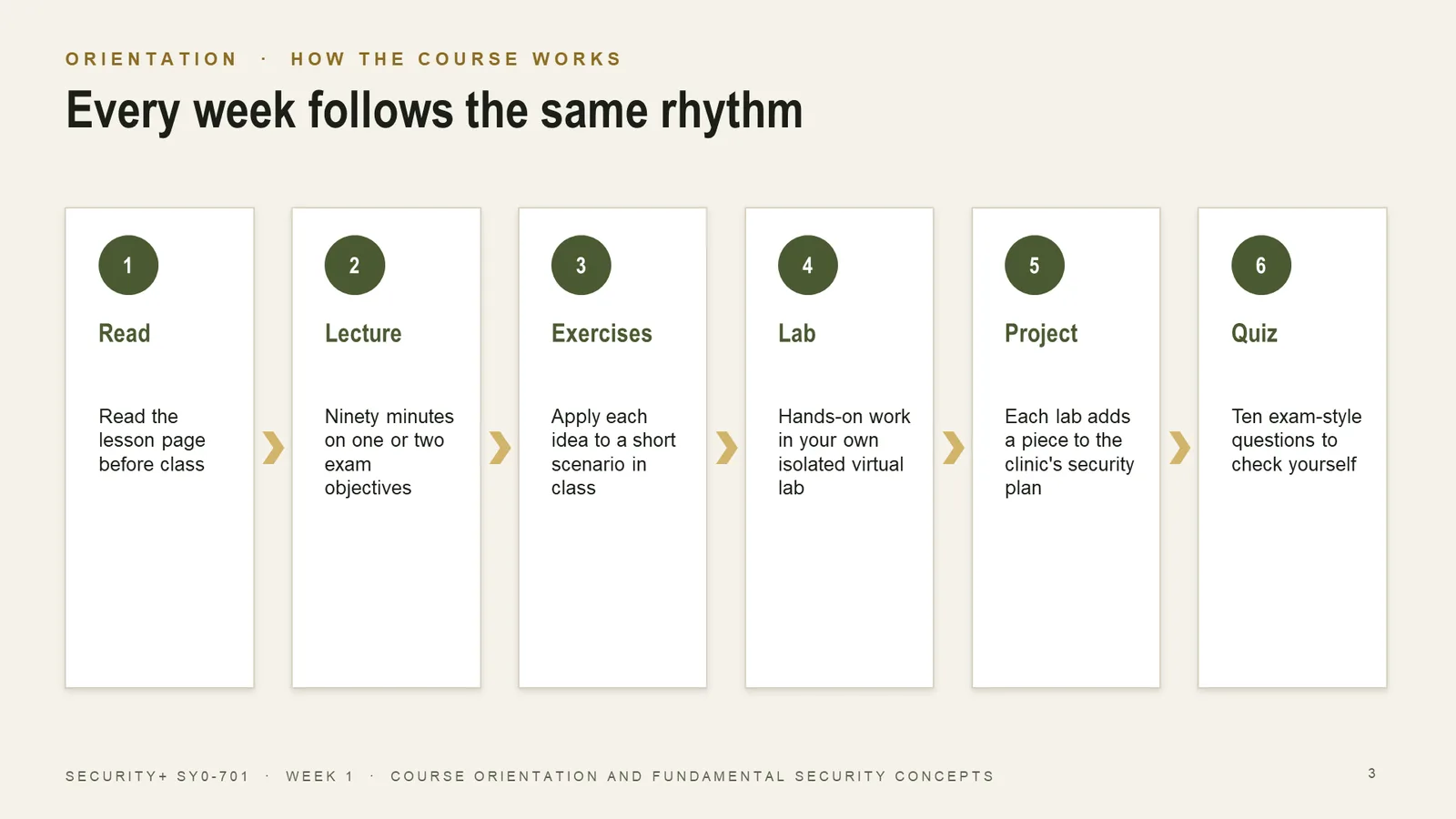
Every week follows the same rhythm:
The project. Lakeside Family Clinic is a fictional 25-person clinic: two doctors, nurses, a front desk, and a billing office. It keeps patient records on staff laptops, takes card payments, shares one administrator account, and relies on a part-time IT contractor. Starting next week you act as its security consultant. You build a risk register, recommend controls, run a business impact analysis, and in week 16 you brief the clinic's leaders in ten minutes, in plain language.
Tip
Keep one folder for the whole course with your lab notes and screenshots. The final report and briefing draw on all of it.
Lab rules. Scan, capture traffic, crack passwords, or run exploits only on machines you own inside your lab. Doing it against a network you do not have written permission to test, including the campus network or an employer's, can break the law, such as the Computer Fraud and Abuse Act in the United States.
10 min
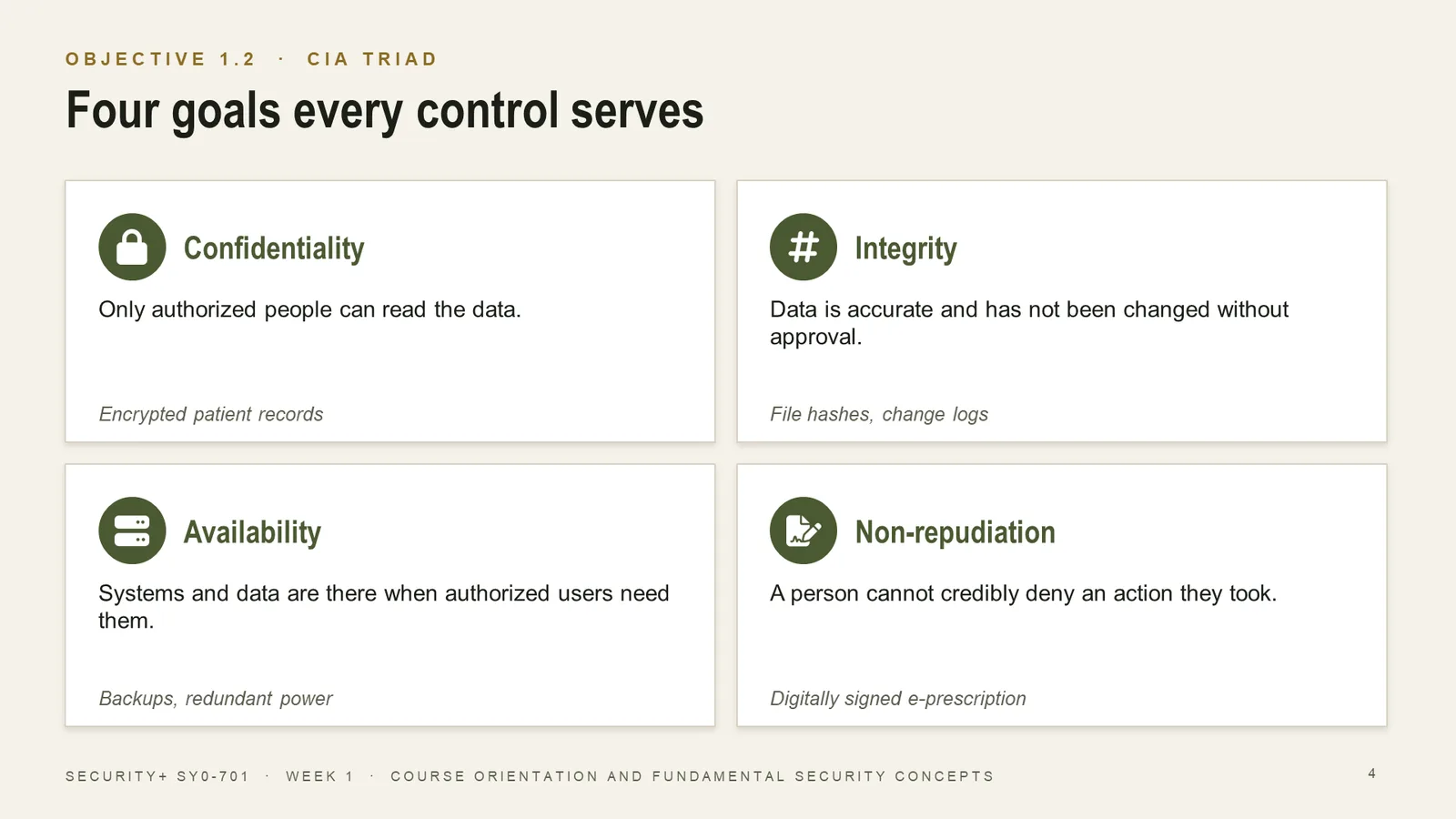
The CIA triad names the three goals security protects.
The goals pull against each other. Locking a file down tightly helps confidentiality and can hurt availability. A clinic will accept a slightly slower login to keep charts private, but it will not accept an EHR that is down during appointments. Good design balances the three for the business.
Non-repudiation means a person cannot credibly deny an action they took, such as sending a message or approving a payment. It needs two kinds of proof: who acted, and that the content has not changed since. A digital signature gives both. Only the holder of the private key could have made it, and any change to the signed data breaks it. Detailed logs tied to individual accounts support non-repudiation too, which is one more reason never to share accounts.
Watch out
Encryption alone does not give non-repudiation. If two people share a symmetric key, either one could have produced the message. Non-repudiation needs something only one party holds, which is why it relies on a private key.
8 min
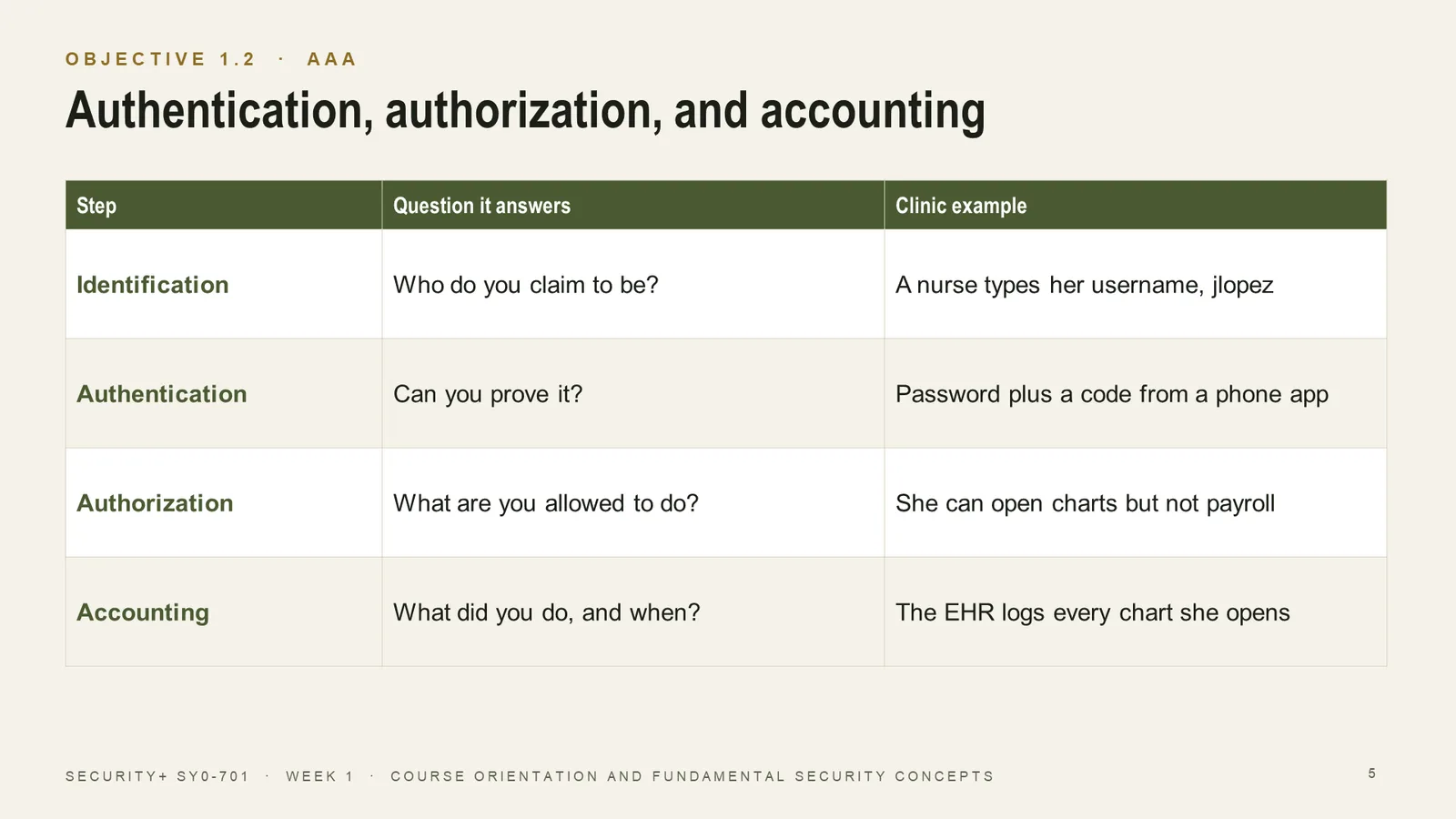
AAA stands for authentication, authorization, and accounting. It is how a system decides who someone is, what they can do, and what they did. It begins with identification, which is only a claim of identity, such as typing a username.
The order matters. You cannot authorize someone you have not authenticated, and accounting only proves anything if each account belongs to one person. A shared front desk login breaks accounting: the log shows that someone at the front desk opened a chart, not who.
In a network, a central AAA server often does all three. A Wi-Fi access point or VPN gateway passes the login to a RADIUS or TACACS+ server, which checks the credentials, returns what the user may reach, and logs the session. You will see both protocols again later in the course.
Tip
On the exam, questions about logging, audit trails, or tracking usage point to accounting. Questions about permissions, rights, or privileges point to authorization. A question about proving identity points to authentication.
8 min
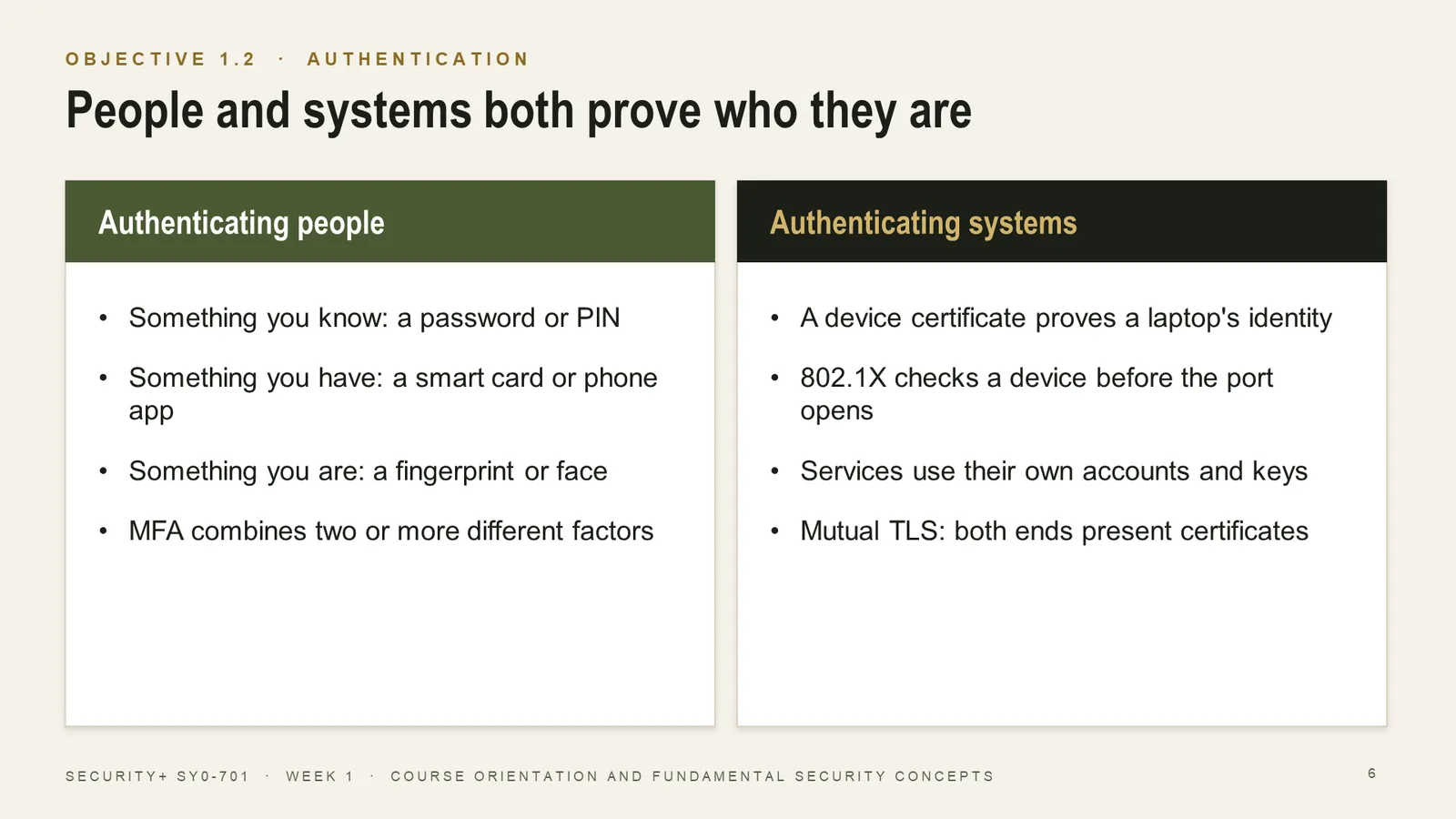
Authenticating people relies on factors:
Multifactor authentication (MFA) combines factors from different categories. A password and a PIN are two things you know, so together they are not MFA. A password plus an app code is.
Authenticating systems matters as much, because devices and services talk to each other with no person typing anything. A clinic laptop can present a device certificate before the VPN lets it in. A switch using 802.1X keeps a port closed until the device proves its identity. A backup service logs in to the file server with its own service account and key, not the shared admin password. When both ends check each other's certificate, as in mutual TLS, it is called mutual authentication.
Authorization models decide access once identity is proven. Week 13 covers them in depth; for now, know the names:
| Model | Who decides access | Example |
|---|---|---|
| Discretionary (DAC) | The owner of the resource | A user shares a folder with a coworker |
| Mandatory (MAC) | The system, by labels and clearances | Government classified data |
| Role-based (RBAC) | Permissions attach to job roles | The billing role can open billing reports |
| Rule-based | System-wide rules | No logins outside clinic hours |
| Attribute-based (ABAC) | Attributes of user, resource, and context | A doctor on a clinic device opens her own patients' charts |
Every model should apply least privilege: give each identity only the access its job needs.
10 min
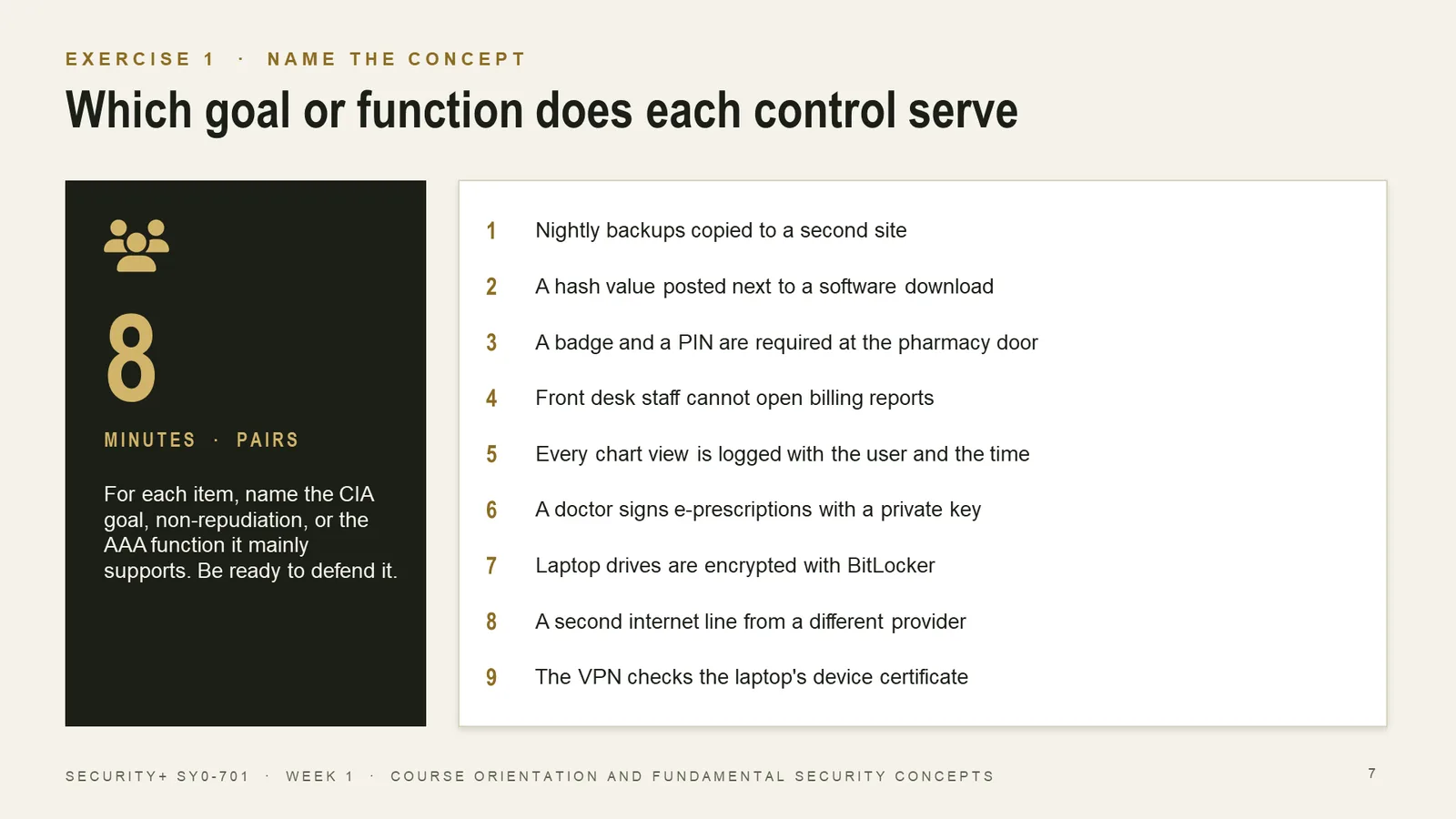
Work with a partner for eight minutes. For each control below, name the CIA goal, non-repudiation, or the AAA function it mainly supports. Some items support more than one; name the main one first and be ready to defend it.
Write your answers down before you open the worked answers.
7 min
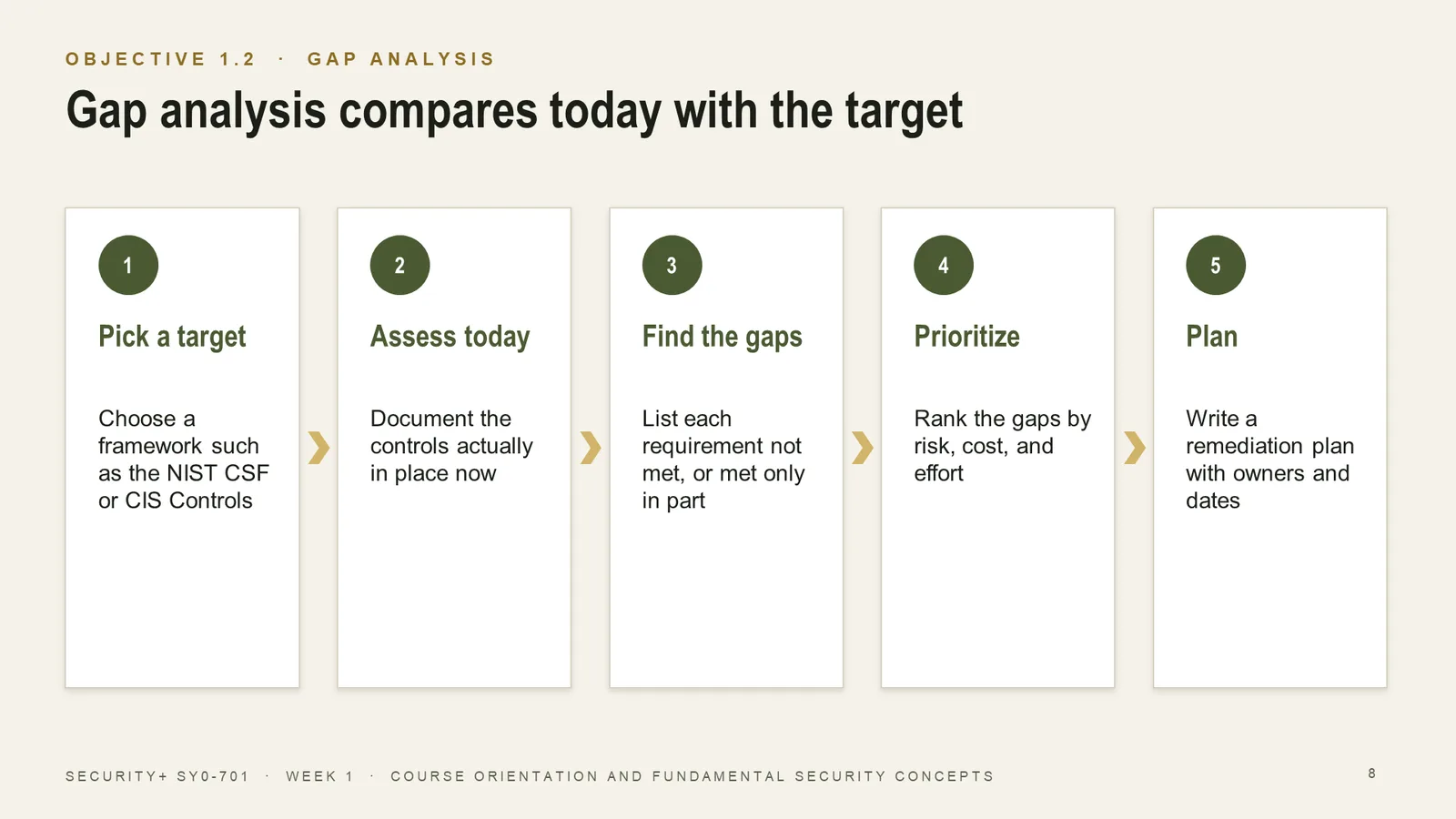
A gap analysis compares the security you have today with the security you want, and lists the difference. It needs a target first. That target is usually a recognized framework or requirement set: the NIST Cybersecurity Framework (CSF) 2.0, the CIS Critical Security Controls, ISO/IEC 27001, or a regulation such as the HIPAA Security Rule for a clinic.
The steps:
At Lakeside, the first CIS Control asks for an inventory of enterprise assets. The clinic has no list of its laptops at all, so that is a full gap. Remote access uses a password only, so a requirement for MFA on remote access is not met. Backups exist but have never been tested, so that one is partly met.
Watch out
Do not confuse three similar activities. A gap analysis measures you against a standard. A vulnerability scan finds technical weaknesses in systems. A risk assessment weighs likelihood and impact. A question that mentions a framework or a desired state is usually about a gap analysis.
10 min
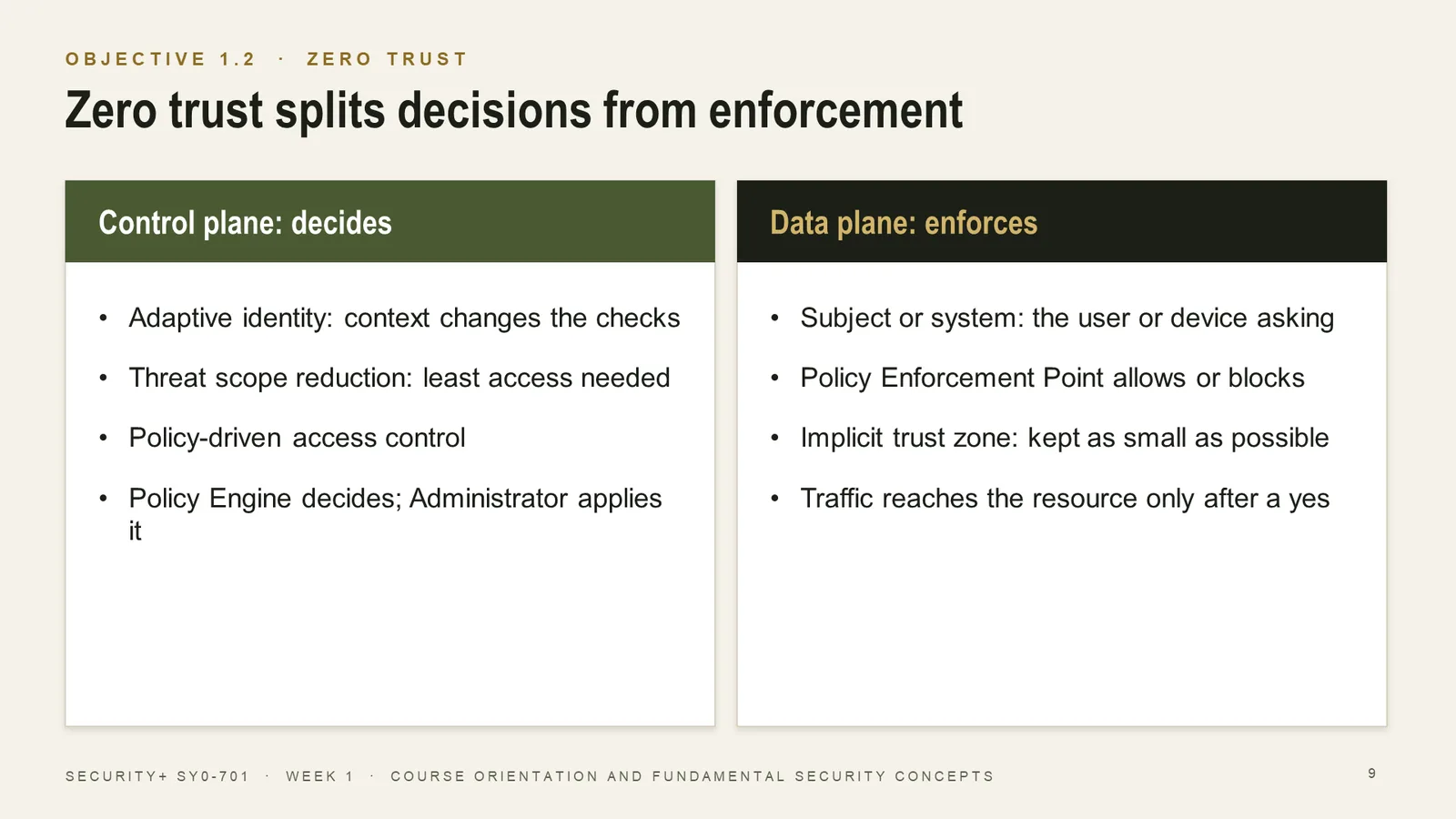
Older networks trusted anything inside the firewall. Zero trust removes that assumption: no user or device is trusted because of where it sits on the network, and every request is checked. NIST SP 800-207 describes the model, and the exam uses its terms.
Control plane: the part that makes decisions.
Data plane: the part that carries traffic and enforces.
Example. A doctor opens the EHR from a personal tablet at 11 p.m. The PEP passes the request to the Policy Engine. Policy says personal devices get read-only access after MFA, so the Administrator sets up a read-only session and the PEP enforces it.
10 min
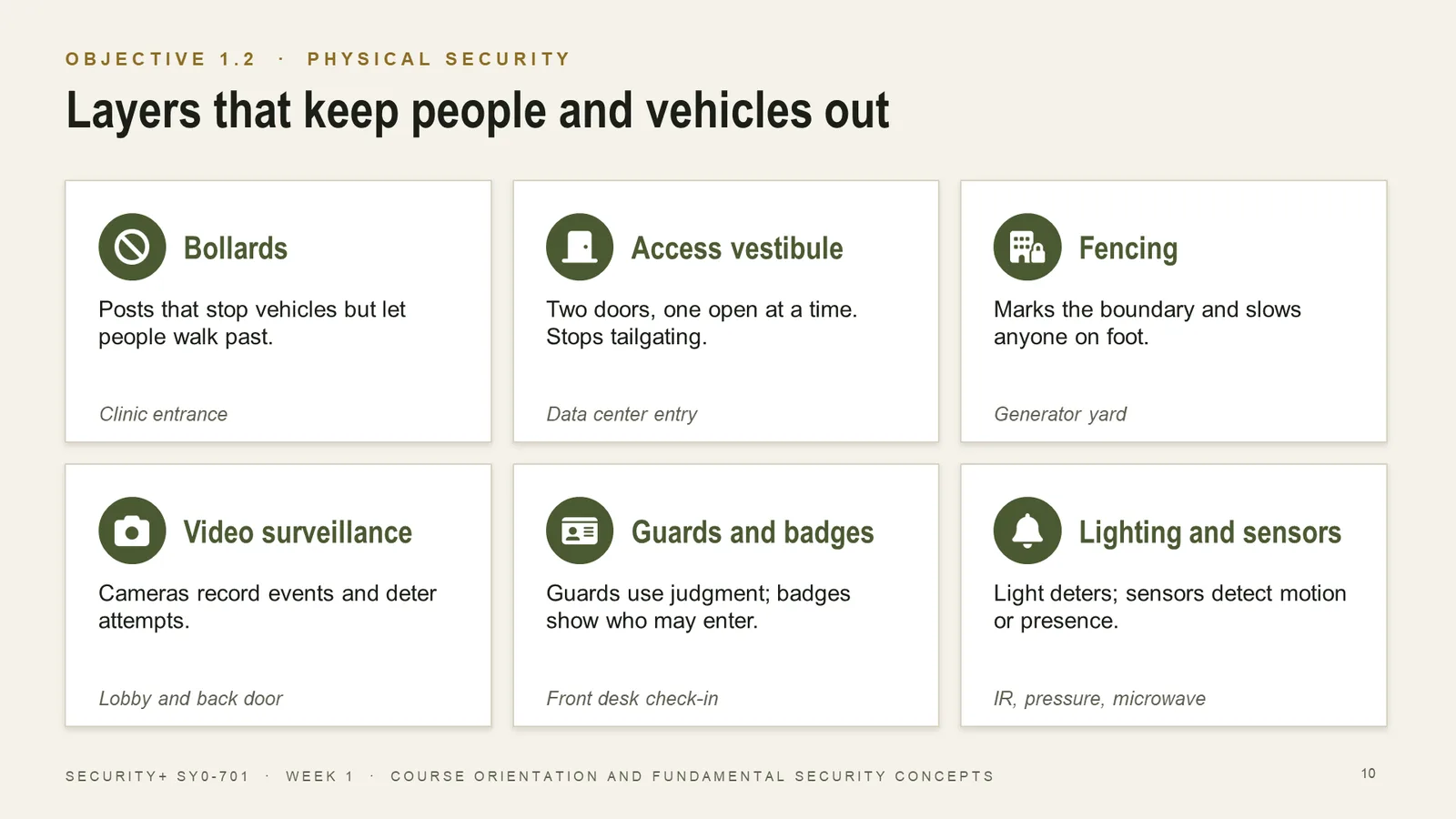
Every digital control fails if someone can walk out with the server. Physical controls work in layers, from the property line to the server closet.
Sensors detect presence or movement:
| Sensor | How it detects |
|---|---|
| Infrared | Heat given off by a body |
| Pressure | Weight on a floor mat or surface |
| Microwave | Changes in reflected radio waves; covers a wide area |
| Ultrasonic | Changes in reflected high-frequency sound |
Tip
Classify these like any control. A bollard is physical and preventive. A camera is physical, detective, and deterrent. Lighting is physical and mostly deterrent.
6 min
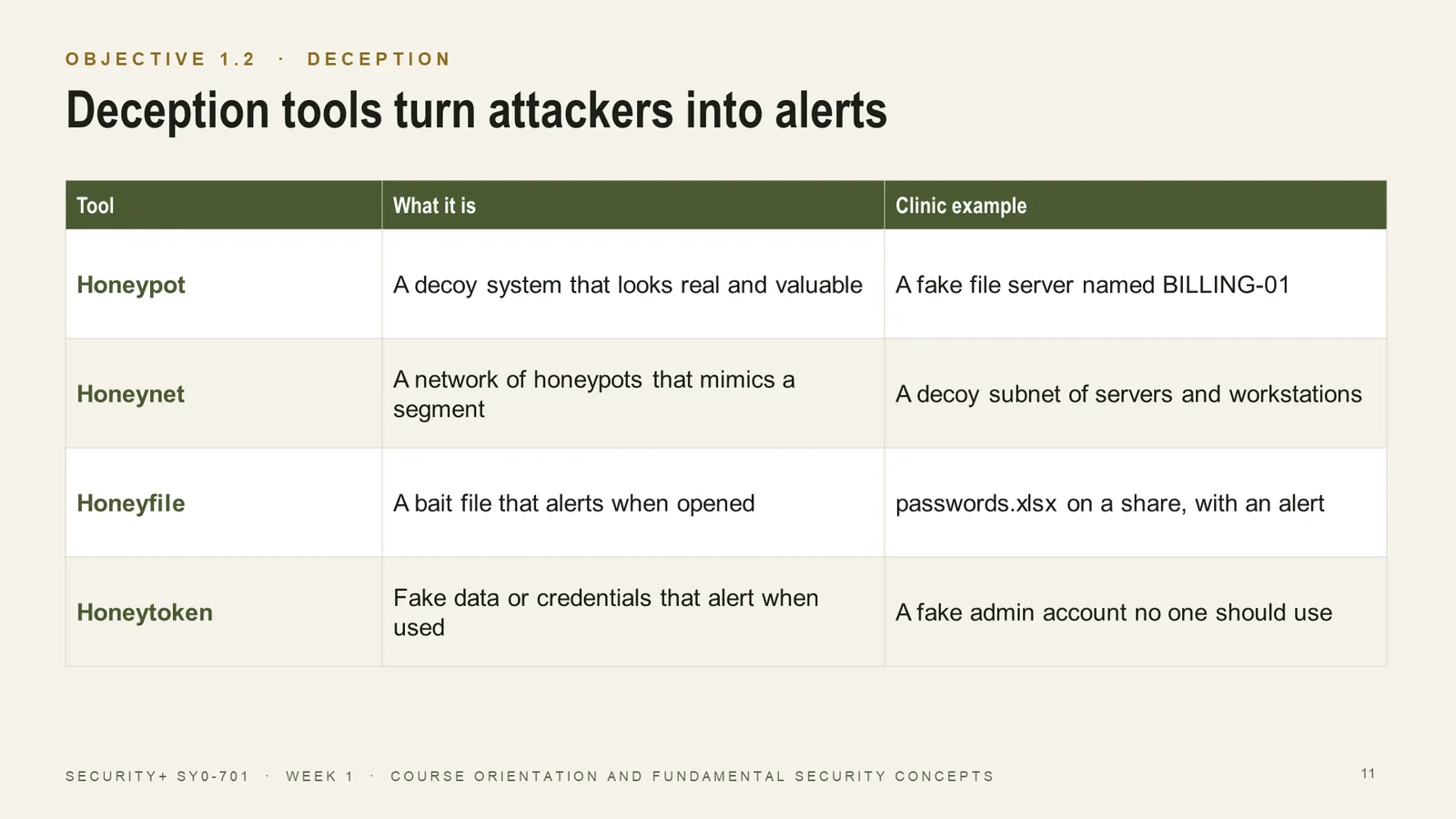
Deception controls are decoys. No legitimate user has a reason to touch one, so any touch is a strong signal that someone is exploring where they should not. They also waste an attacker's time and show defenders which techniques the attacker uses.
Two practical cautions. Isolate honeypots and honeynets so an attacker cannot use them as a stepping stone into the real network. And make the alert go somewhere that someone watches, or the decoy does nothing.
Tip
Size is the exam clue. One system is a honeypot. Several systems together are a honeynet. A single file is a honeyfile. A single piece of data or a credential is a honeytoken.
10 min
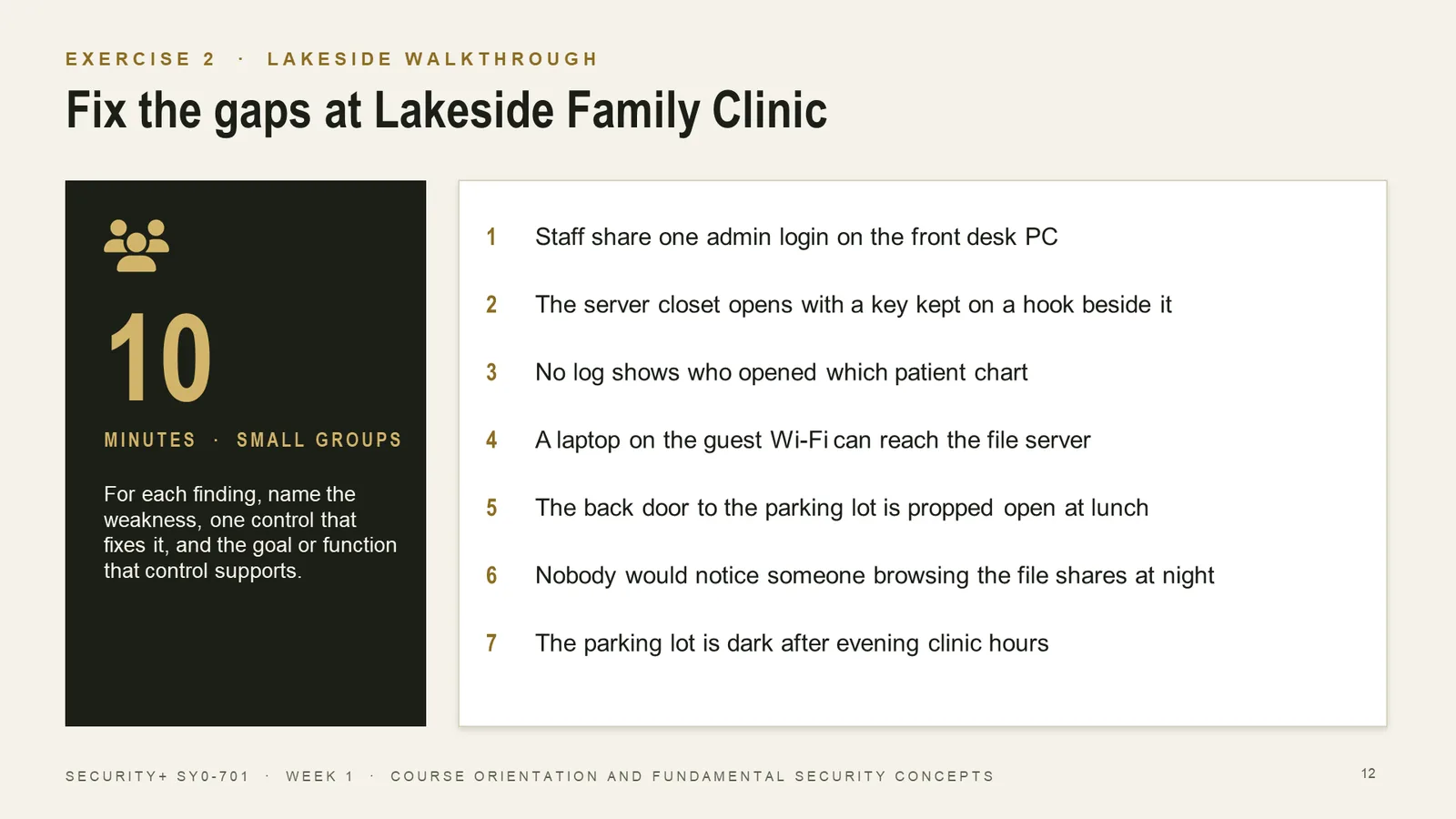
A walk through Lakeside Family Clinic turned up seven findings. In a small group, take ten minutes. For each finding, name the weakness, one specific control that fixes it, and the goal or function (confidentiality, integrity, availability, non-repudiation, authentication, authorization, or accounting) that control supports.
Write your answers before opening the worked answers. More than one fix can be right; what matters is a specific control and a clear reason.
3 min
This week set the vocabulary for the rest of the course.
Before next week, look back at the clinic findings from Exercise 2. Next week you put a dollar value on risks like these and start the clinic's risk register.
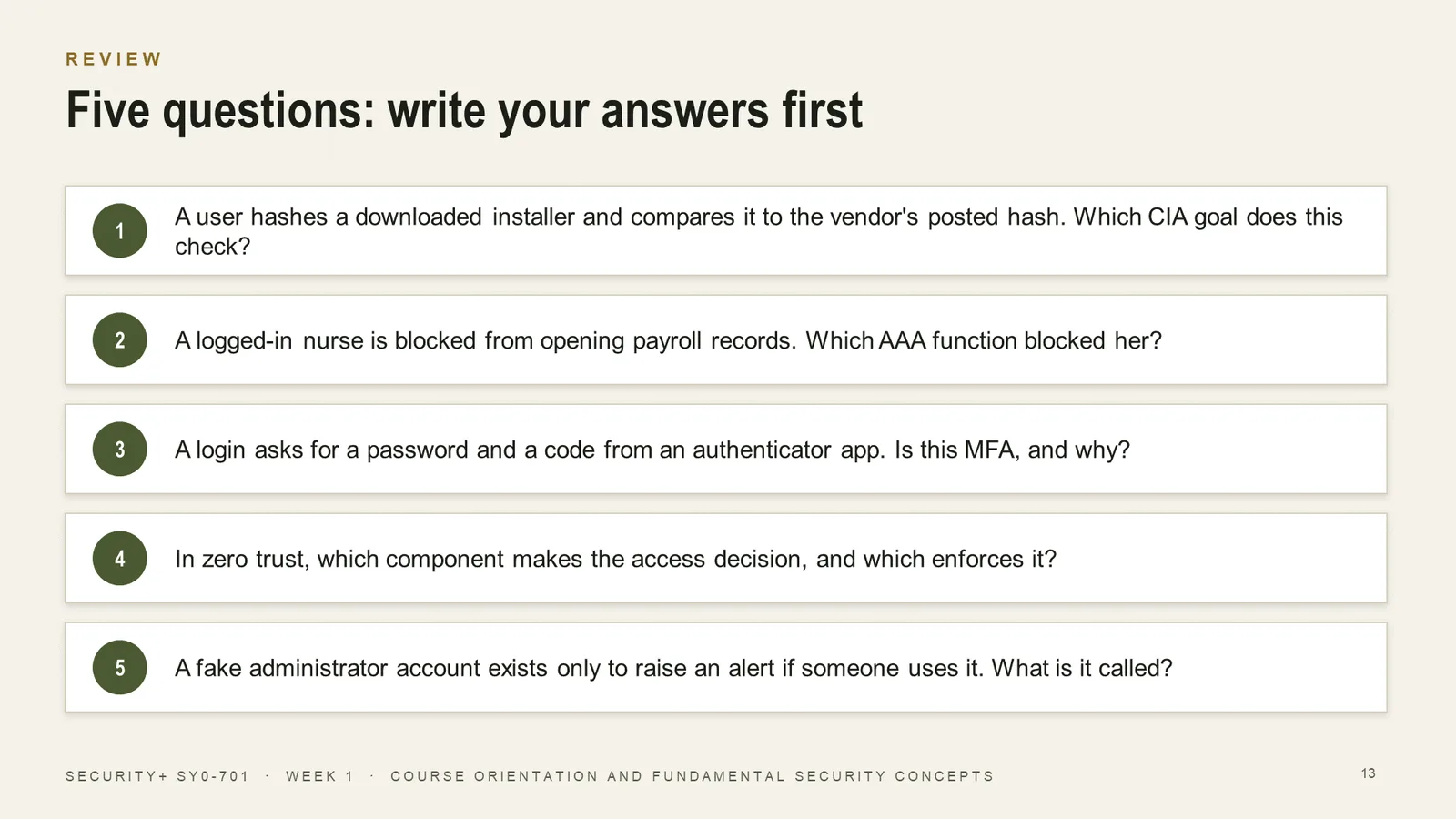
Write your answers to the five review questions first, then open each one to check it.
Integrity. A matching hash shows the file was not altered.
Authorization. She was already authenticated; the system limited what she may do.
Yes. The password is something you know and the app code is something you have, two different factor categories.
The Policy Engine makes the decision (with the Policy Administrator carrying it out). The Policy Enforcement Point on the data plane enforces it.
A honeytoken: a piece of fake data or a credential, not a whole system.
60 min
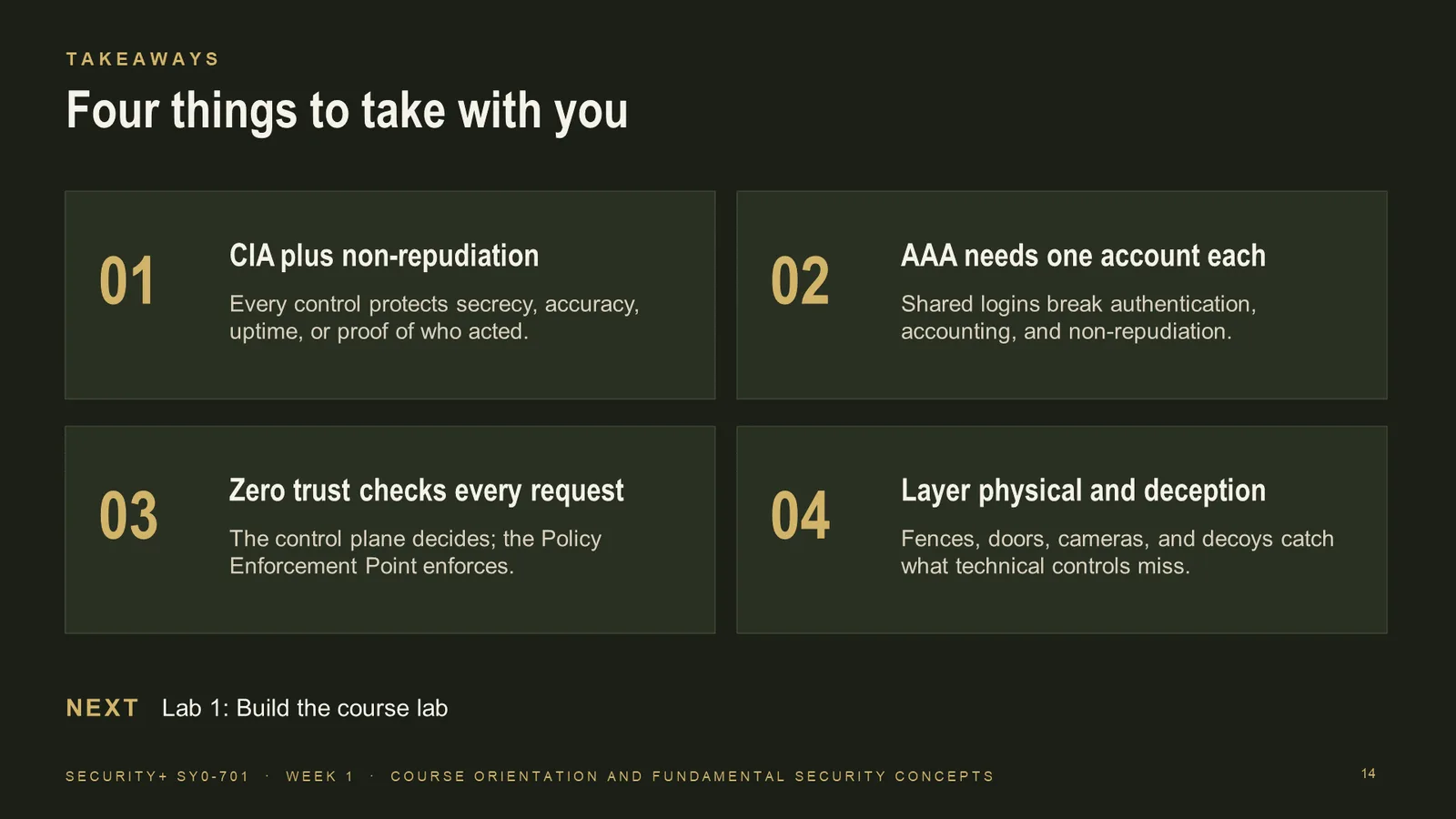
01 CIA plus non-repudiation
Every control protects secrecy, accuracy, uptime, or proof of who acted.
02 AAA needs one account each
Shared logins break authentication, accounting, and non-repudiation.
03 Zero trust checks every request
The control plane decides; the Policy Enforcement Point enforces.
04 Layer physical and deception
Fences, doors, cameras, and decoys catch what technical controls miss.
You need a computer with at least 16 GB of RAM (8 GB works if you run one VM at a time; for the ping test in step 7, which needs both running, lower each VM to 3 GB first), 100 GB of free disk space, and hardware virtualization turned on, plus Oracle VirtualBox, which is free. Both VMs go on a host-only network so nothing you run in later labs can reach the campus network or the internet.
Lab steps · 0 of 9 complete (0%)
A one-page lab report with your lab inventory table and four screenshots: the host-only network settings, a successful ping between the VMs, a failed ping to 8.8.8.8, and the snapshot list for each VM.