
Loading
Warhawk Division is a gaming community. This is a unit document, not a government or military publication.Warhawk Division is an independent gaming community, for entertainment purposes only. It is not affiliated with, sponsored by, or endorsed by Bohemia Interactive, the United States Department of Defense, or any military organization. Arma Reforger is a trademark of its respective owner. Printed from warhawkdivision.com.
Week 3 content
0 of 13 done
Slide 1 of 14
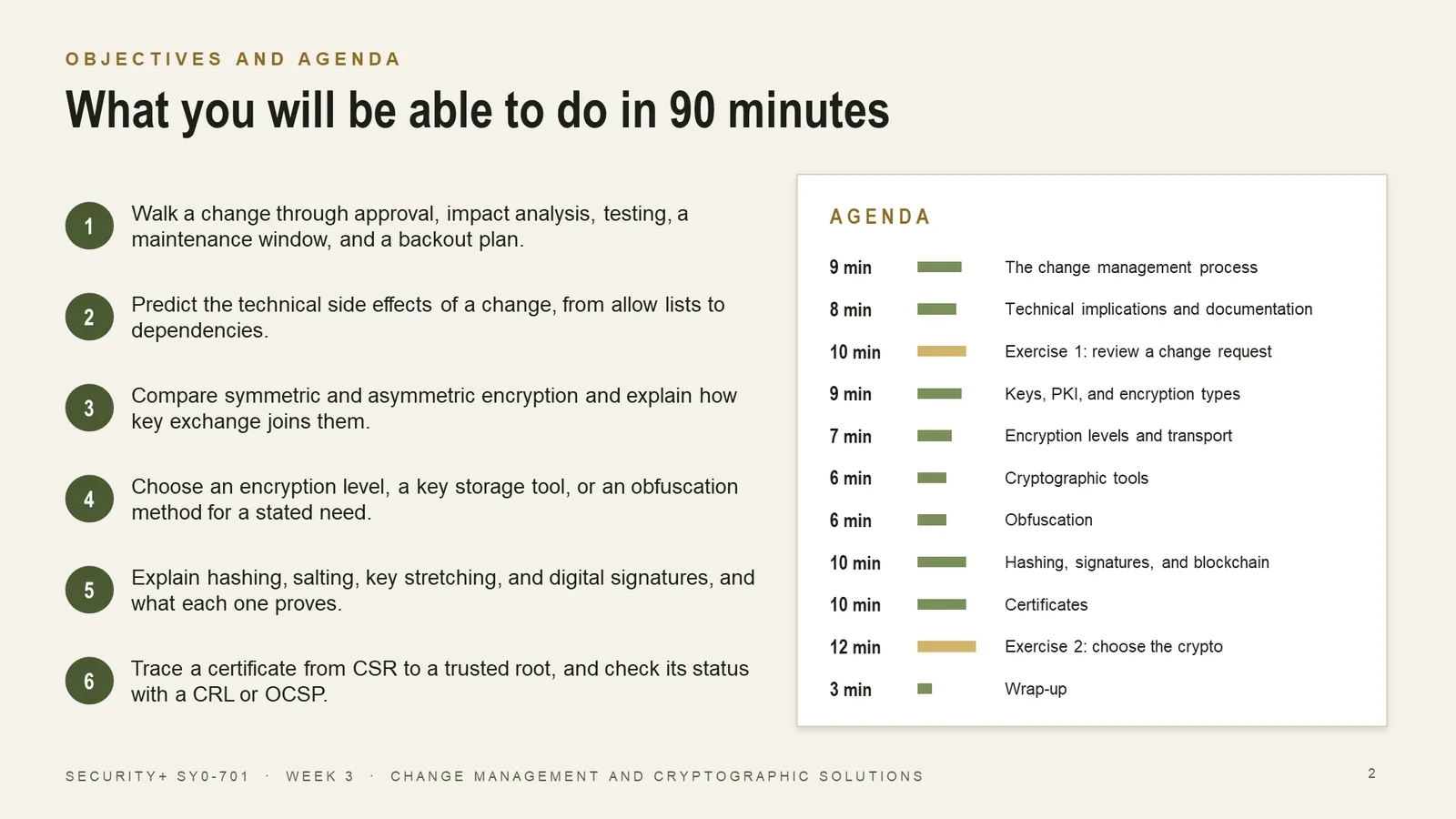
Exam objectives: 1.3 Explain the importance of change management processes and the impact to security. 1.4 Explain the importance of using appropriate cryptographic solutions.
9 min
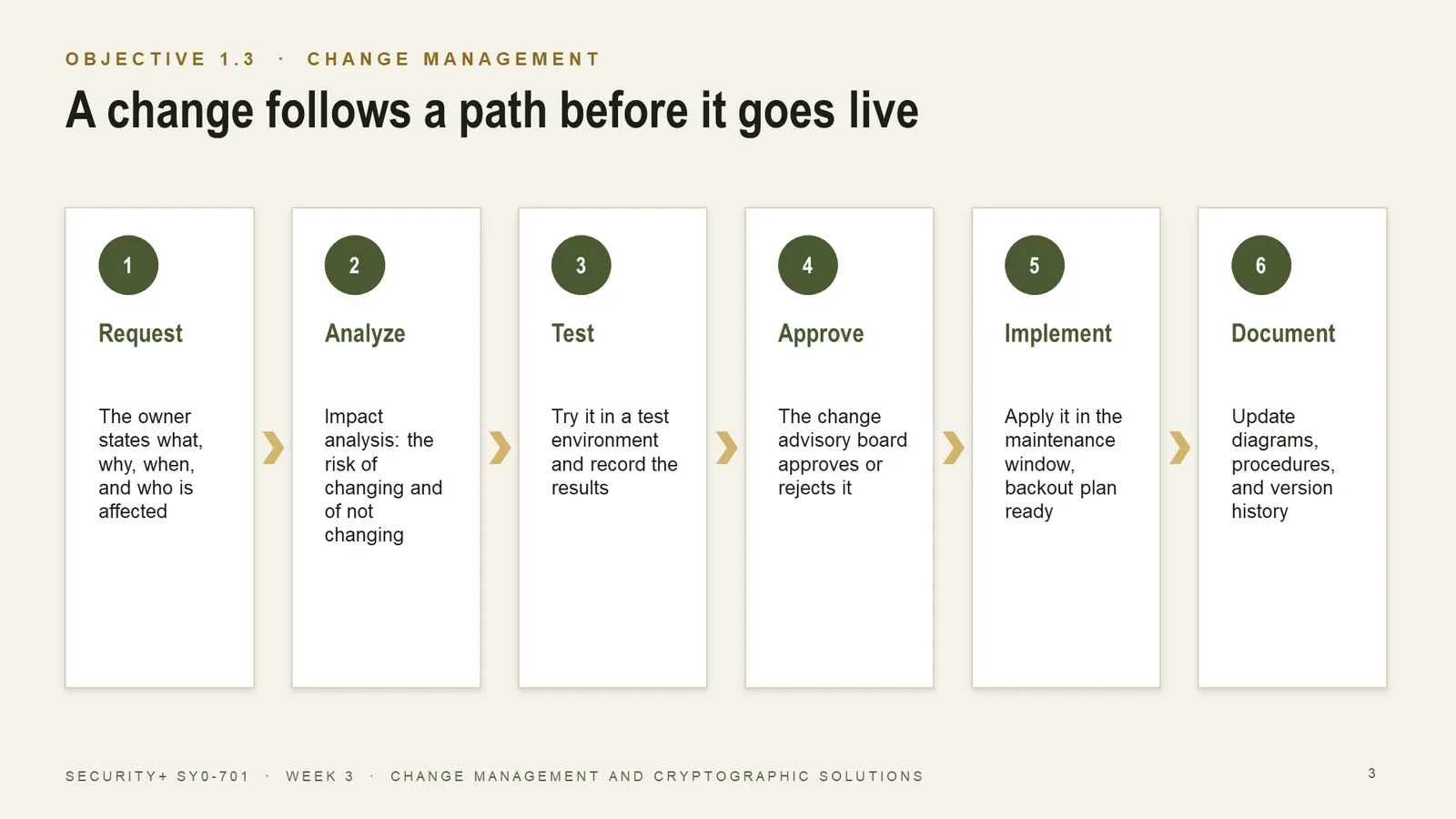
Most outages are not attacks. They are changes: a patch, a new firewall rule, an upgrade that went wrong. Change management is the process that makes changes deliberate, reviewed, and reversible. It matters for security because an unplanned change can open a hole, break a control, or take down the very system you were protecting.
The business processes the exam names:
Watch out
An emergency change still goes through change management. The paperwork may come right after the fix instead of before, but it is still reviewed and documented.
8 min
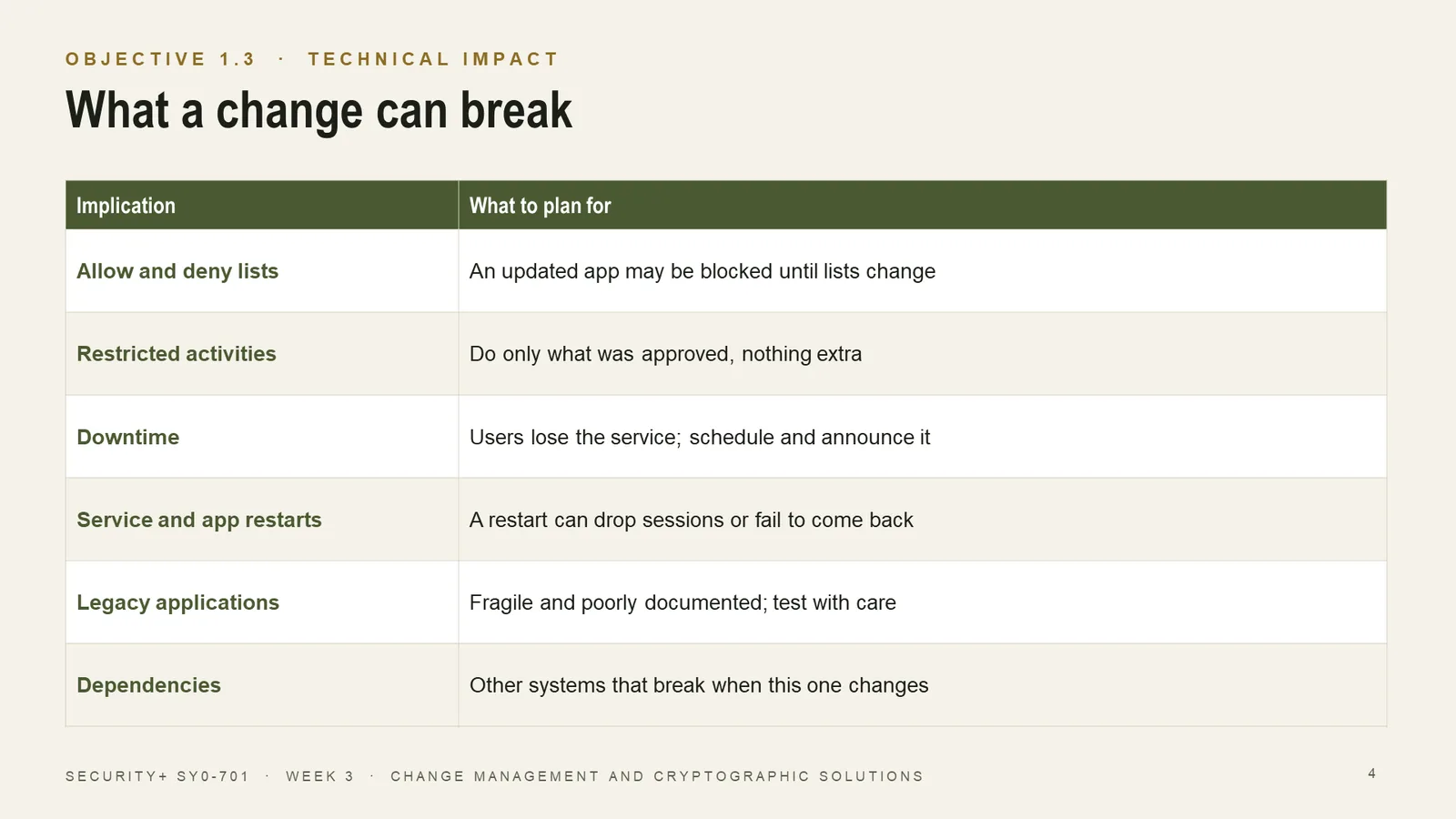
A change can work exactly as intended and still break something else. Plan for these technical implications:
Documentation keeps the record matching reality. After a change, update the network diagrams and update the policies and procedures that describe the system. An out-of-date diagram misleads the next person, including an incident responder at 3 a.m.
Version control tracks every change to code, scripts, configuration files, and documents: who changed what, when, and why. Tools such as Git let you compare versions and roll back to a known-good one, which makes a backout plan easier to carry out.
10 min
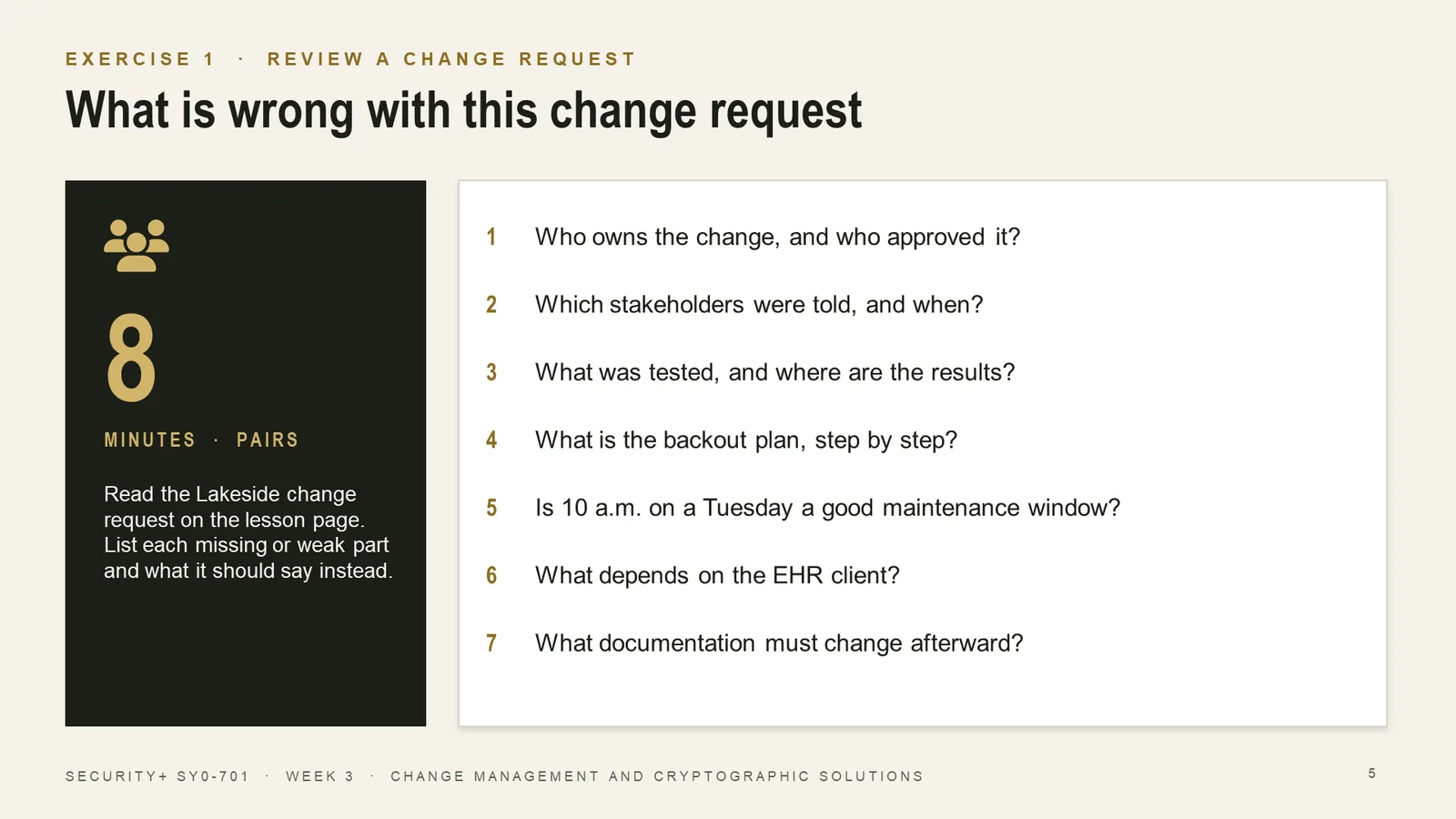
The IT contractor at Lakeside Family Clinic submitted this change request. Work with a partner for eight minutes and list every part that is missing or weak, and what it should say instead.
| Field | Entry |
|---|---|
| Change | Upgrade the EHR client on all 20 workstations to version 9 |
| Requested by | IT contractor |
| Reason | Vendor says version 8 support ends next month |
| When | Tuesday, 10 a.m. |
| Approved by | (blank) |
| Testing | "Vendor says it works" |
| Backout plan | "Reinstall if broken" |
| Users notified | No |
Write your list before opening the answers.
9 min
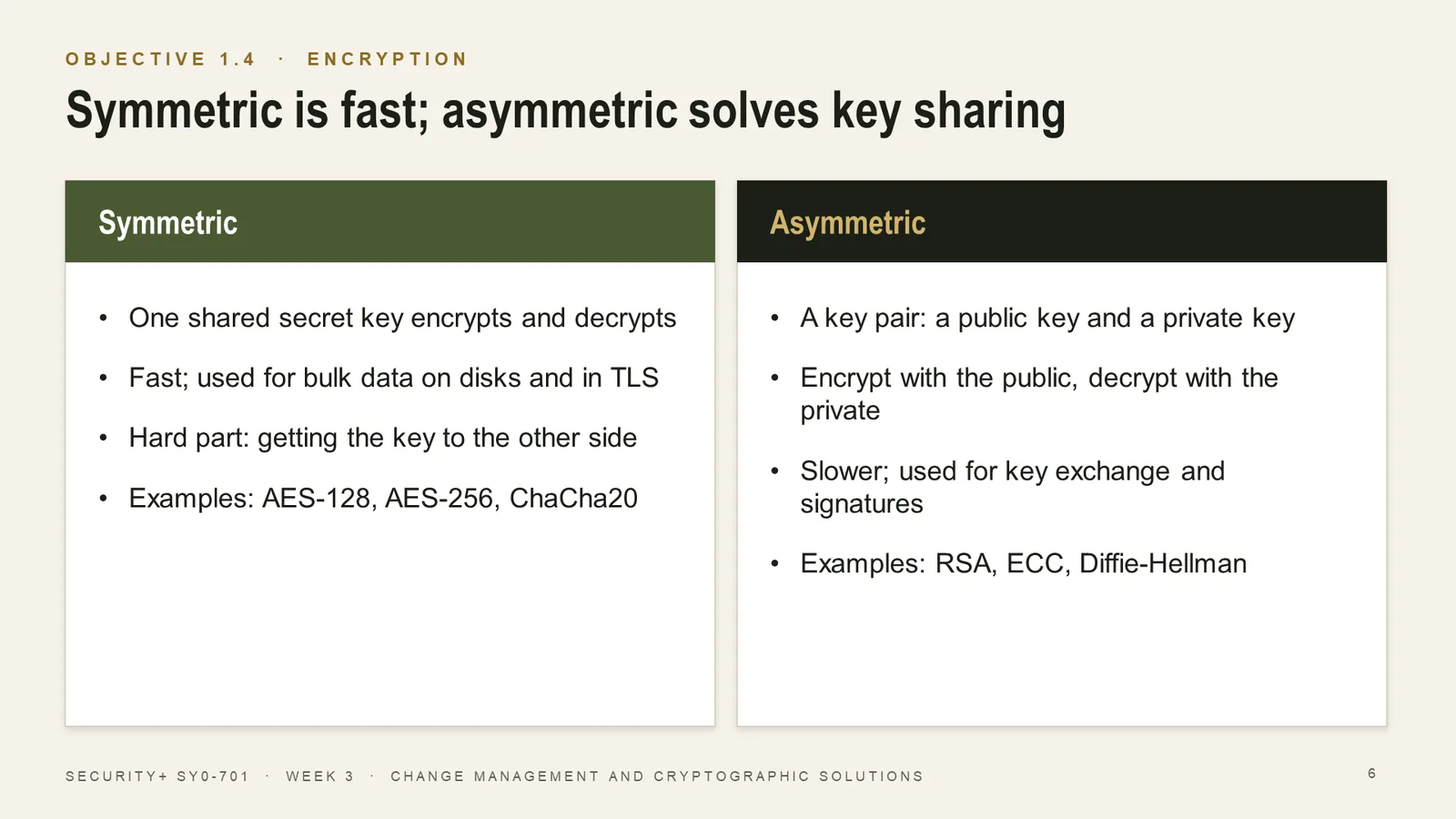
Symmetric encryption uses one shared secret key to encrypt and decrypt. It is fast, so it protects bulk data: disks, databases, and the data inside a TLS session. AES is the standard algorithm. Its weakness is key distribution: both sides need the same key without anyone else getting it.
Asymmetric encryption uses a key pair. The public key can be shared with anyone. The private key is kept secret by its owner. Data encrypted with someone's public key can only be decrypted with their private key. It is much slower, so it is used for small jobs: exchanging keys and making digital signatures. RSA and elliptic curve cryptography (ECC) are the common algorithms.
Key exchange joins the two. In a TLS session, the browser and server use an asymmetric method, usually Diffie-Hellman (often its elliptic curve form, ECDHE), to agree on a shared symmetric key without ever sending it. Then AES or ChaCha20 encrypts the actual traffic.
Algorithms and key length. A longer key means more possible keys and more work for an attacker. AES-256 is stronger than AES-128. Asymmetric keys must be much longer for the same strength: a 256-bit ECC key is about as strong as a 3072-bit RSA key, which is why ECC suits phones and smart cards.
Public key infrastructure (PKI) is the system of certificate authorities, certificates, policies, and procedures that ties public keys to identities, so you know whose public key you are using.
Key escrow means a trusted party keeps a copy of a key so data can be recovered. A clinic that stores each laptop's BitLocker recovery key in its directory service can still unlock the drive after an employee leaves.
Tip
To keep something secret, encrypt with the recipient's public key. To sign, use the sender's private key.
7 min
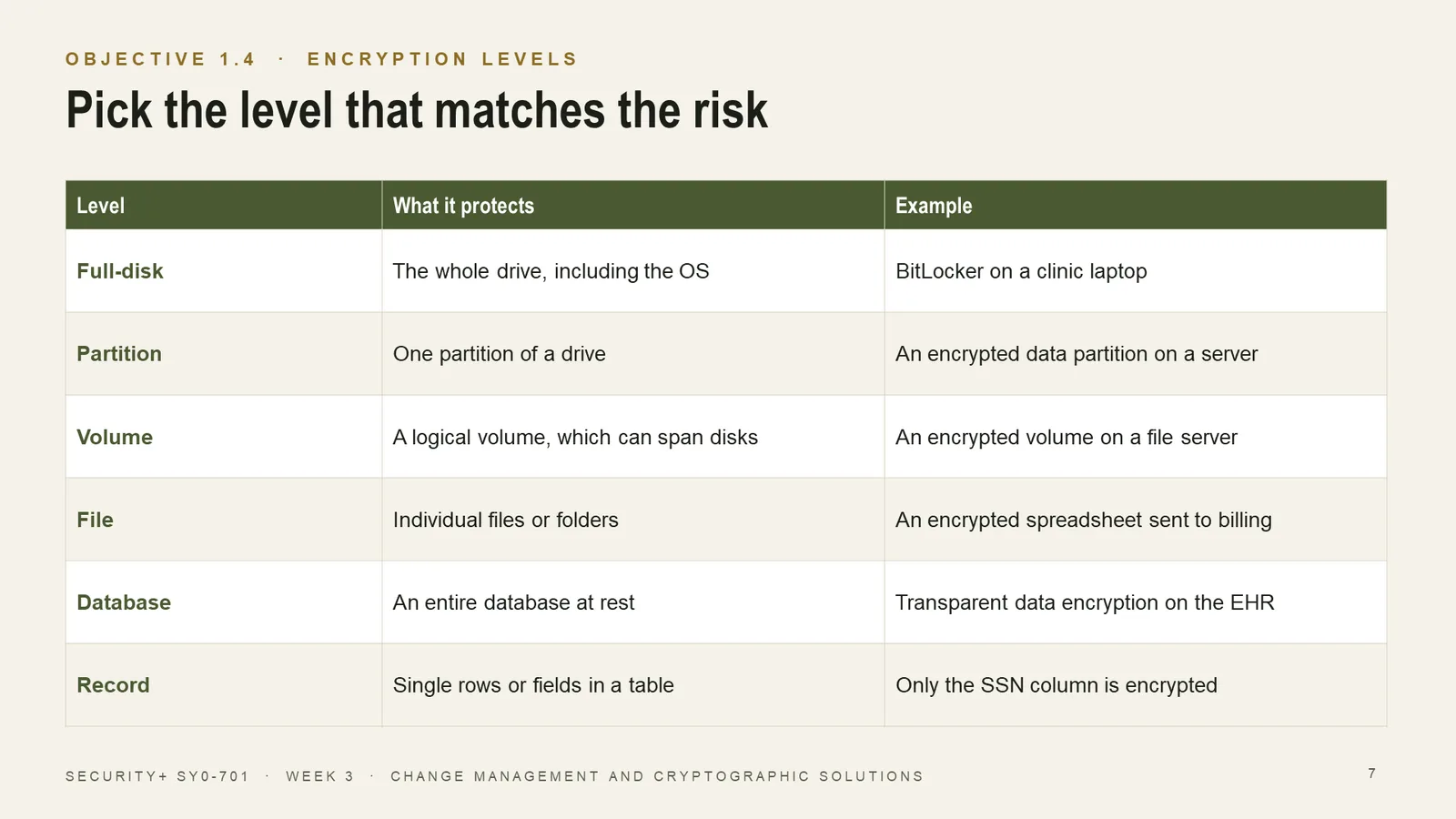
Encryption can be applied at different levels. The right level depends on the threat.
All of these protect data at rest. Transport or communication encryption protects data in transit: TLS for web traffic and email between servers, SSH for remote administration, and IPsec or TLS VPNs for whole network connections.
Watch out
FDE does not protect data on a running, logged-in machine. If the question describes malware or an insider on a running system, full-disk encryption is not the answer.
6 min
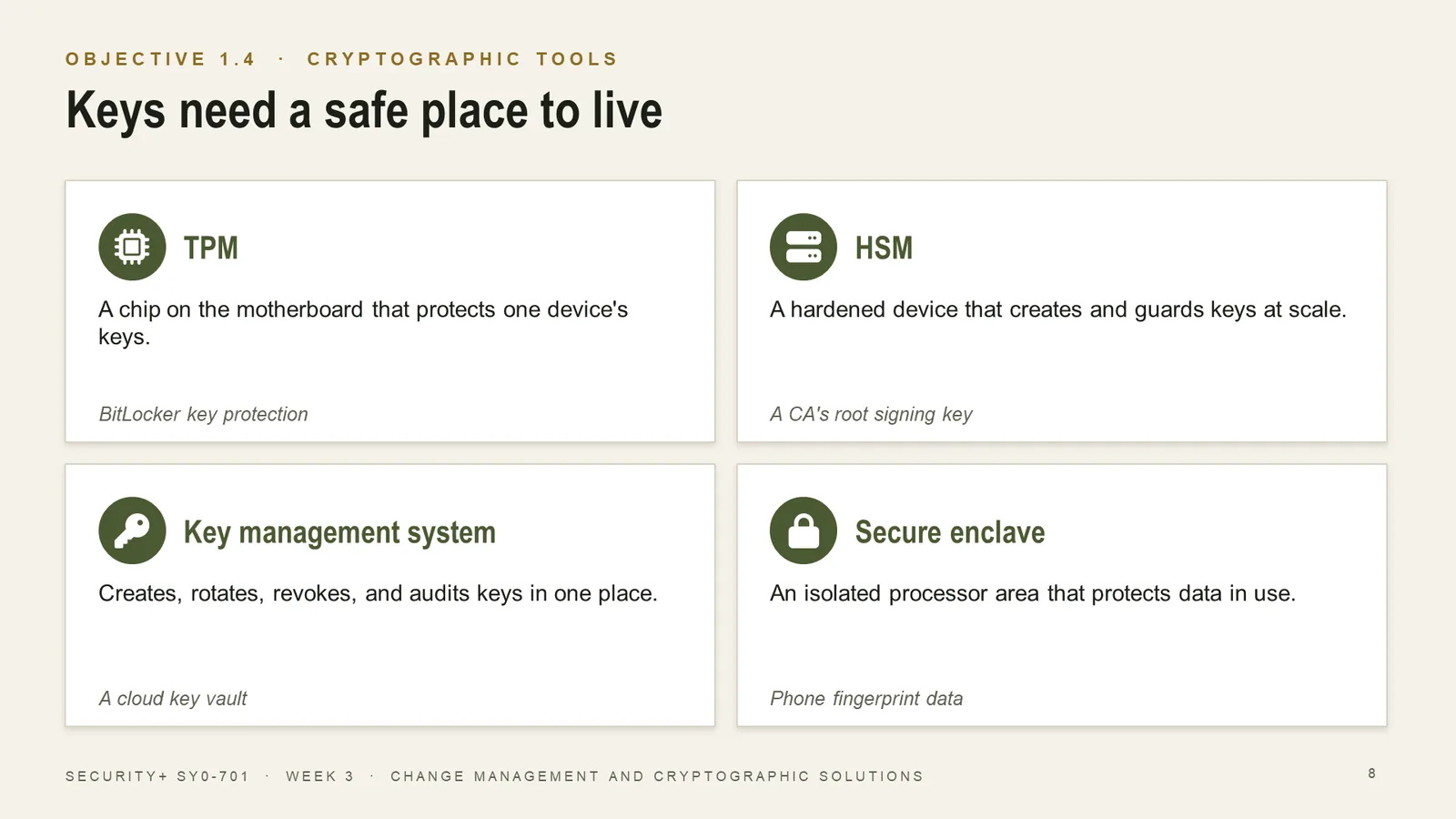
Encryption is only as strong as the protection on its keys. If the key sits in a text file next to the data, the encryption adds little. Four tools keep keys safe.
Tip
Scope is the exam clue. One device: TPM. Many systems or high-volume signing: HSM. Lifecycle and policy: KMS. Protecting data in use inside the processor: secure enclave.
6 min
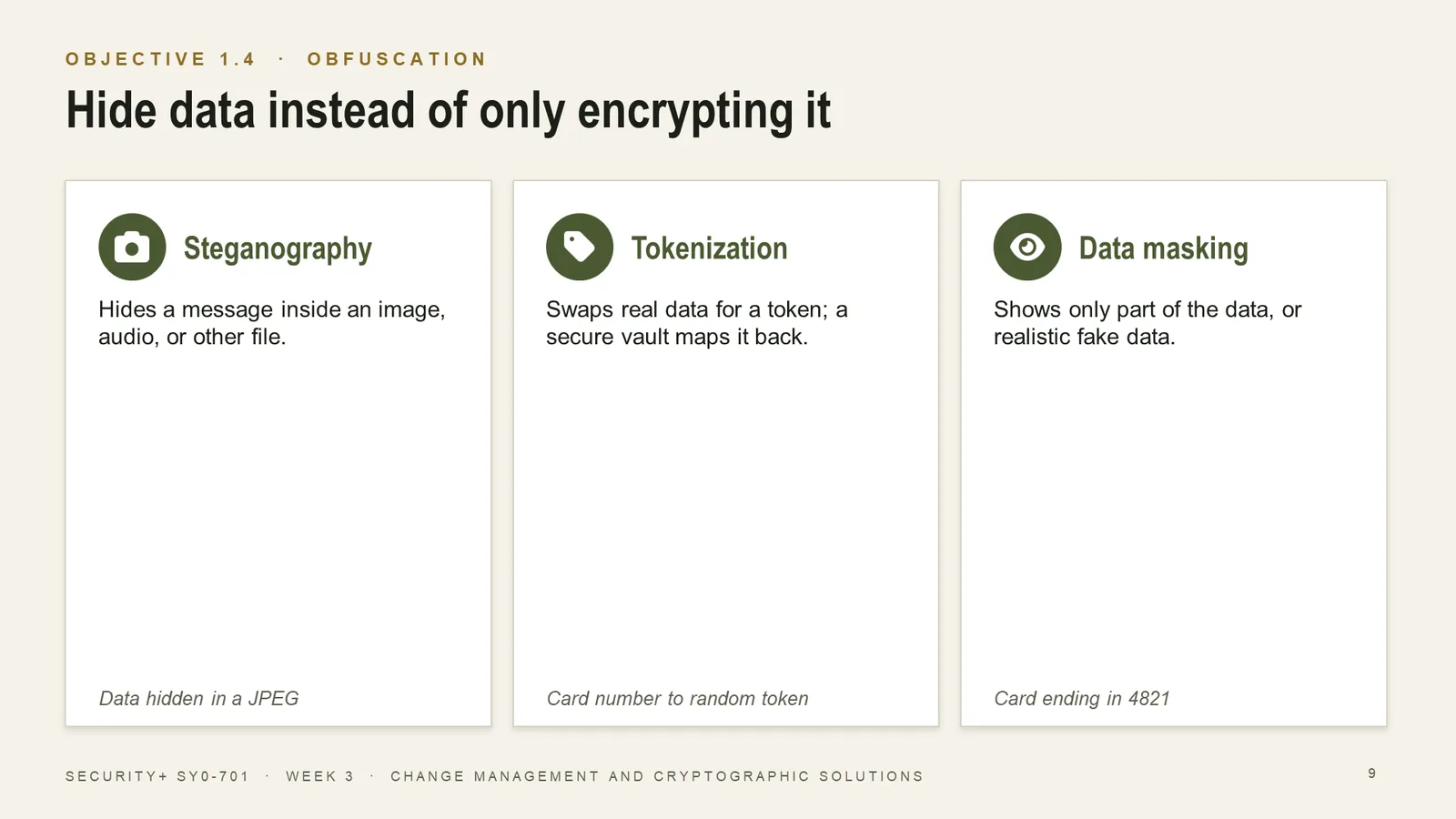
Obfuscation makes data hard to find or understand without necessarily encrypting it. The exam names three methods.
Watch out
Tokenization is not encryption. Encrypted data can be decrypted with the key. A token can only be swapped back by the vault that issued it. When a question asks how to keep card numbers out of a merchant's systems, tokenization is the answer.
10 min
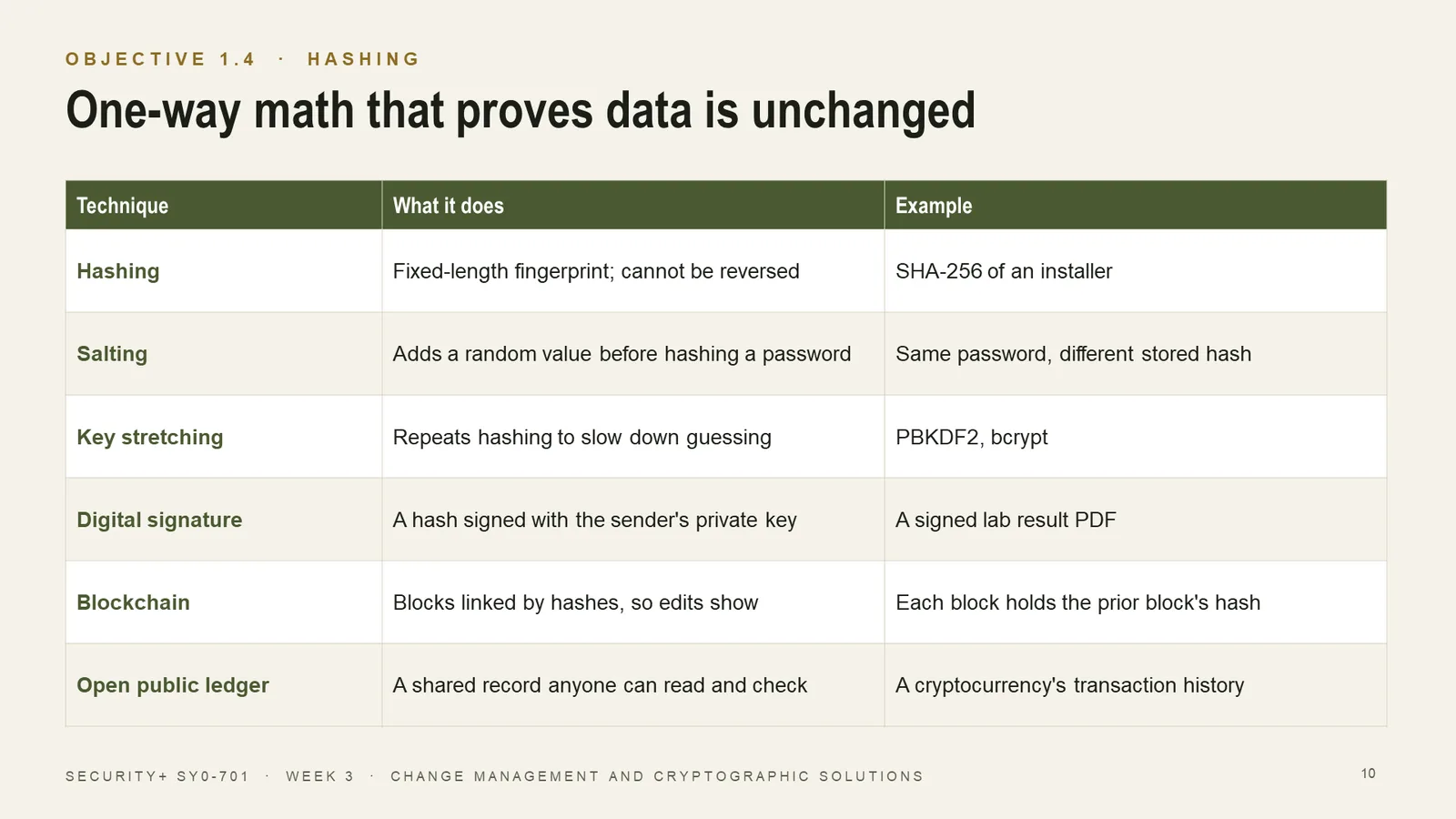
A hash is a fixed-length value computed from data. The same input always gives the same hash, a one-character change gives a completely different hash, and you cannot reverse a hash to get the input. SHA-256 is the common choice. MD5 and SHA-1 are broken for security use because attackers can create two inputs with the same hash, a collision. Hashes prove integrity: compare the hash of a download to the one the vendor published.
Systems store password hashes, not passwords. Two additions make them much harder to crack:
A digital signature combines hashing and asymmetric keys. The sender hashes the message and encrypts the hash with their private key. The recipient decrypts it with the sender's public key and compares it with their own hash of the message. A match proves integrity, authentication of the sender, and non-repudiation. A signature does not make the message secret.
A blockchain is a chain of records, or blocks, where each block holds the hash of the one before it. Changing an old block changes its hash and breaks every link after it, so tampering shows. An open public ledger is a blockchain that many independent parties hold copies of and anyone can read and verify, as with cryptocurrency transactions. No single party can quietly rewrite it.
10 min
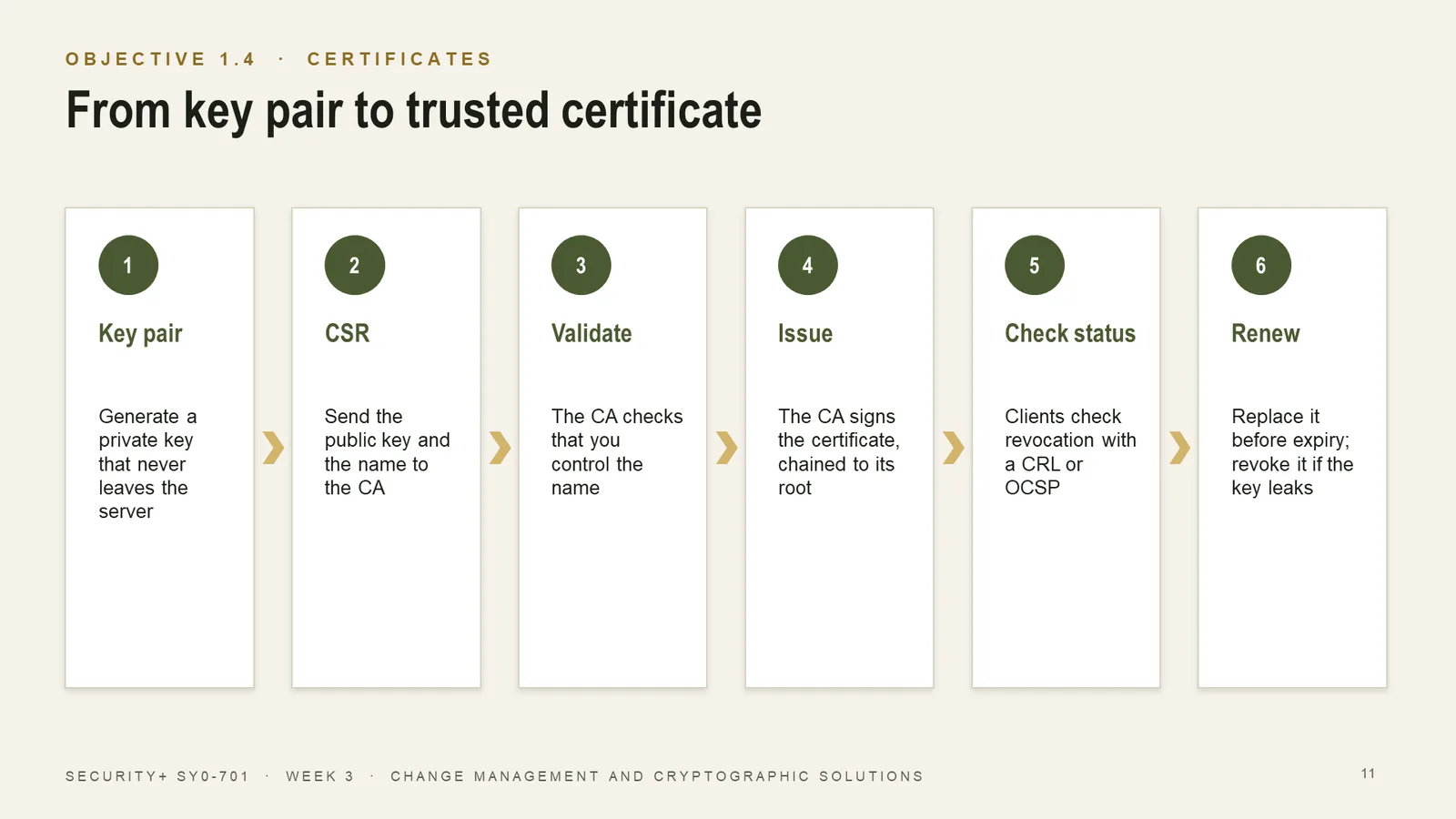
A digital certificate (in the X.509 format) binds a public key to a name, such as portal.lakeside.example, and is signed by a certificate authority (CA). Trust comes from that signature.
Getting a certificate. The server generates a key pair. It creates a certificate signing request (CSR), which contains the public key and the name, and sends only the CSR to the CA. The private key never leaves the server. The CA validates that the requester controls the name, then signs and issues the certificate.
Root of trust. Browsers and operating systems ship with a trust store of root CA certificates. A root CA usually signs intermediate CAs, which sign server certificates. A client trusts a certificate only if it can follow this chain back to a root it already trusts.
Revocation. A certificate can be revoked before it expires, for example if its private key leaks.
Kinds of certificates:
Tip
Real-time check of one certificate: OCSP. A downloaded list: CRL. What you send to the CA: CSR.
12 min
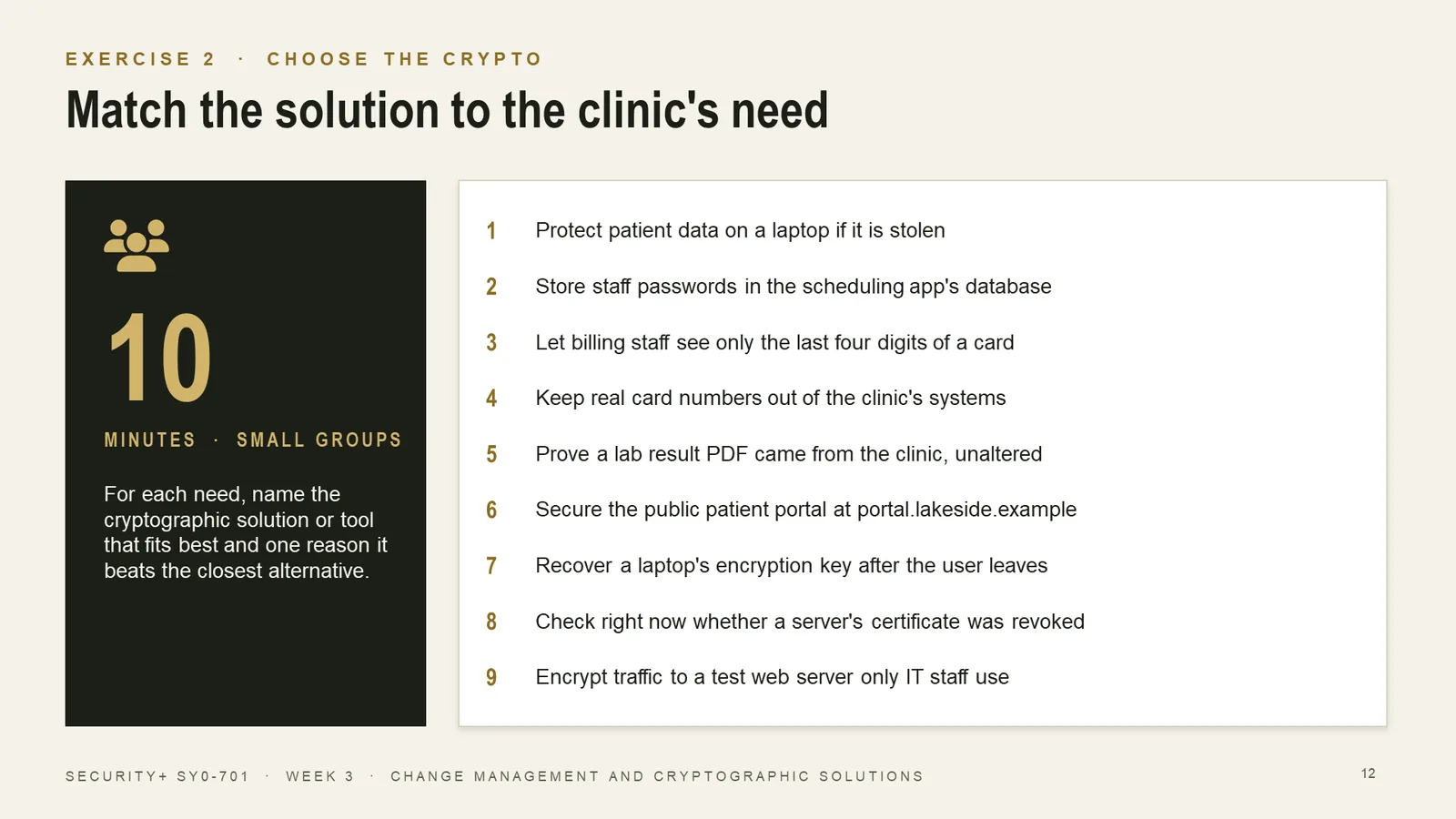
Lakeside Family Clinic has nine needs. In a small group, take ten minutes. For each one, name the cryptographic solution or tool that fits best and give one reason it beats the closest alternative.
Write your answers before opening the worked answers.
3 min
This week covered two objectives that both come down to control.
Next week turns from defenses to the people attacking them: threat actors, their motives, and the paths they use to get in.
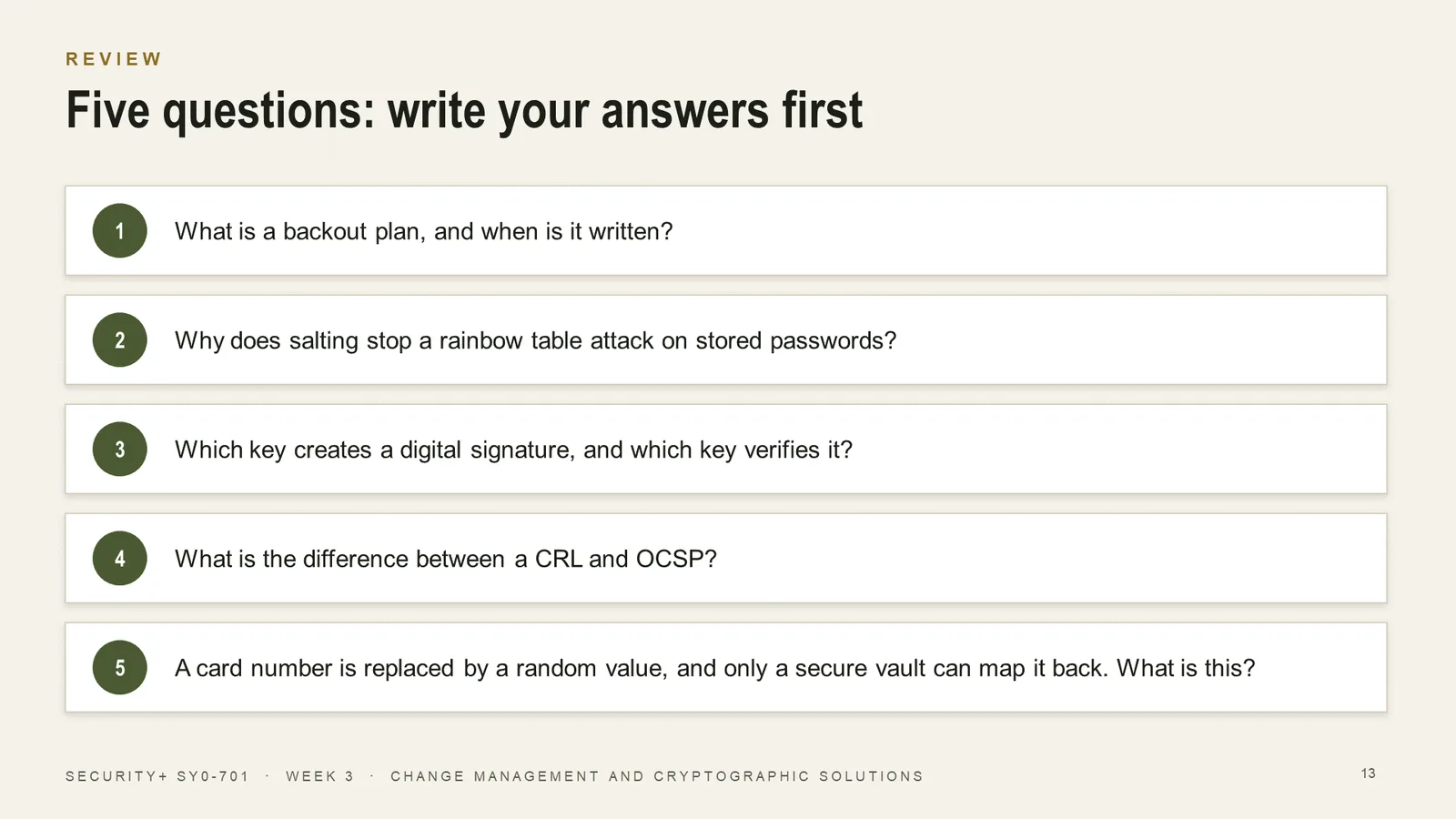
Write your answers to the five review questions first, then open each one to check it.
The documented steps to return a system to its previous state if a change fails. It is written and approved before the change is made.
A unique random salt is added to each password before hashing, so the stored hashes no longer match any precomputed table, and identical passwords produce different hashes.
The sender's private key creates it. Anyone with the sender's public key can verify it.
A CRL is a list of revoked certificates that the CA publishes and clients download. OCSP lets a client ask about one certificate's status in real time.
Tokenization. The token has no mathematical link to the card number, so it cannot be decrypted.
60 min
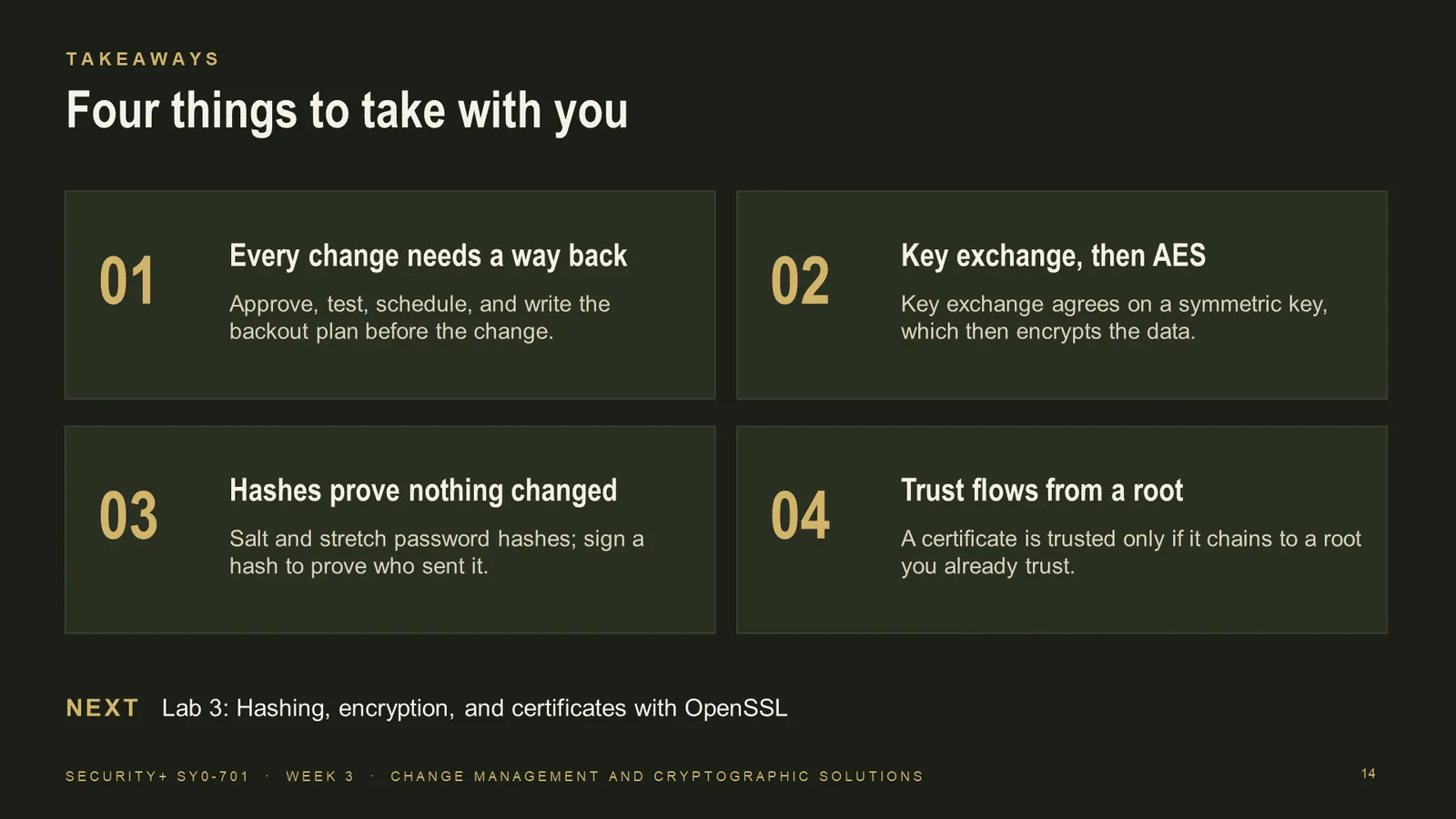
01 Every change needs a way back
Approve, test, schedule, and write the backout plan before the change.
02 Key exchange, then AES
Key exchange agrees on a symmetric key, which then encrypts the data.
03 Hashes prove nothing changed
Salt and stretch password hashes; sign a hash to prove who sent it.
04 Trust flows from a root
A certificate is trusted only if it chains to a root you already trust.
Week 3 interactive lab
Computing...
Computing...
Avalanche diff: 0 of 64 hex characters differ (0%). Changing even one bit flips roughly half the digest, and salting stops rainbow tables from matching identical passwords.
Use the Linux VM from Lab 1, which has OpenSSL installed; check with openssl version. Work in a new folder, mkdir ~/lab3 && cd ~/lab3. Step 8 needs internet access, so do it on your host computer or briefly switch the VM's adapter back to NAT, and switch it back afterward.
Lab steps · 0 of 8 complete (0%)
A lab report with the commands you ran, screenshots of the two different hashes, the decrypted file matching the original, Verified OK followed by the failed verification, and the certificate chain you inspected, plus answers to the questions below.