
Loading
Warhawk Division is a gaming community. This is a unit document, not a government or military publication.Warhawk Division is an independent gaming community, for entertainment purposes only. It is not affiliated with, sponsored by, or endorsed by Bohemia Interactive, the United States Department of Defense, or any military organization. Arma Reforger is a trademark of its respective owner. Printed from warhawkdivision.com.
Week 15 content
0 of 14 done
Slide 1 of 14
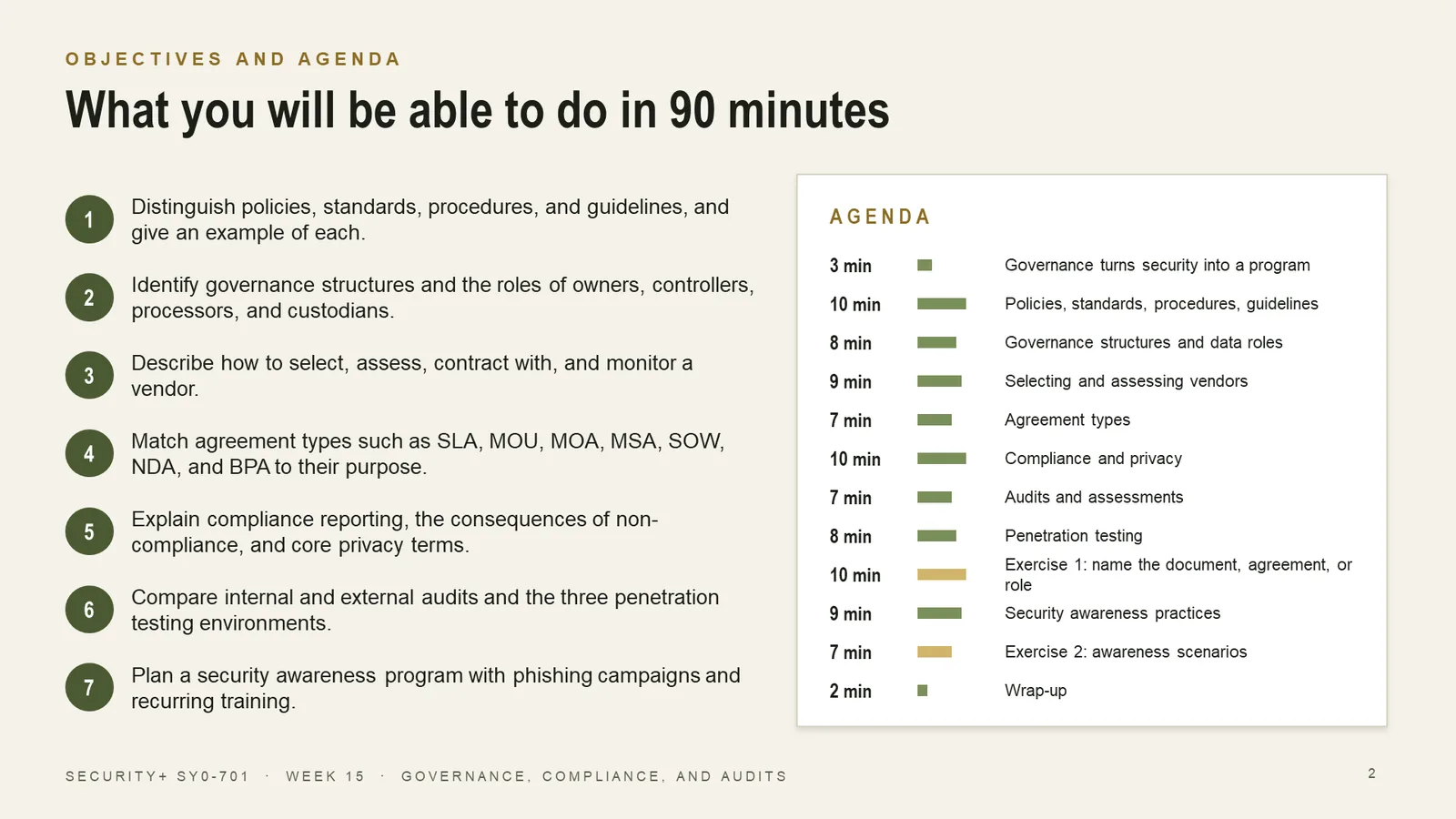
Exam objectives: 5.1 Summarize elements of effective security governance. 5.3 Explain the processes associated with third-party risk assessment and management. 5.4 Summarize elements of effective security compliance. 5.5 Explain types and purposes of audits and assessments. 5.6 Given a scenario, implement security awareness practices.
3 min
The first fourteen weeks were mostly about controls: what they are, how attackers get around them, and how a team responds when they fail. This week is about the program that decides which controls exist, who owns them, and how anyone knows they work. That is governance: the structure of rules, roles, and oversight that directs security.
Without governance, a clinic can buy good tools and still fail an audit, because nothing is written down, no one owns the patient data, and the billing vendor was never checked. With it, every control traces back to a policy, every data set has an owner, and every vendor has been assessed and is under contract.
Domain 5 is 20 percent of the exam, and this week covers five of its six objectives: 5.1 governance, 5.3 third-party risk, 5.4 compliance, 5.5 audits and assessments, and 5.6 security awareness. Objective 5.2, risk management, was covered in week 2. The material is less technical than earlier weeks, but the exam tests its vocabulary precisely. Expect questions that turn on the difference between a policy and a standard, an MOU and an MOA, or a controller and a processor.
The lab puts this to work: you write a one-page acceptable use policy for Lakeside Family Clinic and a vendor risk questionnaire for its cloud EHR provider.
10 min
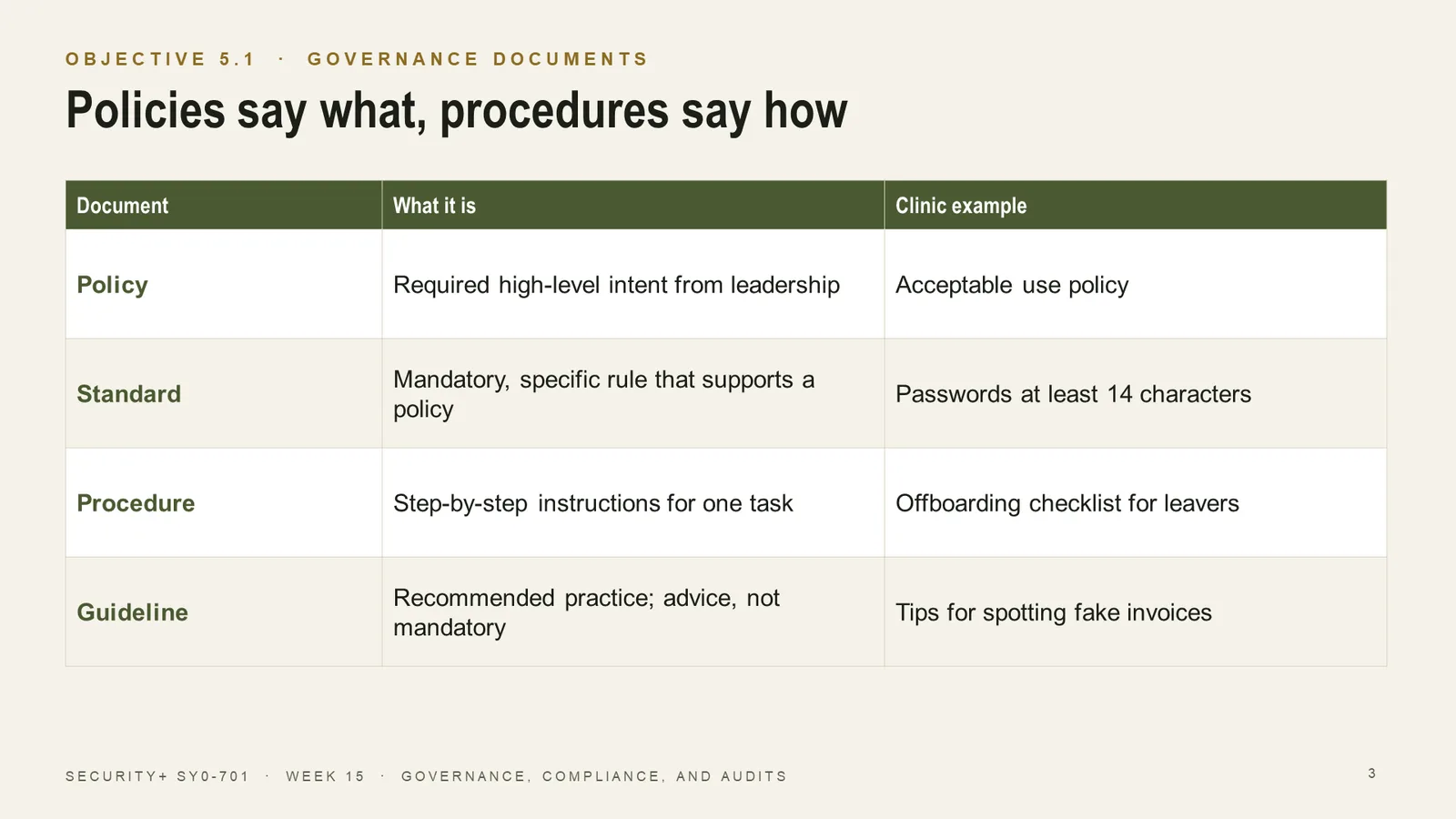
Governance documents form a hierarchy, and the exam expects you to place each one.
Policies state management's intent and requirements at a high level. They say what must happen and why, are approved by leadership, and change rarely. Objective 5.1 lists these:
Standards are mandatory, specific, measurable rules that support a policy. The objectives name password, access control, physical security, and encryption standards. "Passwords must be at least 14 characters" and "laptops must use AES-256 full disk encryption" are standards.
Procedures are step-by-step instructions: the change management procedure for submitting a change ticket, the onboarding/offboarding checklist, and playbooks, which are procedures for one type of event, such as a reported phish or a ransomware alert.
Guidelines are recommendations. They help people meet a policy but are not mandatory.
External considerations shape all of these: regulatory (HIPAA for a clinic), legal (contracts and breach notification laws), industry (PCI DSS if the clinic takes cards), and requirements at the local/regional, national, and global levels, such as state privacy laws or the EU's GDPR.
Governance also includes monitoring and revision. Review every document on a schedule, usually yearly, and after a major change, an incident, or a new law.
Tip
Mandatory and broad is a policy. Mandatory and specific is a standard. Ordered steps is a procedure. Optional advice is a guideline.
8 min
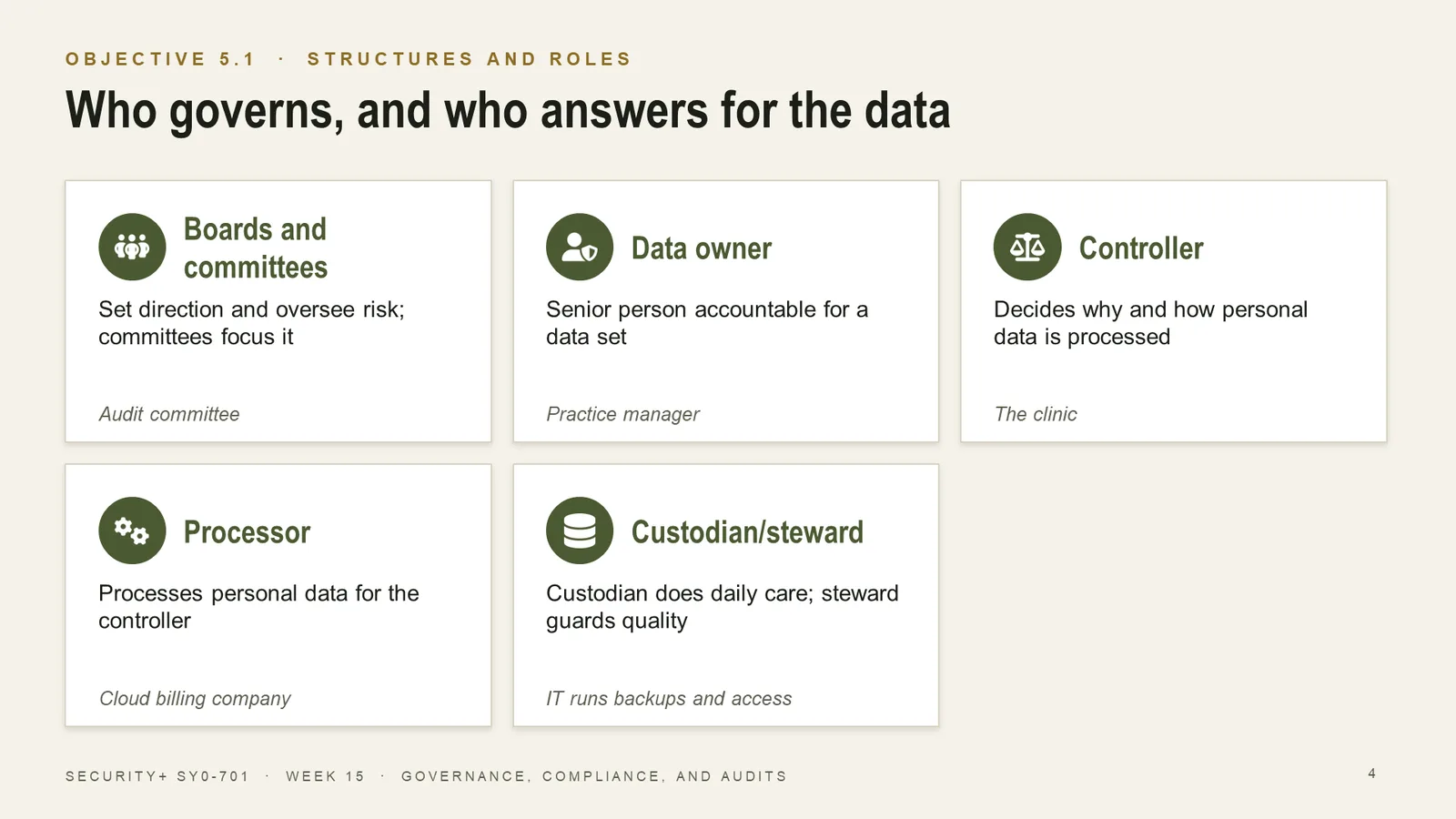
Governance structures decide who sets direction.
Roles and responsibilities for systems and data:
Watch out
Owners are accountable; custodians do the work. If a question asks who decides who may access the data, the answer is the owner, even though IT is the one who clicks the button.
Controller and processor come from privacy law, most famously the GDPR, and they return in objective 5.4. HIPAA uses parallel terms: the clinic is a covered entity, and a vendor that handles patient data for it is a business associate.
9 min
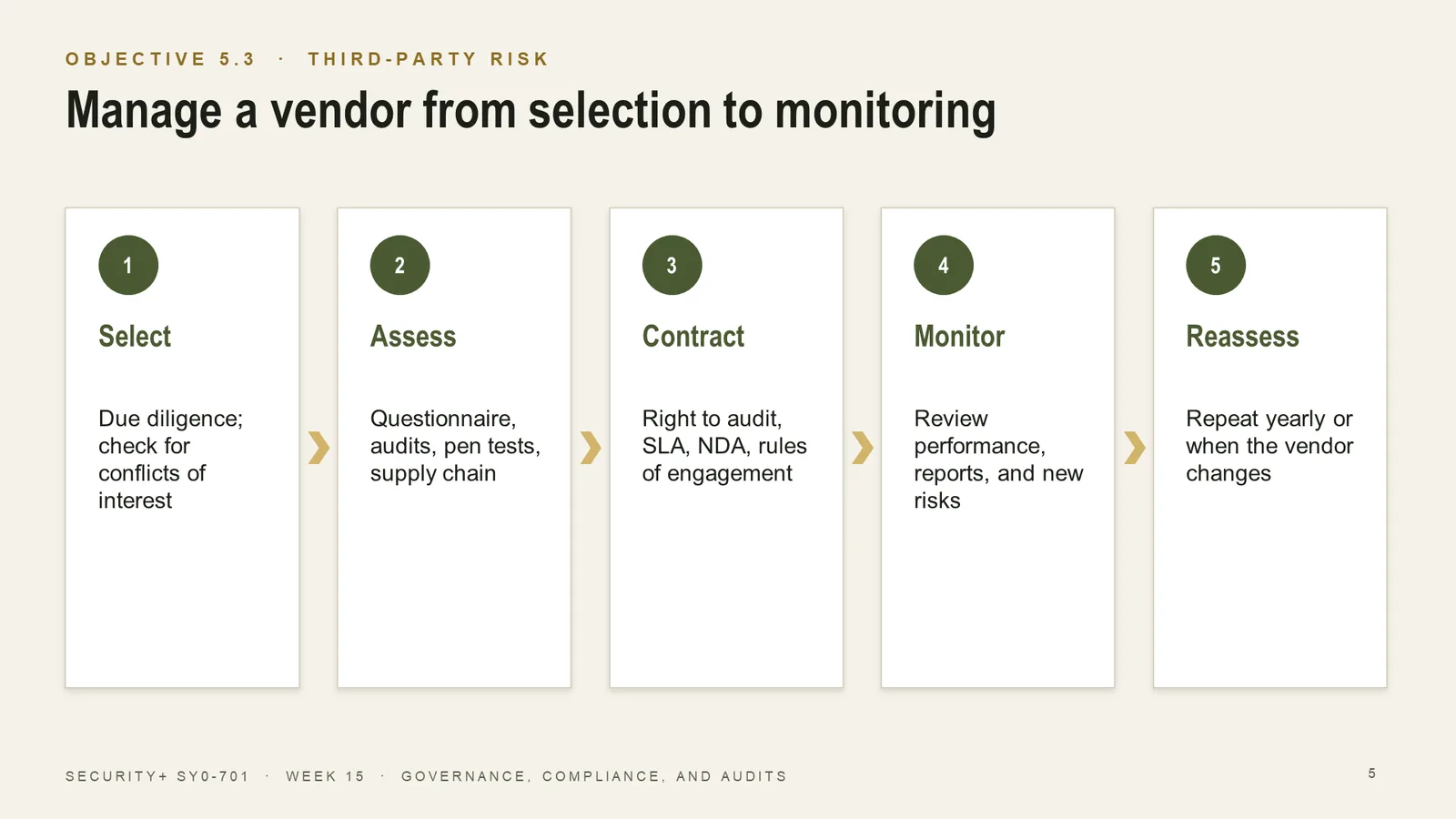
Many breaches at small organizations start in someone else's system: the EHR vendor, the IT support firm, the billing service. Third-party risk management applies the risk process to vendors.
Vendor selection starts with due diligence: research before signing. Look at the vendor's security program, financial stability, past breaches, references, and certifications. Check for conflicts of interest, such as a staff member choosing a vendor owned by a relative, or a consultant recommending a product they are paid to resell. Conflicts must be disclosed, and the person steps out of the decision.
Vendor assessment methods from objective 5.3:
Questionnaires are the most common tool: a standard set of security questions the vendor answers, such as whether it encrypts data at rest, requires MFA, and tests backups. Ask for evidence with each answer, not just yes or no.
Vendor monitoring continues after the contract is signed: review SLA reports, watch for breaches in the news, request updated audit reports each year, and reassess when the vendor changes ownership or services.
Tip
A right-to-audit clause must be in the contract before you need it. You cannot add one after a breach.
7 min
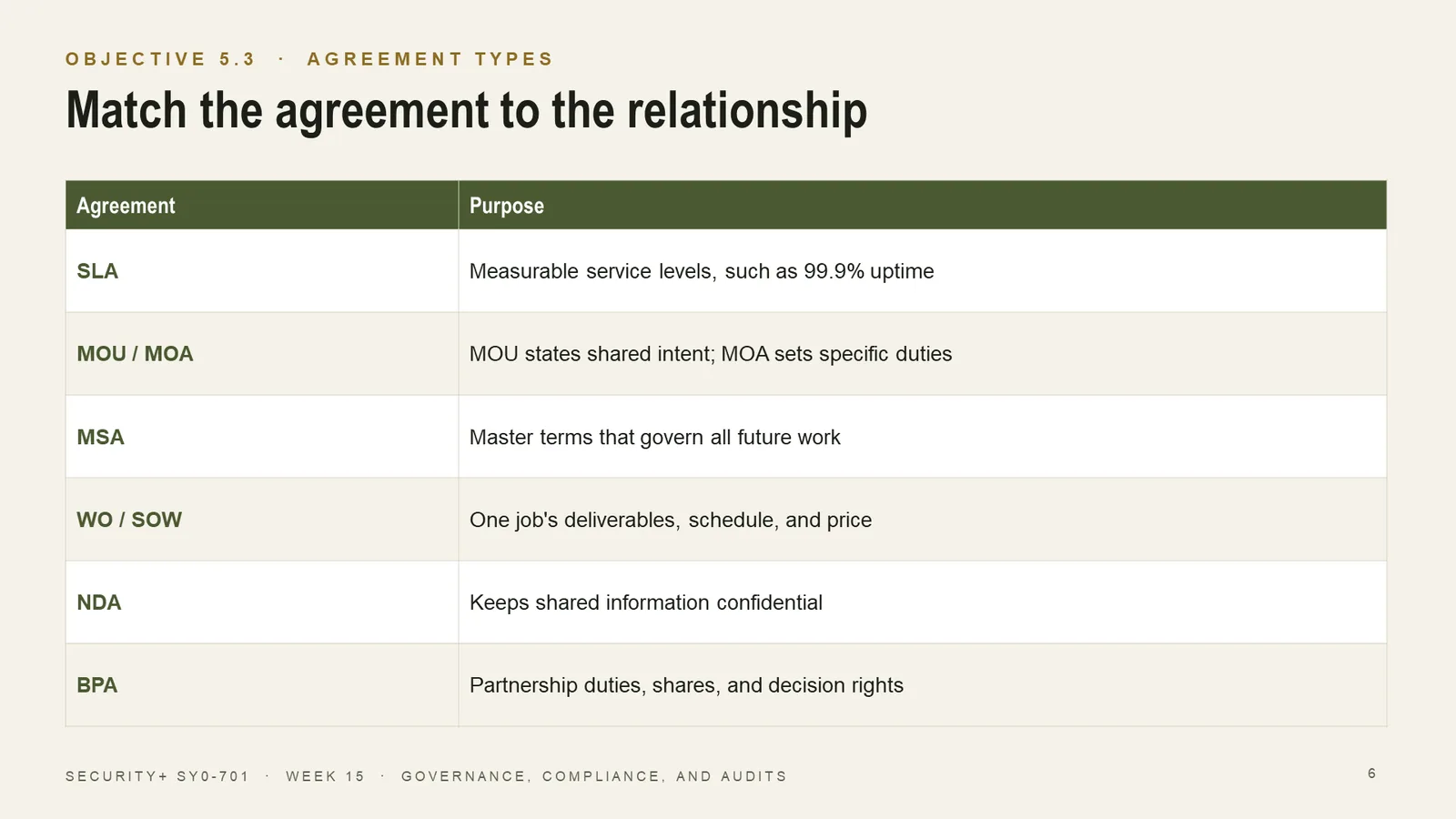
Agreement types define the relationship. The exam describes a situation and asks which one fits.
| Agreement | Purpose | Example |
|---|---|---|
| SLA, service-level agreement | Measurable performance commitments and remedies if they are missed | 99.9% uptime; outage response within one hour |
| MOU, memorandum of understanding | A statement of shared intent; usually not legally binding | Two clinics agree in principle to help each other in a disaster |
| MOA, memorandum of agreement | More formal than an MOU; sets the specific duties of each party | The two clinics define who provides which rooms and staff |
| MSA, master service agreement | Umbrella terms for an ongoing relationship: liability, payment, confidentiality | The clinic's overall contract with its IT support firm |
| WO/SOW, work order or statement of work | One specific job under the MSA: deliverables, schedule, cost | Migrate the file server by March 1 for a fixed fee |
| NDA, non-disclosure agreement | Keeps shared information confidential | A penetration tester signs before seeing the network diagram |
| BPA, business partners agreement | Governs a partnership: responsibilities, shares, decision rights | Two physicians form a joint practice |
Two pairs cause most mistakes. MOU vs MOA: both are cooperative documents between organizations, but the MOA spells out specific responsibilities. MSA vs SOW: the MSA is signed once; each project then gets its own SOW or work order under it.
One more for healthcare: under HIPAA, a clinic must have a business associate agreement with any vendor that creates, receives, stores, or transmits protected health information for it. That is a legal requirement rather than one of CompTIA's listed agreement types, but it is the first contract a clinic's vendor review should look for.
10 min
Compliance means meeting the requirements of laws, regulations, standards, and contracts, and being able to prove it.
Compliance reporting is internal, to management, the board, or the audit committee, showing status and gaps, or external, to regulators, customers, or partners, such as a PCI DSS report on compliance or a breach report to a regulator.
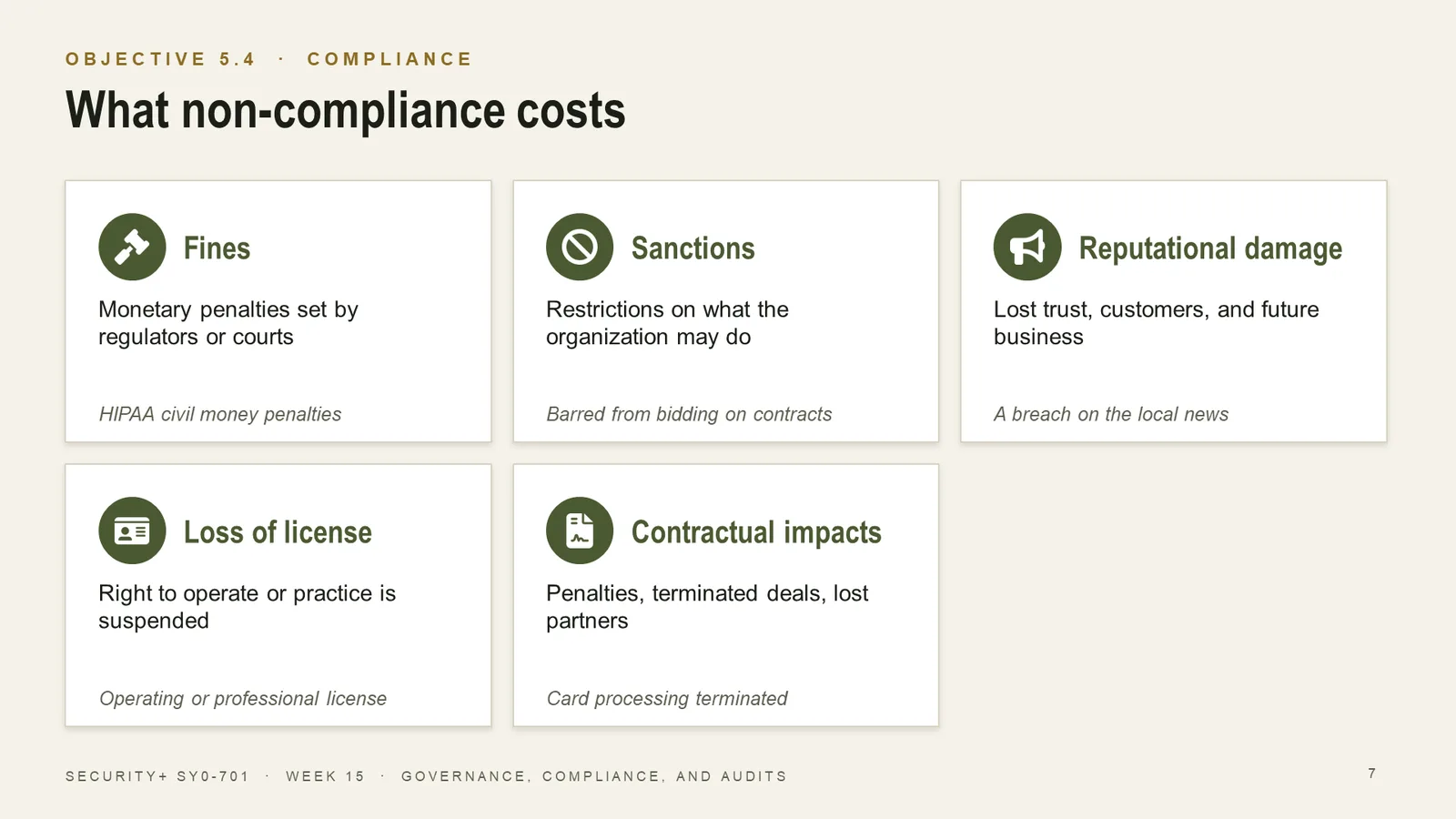
Consequences of non-compliance: fines; sanctions that restrict what the organization may do; reputational damage; loss of license to operate or practice; and contractual impacts, such as a payment processor ending card acceptance or a partner terminating a deal.
Compliance monitoring:
Privacy has its own vocabulary:
Watch out
The right to be forgotten is not absolute. A clinic must keep medical records for the period the law requires, even if a patient asks for deletion.
7 min
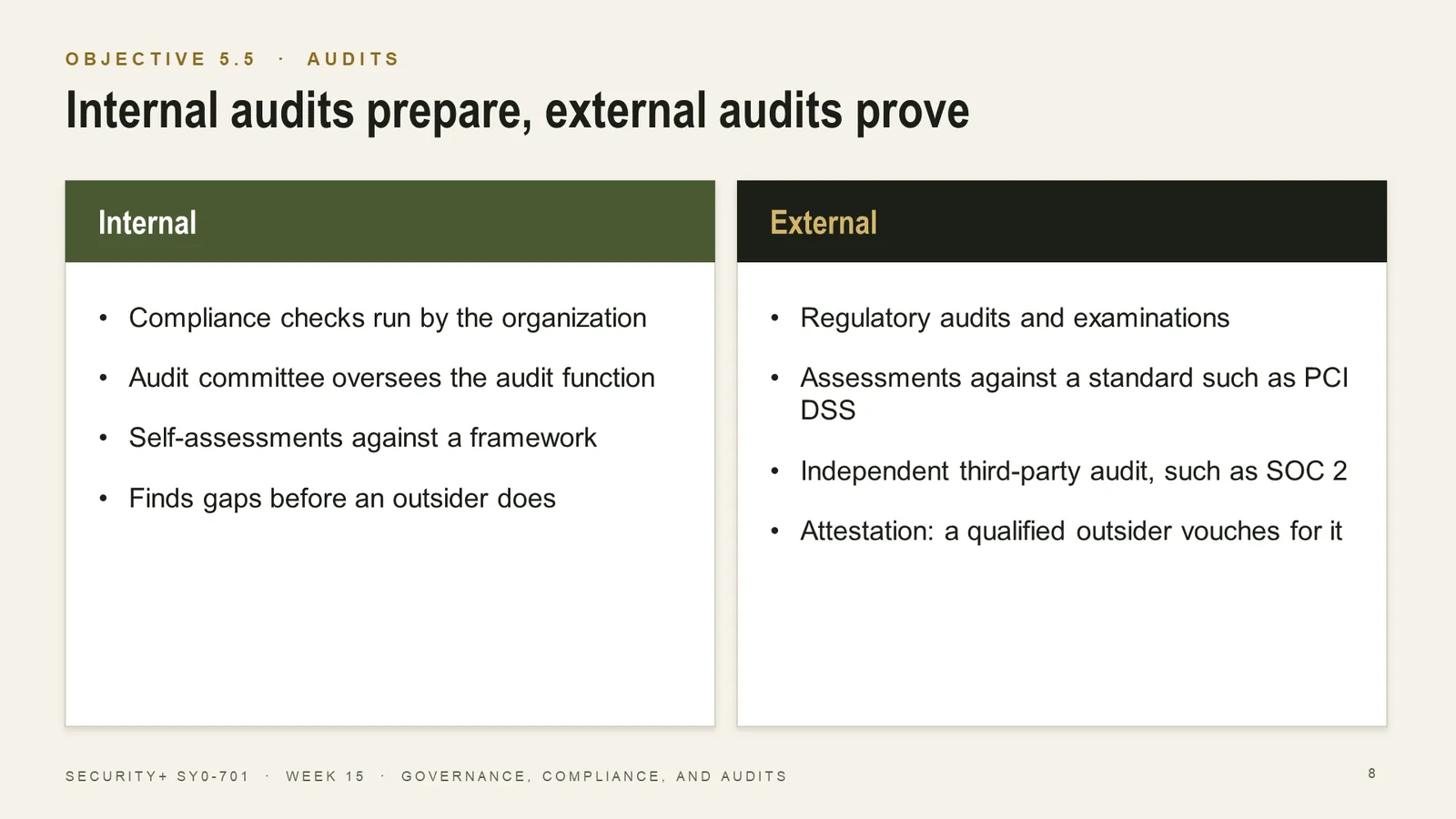
An audit checks whether controls exist and work, against a defined standard. An assessment is broader and often less formal. Attestation is a formal statement by a qualified party that something is true, such as a CPA firm's SOC 2 report attesting that a vendor's controls operated as described.
Internal audits and assessments are run by or for the organization itself:
External audits and assessments are run by outsiders:
Tip
If the question stresses independence, objectivity, or a customer asking for proof, the answer is an independent third-party audit. If it stresses oversight by the board, the answer is the audit committee.
8 min
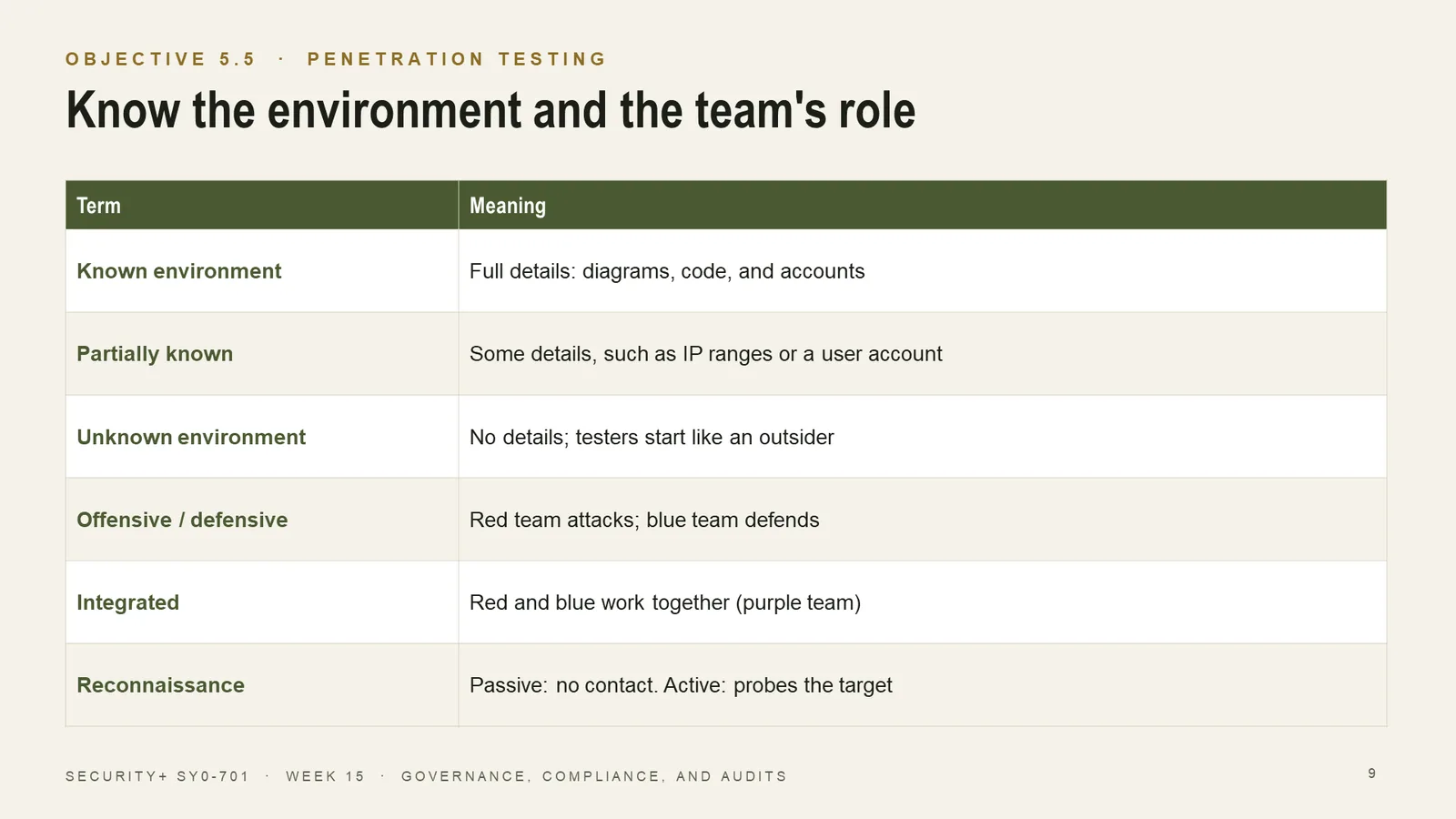
A penetration test goes beyond a vulnerability scan: testers actually exploit weaknesses, with written permission, to show what an attacker could do. Rules of engagement set the scope, timing, allowed methods, and emergency contacts before testing starts.
Types of testing in objective 5.5:
Environments describe how much the testers know at the start:
Reconnaissance comes first:
Watch out
Running Nmap against the clinic's firewall is active. Reading the clinic's job ad that names its EHR product is passive.
10 min
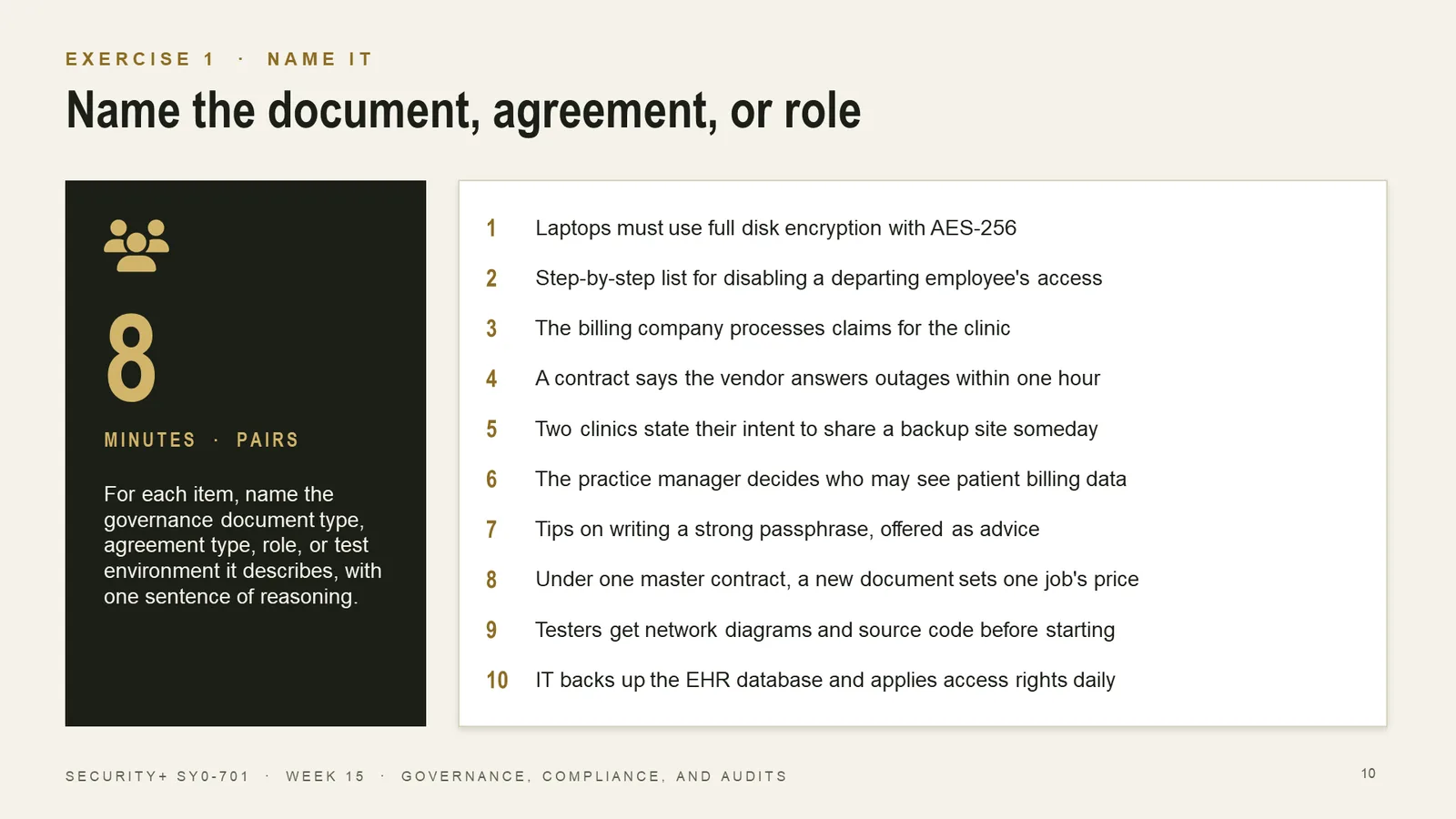
Work in pairs for eight minutes. Each item describes a governance document, an agreement, a data role, or a penetration testing environment. Name it, and write one sentence of reasoning before you check.
| # | Answer | Reasoning |
|---|---|---|
| 1 | Standard (encryption standard) | Mandatory and specific: it names the control and the algorithm |
| 2 | Procedure (offboarding) | Ordered steps for one task |
| 3 | Processor | Processes personal data on the controller's instructions |
| 4 | SLA | A measurable service level with a remedy |
| 5 | MOU | Shared intent with no specific duties; an MOA would set duties |
| 6 | Data owner | The owner is accountable and approves access |
| 7 | Guideline | Advice, not mandatory |
| 8 | SOW or work order | One job under the master service agreement |
| 9 | Known environment | Testers receive full information up front |
| 10 | Custodian | Does the daily care and applies the owner's decisions |
Where students slip.
9 min
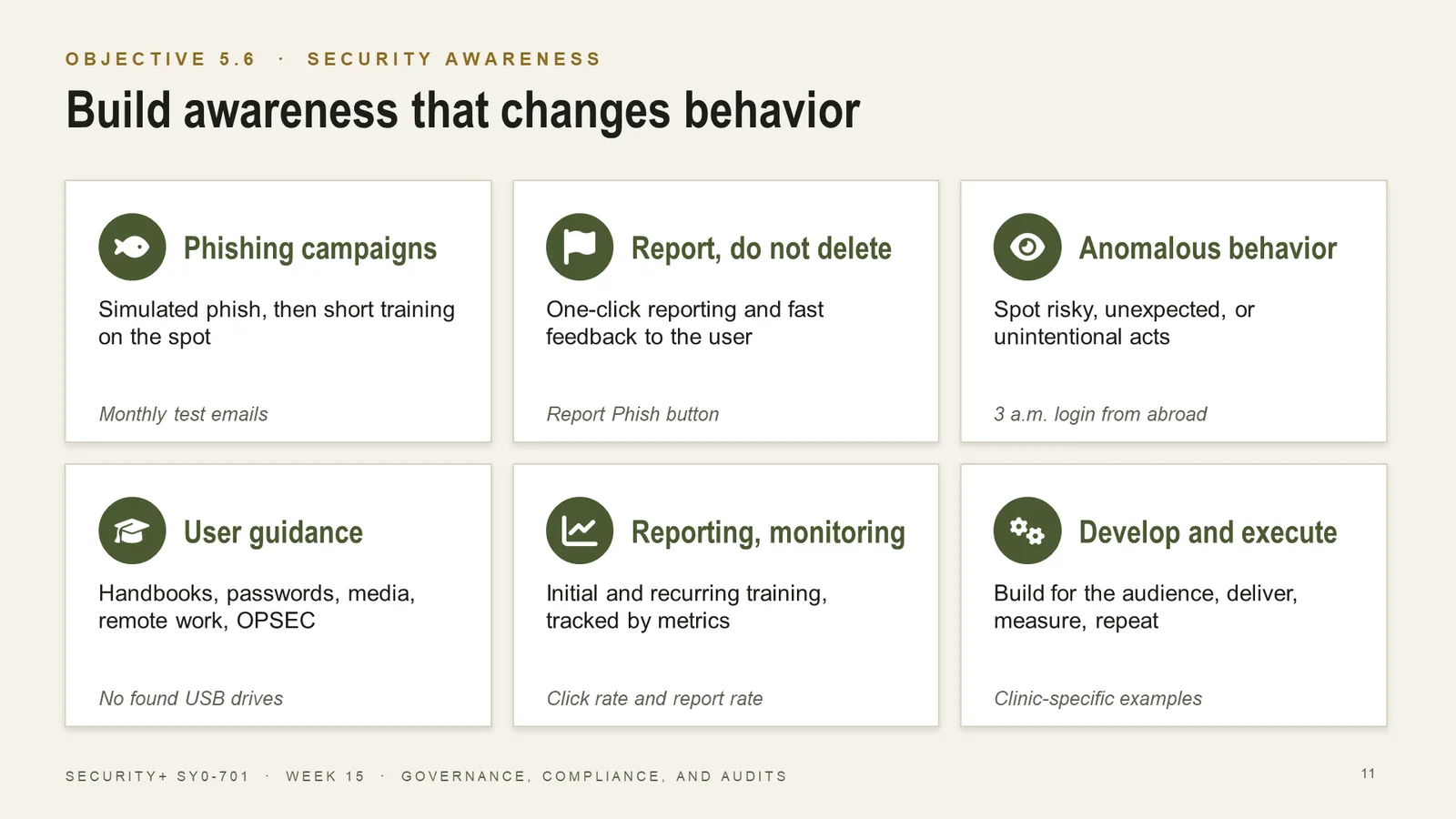
Most attacks on small organizations start with a person: a phishing email, a phone call, a borrowed password. Objective 5.6 is a given a scenario objective, so expect questions that describe a behavior and ask what to do.
Phishing:
Anomalous behavior recognition sorts behavior three ways: risky, which is knowingly unsafe, such as sharing a password; unexpected, which is unusual for that person, such as a 3 a.m. login or a download of data they never use; and unintentional, an honest mistake such as emailing the wrong recipient.
User guidance and training covers policy/handbooks; situational awareness, such as noticing tailgaters and shoulder surfers; insider threat; password management with a password manager, MFA, and no reuse; removable media and cables, meaning no found USB drives and no unknown charging cables; social engineering; operational security, not posting details that help attackers; and hybrid/remote work environments: home Wi-Fi, screen privacy, and locked devices.
Reporting and monitoring means initial training at onboarding and recurring training at least yearly, with completion and phishing metrics reported to leadership.
Development means building content for your audience and its real risks; execution means delivering it, measuring results, and adjusting. Lakeside's training should use clinic examples, such as a fake insurance portal login, not a fake shipping notice.
7 min
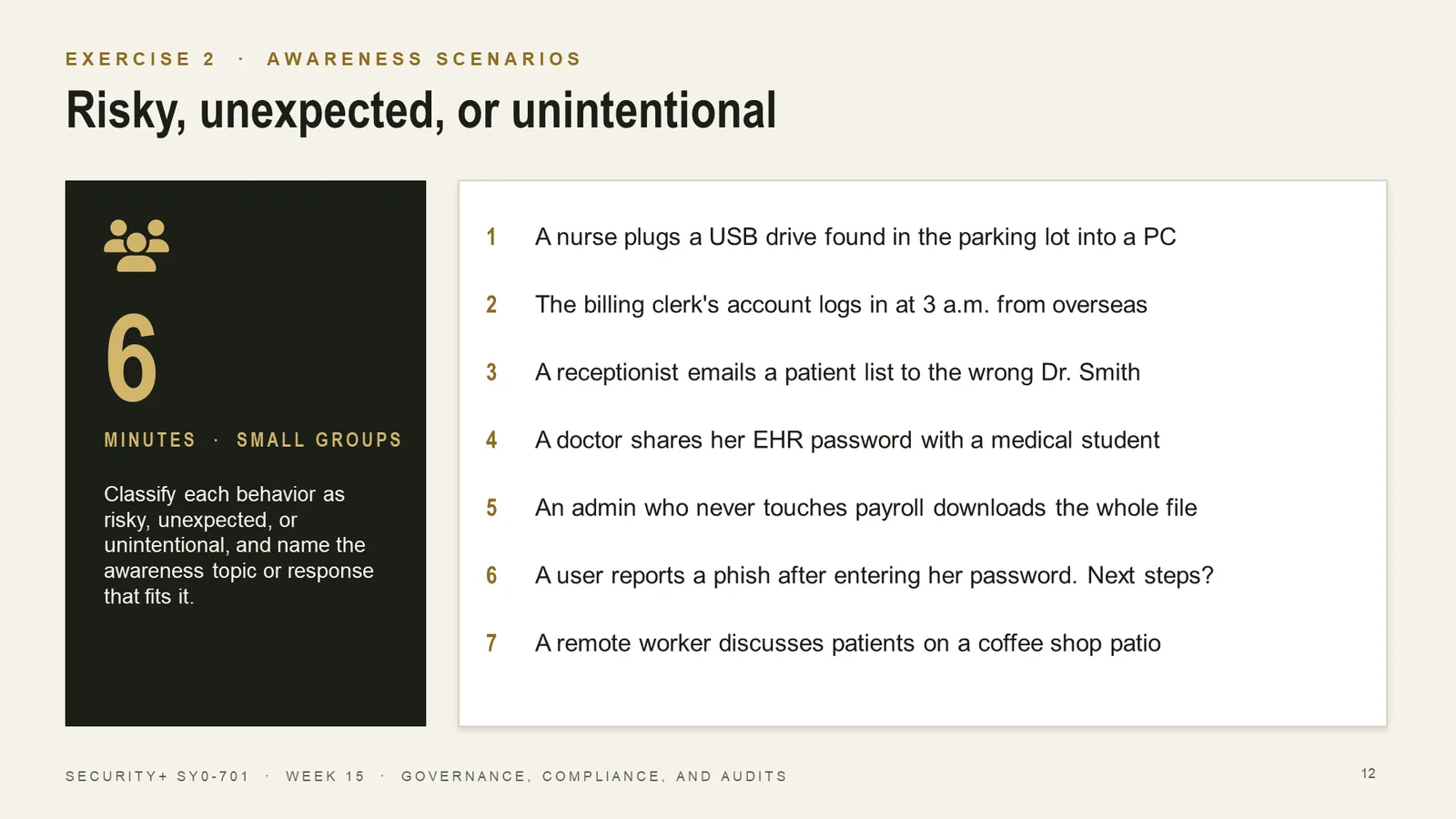
Work in small groups for six minutes. For each behavior at Lakeside Family Clinic, decide whether it is risky, unexpected, or unintentional, and name the awareness topic or response that fits. Item 6 asks for the response steps instead.
| # | Category | Topic or response |
|---|---|---|
| 1 | Risky | Removable media and cables; report found devices to IT unplugged |
| 2 | Unexpected | Possible stolen credentials; investigate, disable the session, reset the password |
| 3 | Unintentional | Training on checking recipients; treat it as a possible privacy breach and report it |
| 4 | Risky | Password management; each person needs their own account so access is traceable |
| 5 | Unexpected | Insider threat; confirm whether there was a business reason before assuming malice |
| 6 | Response | Thank her, reset her password and revoke sessions, pull the email from other inboxes, block the sender and URL, check logs for use of her account |
| 7 | Risky | Hybrid/remote work and situational awareness; patient details must not be overheard |
Notes on the harder ones.
2 min
Governance is the frame around every control in this course. Policies state intent, standards make it measurable, procedures make it repeatable, and guidelines help. Boards and committees oversee; owners are accountable; custodians do the daily work; controllers and processors divide responsibility for personal data.
Third parties extend your risk, so you choose them with due diligence, assess them with questionnaires, audit evidence, and independent reports, bind them with the right agreements, and keep monitoring them. Compliance means proving you meet your obligations, and failing costs fines, sanctions, lost licenses, lost contracts, and lost trust. Audits come from inside and outside, and penetration tests show what an attacker could actually do, starting from a known, partially known, or unknown environment.
People are part of the system, so awareness training, phishing campaigns, and easy reporting are controls like any other.
Next week is the final review: all five domains, exam-day strategy, and your briefing to Lakeside's leadership.
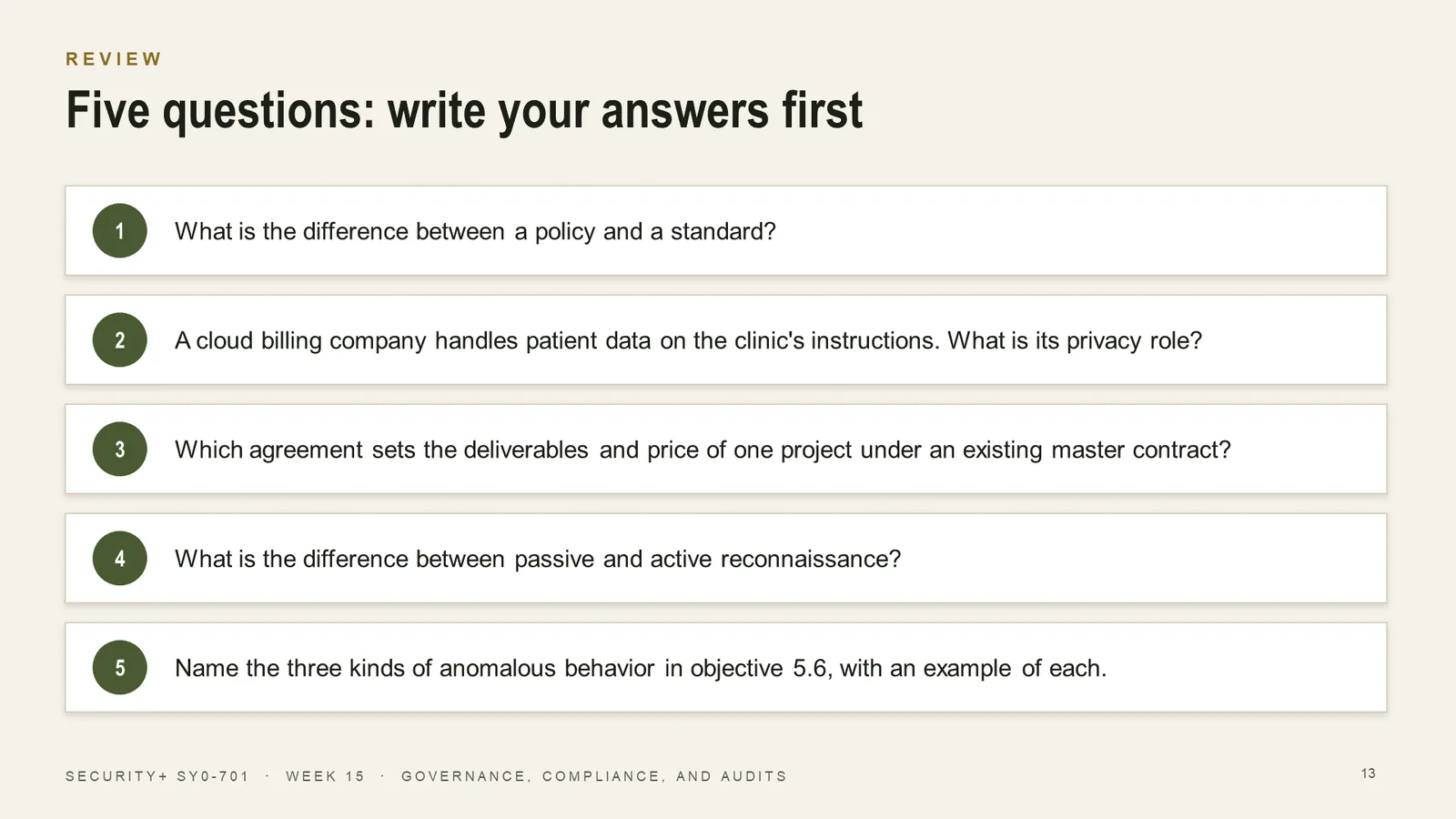
Write your answers to the five review questions first, then open each one to check it.
A policy states leadership's high-level intent and requirements. A standard is a mandatory, specific, measurable rule that supports a policy, such as a 14-character minimum password length.
Processor. The clinic, which decides why and how the data is processed, is the controller.
A statement of work (SOW) or work order (WO), issued under the master service agreement (MSA).
Passive reconnaissance gathers information without touching the target's systems, such as job postings and social media. Active reconnaissance interacts with the target, such as a port scan, and can be detected.
Risky, such as sharing a password; unexpected, such as a 3 a.m. login from another country; unintentional, such as emailing data to the wrong person.
60 min
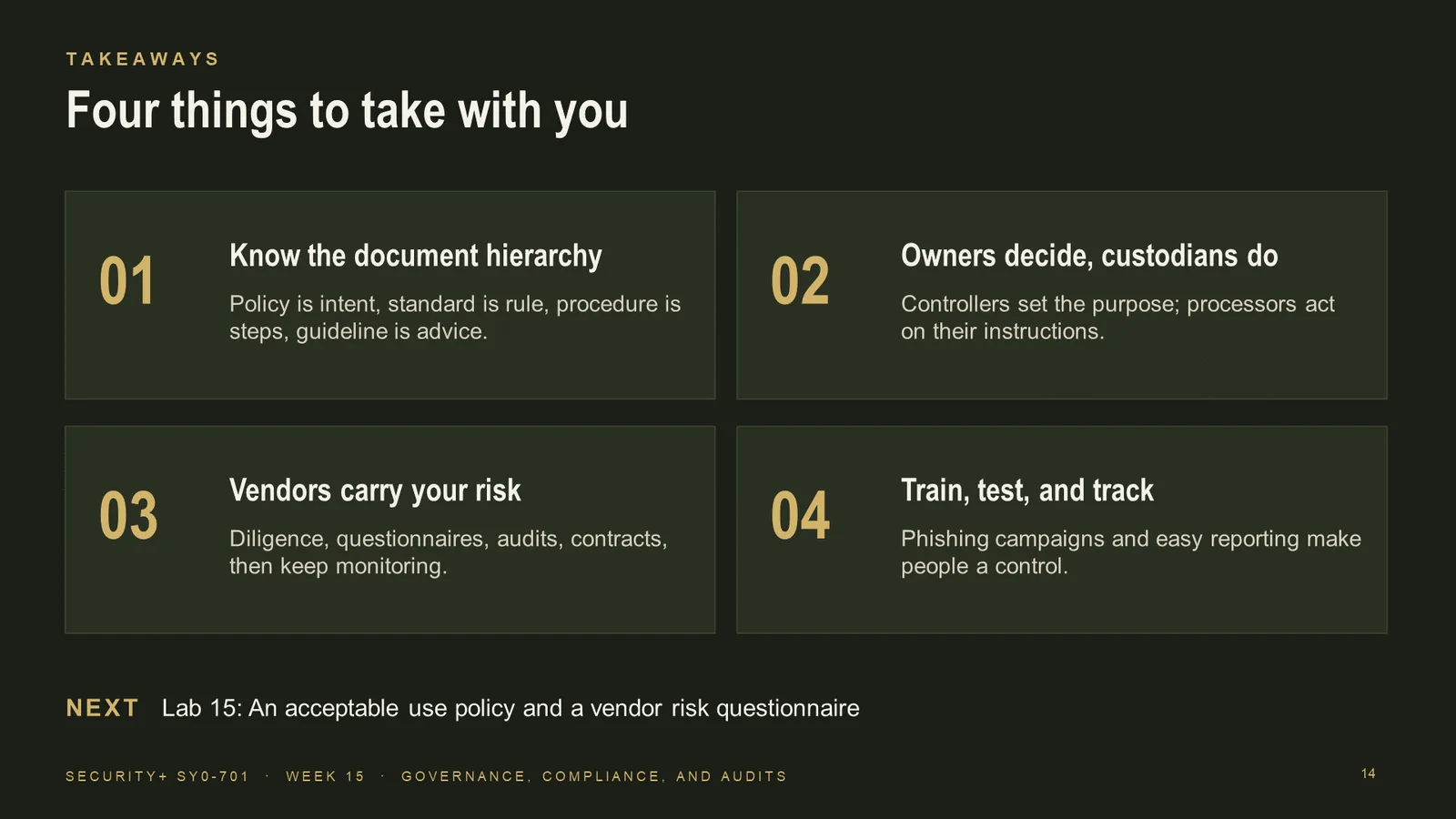
01 Know the document hierarchy
Policy is intent, standard is rule, procedure is steps, guideline is advice.
02 Owners decide, custodians do
Controllers set the purpose; processors act on their instructions.
03 Vendors carry your risk
Diligence, questionnaires, audits, contracts, then keep monitoring.
04 Train, test, and track
Phishing campaigns and easy reporting make people a control.
You need a word processor, a spreadsheet, and your project notes on Lakeside Family Clinic. Assume the clinic uses a cloud EHR vendor, an outside IT support firm, and staff laptops that sometimes go home. No tools touch any network in this lab.
Lab steps · 0 of 8 complete (0%)
The one-page AUP, the vendor questionnaire spreadsheet, the three required agreements or clauses with reasons, and the peer review comments you received with a note on how you changed your drafts. These become appendices to your final project report.