
Loading
Warhawk Division is a gaming community. This is a unit document, not a government or military publication.Warhawk Division is an independent gaming community, for entertainment purposes only. It is not affiliated with, sponsored by, or endorsed by Bohemia Interactive, the United States Department of Defense, or any military organization. Arma Reforger is a trademark of its respective owner. Printed from warhawkdivision.com.
Week 5 content
0 of 14 done
Slide 1 of 14
Exam objectives: 2.3 Explain various types of vulnerabilities.
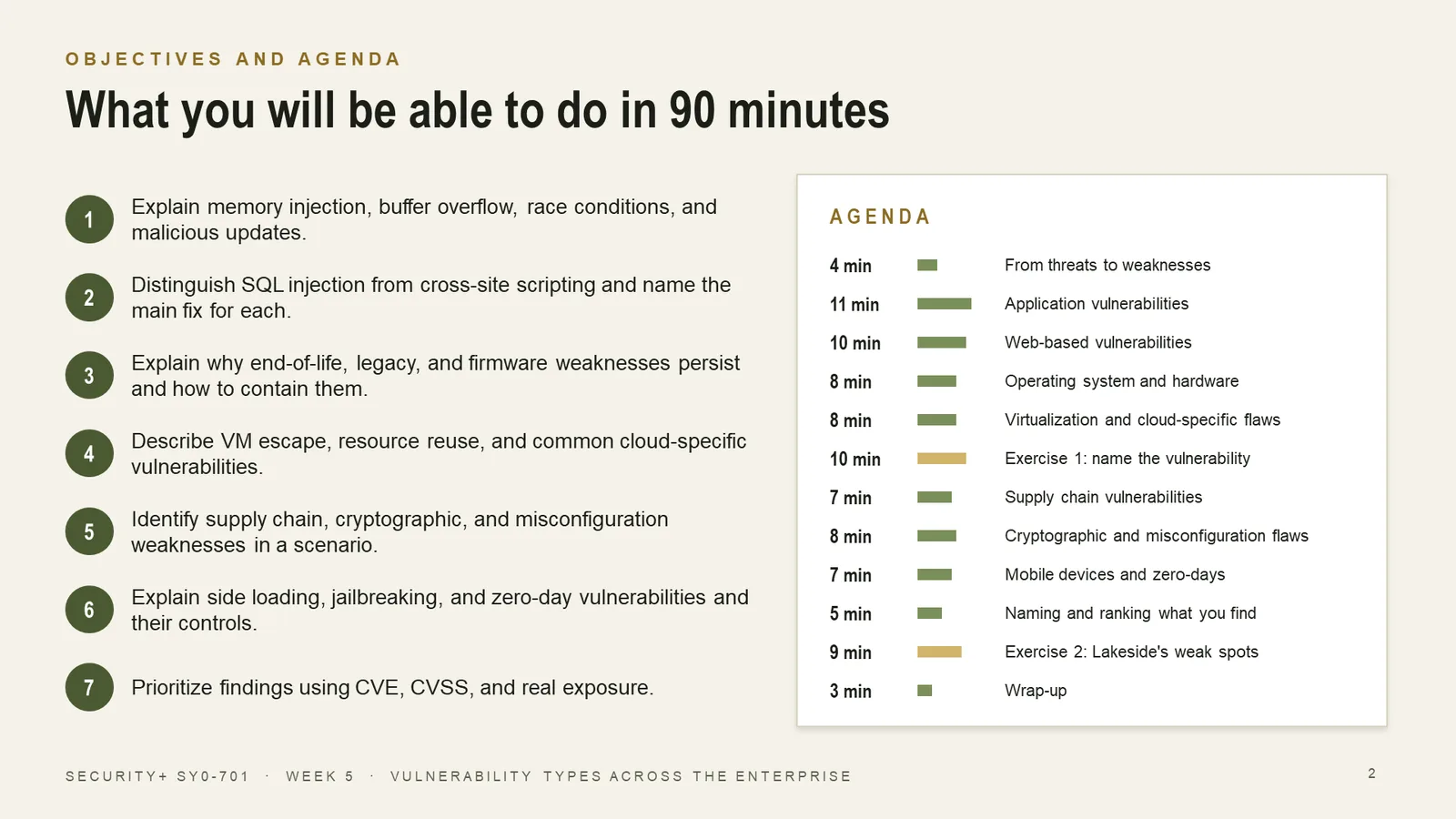
4 min
Last week you met the threat actors and the vectors they use. This week is about what they are looking for when they arrive: a vulnerability, a weakness in a system, process, or design that a threat can exploit.
Objective 2.3 sorts vulnerabilities by where they live: in applications, operating systems, web code, hardware, virtualization, the cloud, the supply chain, cryptography, configuration, and mobile devices, plus the special case of the zero-day. Learning the types is not memorization for its own sake. A scan report from Greenbone or a cloud posture tool is a list of these types, and the type usually tells you the fix. A SQL injection finding points to the code; a default password finding points to a setting; an end-of-life finding points to the budget.
Keep one distinction in mind all lesson. A vulnerability is the weakness. An exploit is the code or technique that uses it. A threat is whoever or whatever might use it. A server can be badly vulnerable and never exploited, and that is luck, not security.
11 min
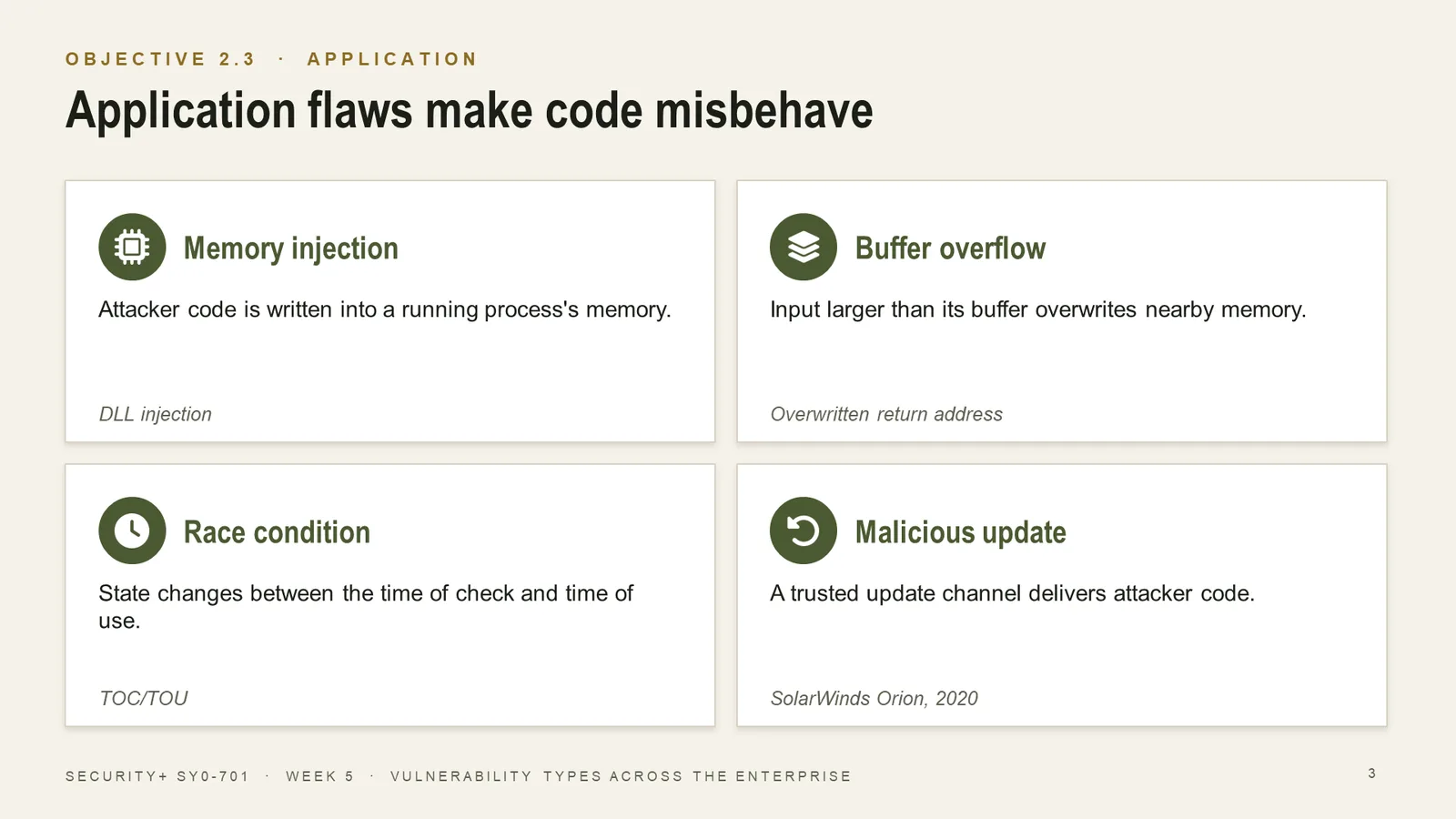
Application vulnerabilities live in the software itself. Security+ names four.
Memory injection puts attacker code into the memory of a process that is already running, so the code runs with that process's identity and permissions. DLL injection and process hollowing are common forms, and much fileless malware works this way because nothing malicious ever touches the disk. Endpoint detection that watches process behavior catches it better than file scanning does.
Buffer overflow happens when a program writes more data into a fixed-size buffer than it can hold. The extra bytes spill into adjacent memory. On the stack, that can overwrite the return address and send execution to attacker code. Defenses include bounds checking in code, memory-safe languages, ASLR (address space layout randomization), and DEP (data execution prevention, also called NX), which marks data areas as not executable.
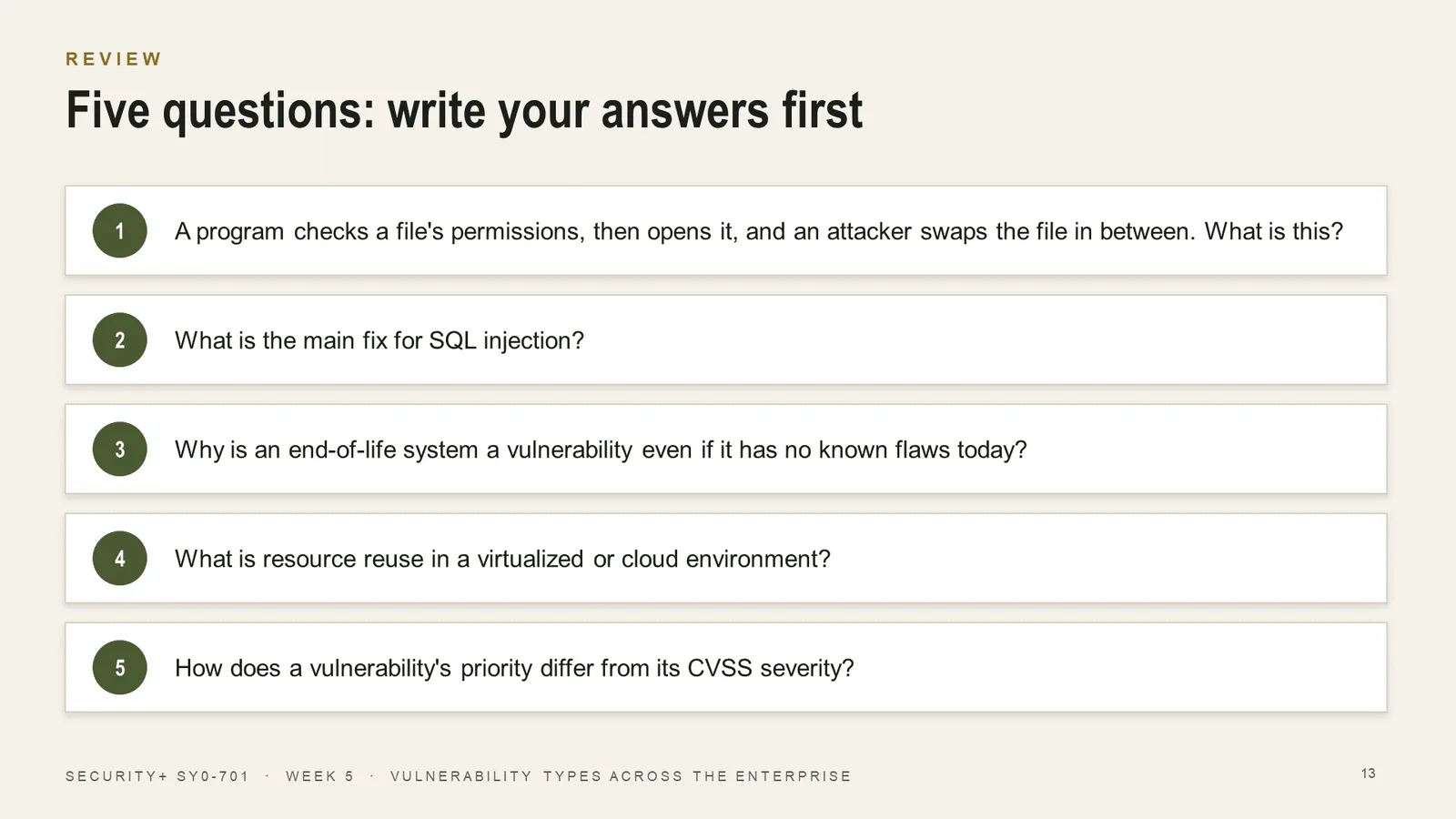
Race conditions occur when the result depends on the timing of two events. The exam form is TOC/TOU, time of check to time of use: a program checks something, then acts on it, and the attacker changes it in between. Two withdrawals submitted at the same instant can both pass a balance check before either is subtracted. A program can check a file's permissions, then open a file that was swapped for a link to a protected file. The fix is to make the check and the use one atomic operation, or to lock the resource.
Malicious update abuses the trust you place in a vendor's update channel. In the SolarWinds Orion compromise, attackers inserted a backdoor into the vendor's build process, and customers installed it as a signed, legitimate update.
Tip
A digital signature proves who published an update, not that the code is safe. If the vendor's build system is compromised, the malicious update is signed too.
10 min
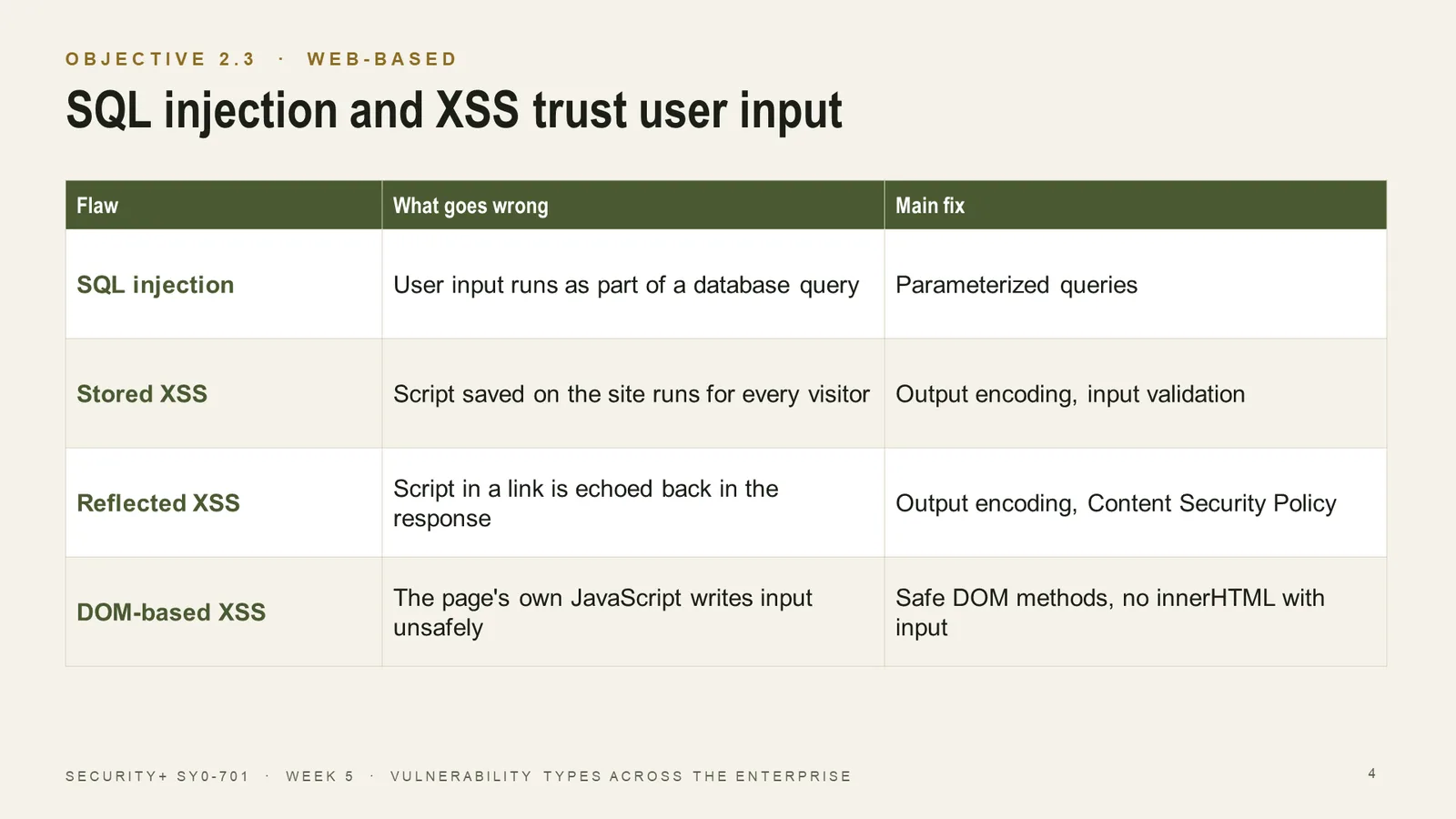
Both web flaws on the exam come from treating user input as code.
SQL injection (SQLi) happens when an application builds a database query by pasting in user input. A login form that runs SELECT * FROM users WHERE name = ' plus whatever was typed can be fooled by input such as ' OR 1=1 --. The quote closes the string, OR 1=1 is always true, and -- comments out the rest. The attacker may read, change, or delete data, or log in without a password. The fix is parameterized queries (prepared statements), which send the query and the data separately so input can never become code. Input validation and least-privilege database accounts help, but they are backups, not the fix.
Cross-site scripting (XSS) injects script that runs in another user's browser, under the trust of the vulnerable site. The script can steal session cookies, rewrite the page, or act as the user.
The fix is output encoding, so the browser shows an injected script tag as plain text instead of running it, plus input validation and a Content Security Policy that limits where scripts may load from.
Watch out
The exam trap: SQL injection attacks the server's database. XSS attacks users' browsers. If the question mentions a script running for visitors, it is XSS.
8 min
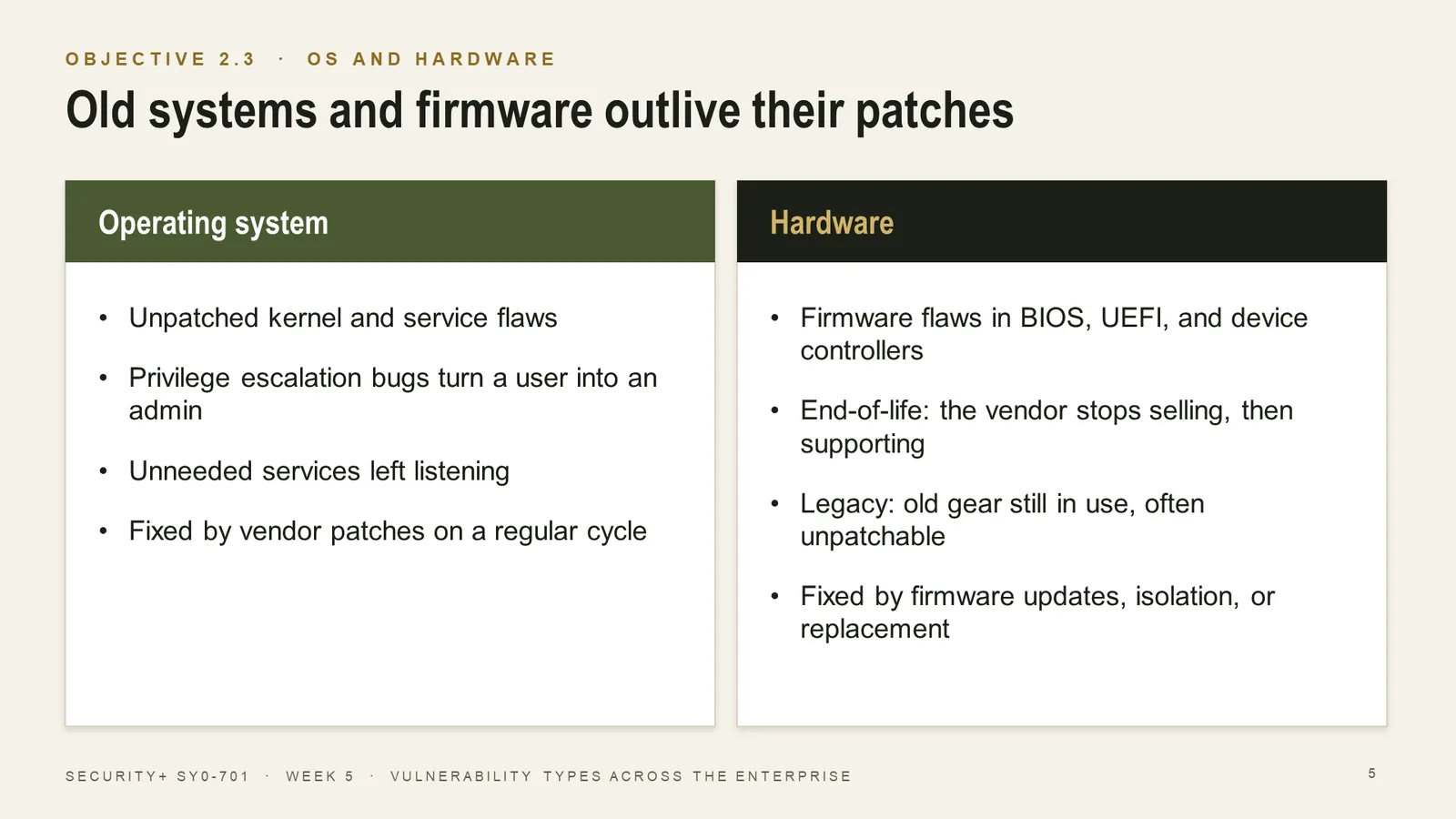
Operating system vulnerabilities are flaws in the kernel, drivers, and built-in services. They are the most common findings on any network scan. Many are privilege escalation bugs that let a normal user or process gain administrator or root rights. Others are remote flaws in network services. WannaCry spread in 2017 through an SMB flaw that Microsoft had patched two months earlier; organizations that had not applied the patch, or still ran unsupported Windows versions, were hit hardest. The control is a patch management process with deadlines by severity, plus disabling services you do not need.
Hardware vulnerabilities are harder to fix.
When you cannot patch, you contain: isolate the device on its own network segment, block it from the internet, restrict who can reach it, and monitor it closely. Those are compensating controls, and the long-term fix is a replacement plan in the budget.
8 min
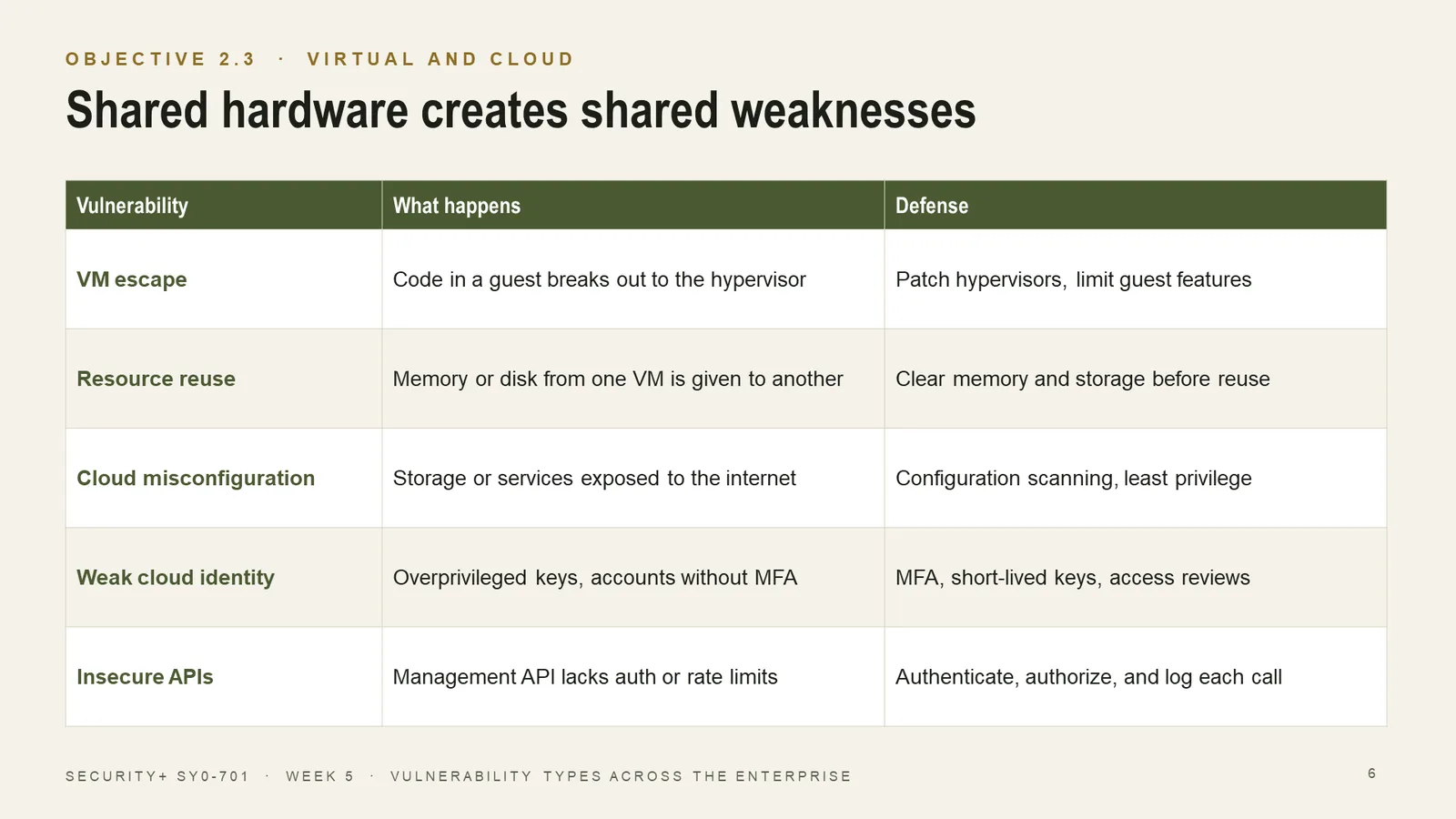
Virtualization runs many virtual machines on one physical host, separated by the hypervisor. Two vulnerabilities attack that separation.
VM escape is code inside a guest breaking out to the hypervisor or to other guests on the same host. It is rare and valuable, because one escape can expose every VM on the host. Defenses: patch the hypervisor promptly, disable guest features you do not use (shared folders, clipboard sharing, unneeded virtual devices), and do not mix trust levels on one host.
Resource reuse happens when memory, disk, or other resources freed by one VM or tenant are handed to another without being cleared. The new owner may read what the last one left behind. Hypervisors and cloud providers should zero memory and storage before reassigning it.
Cloud-specific vulnerabilities come mostly from the customer's side of the shared responsibility model, which you will study in week 7:
Cloud security posture management tools scan cloud accounts for these settings continuously.
Tip
If an exam scenario describes data exposed in a cloud storage bucket, the answer is almost always misconfiguration on the customer's side, not a flaw in the provider's platform.
10 min
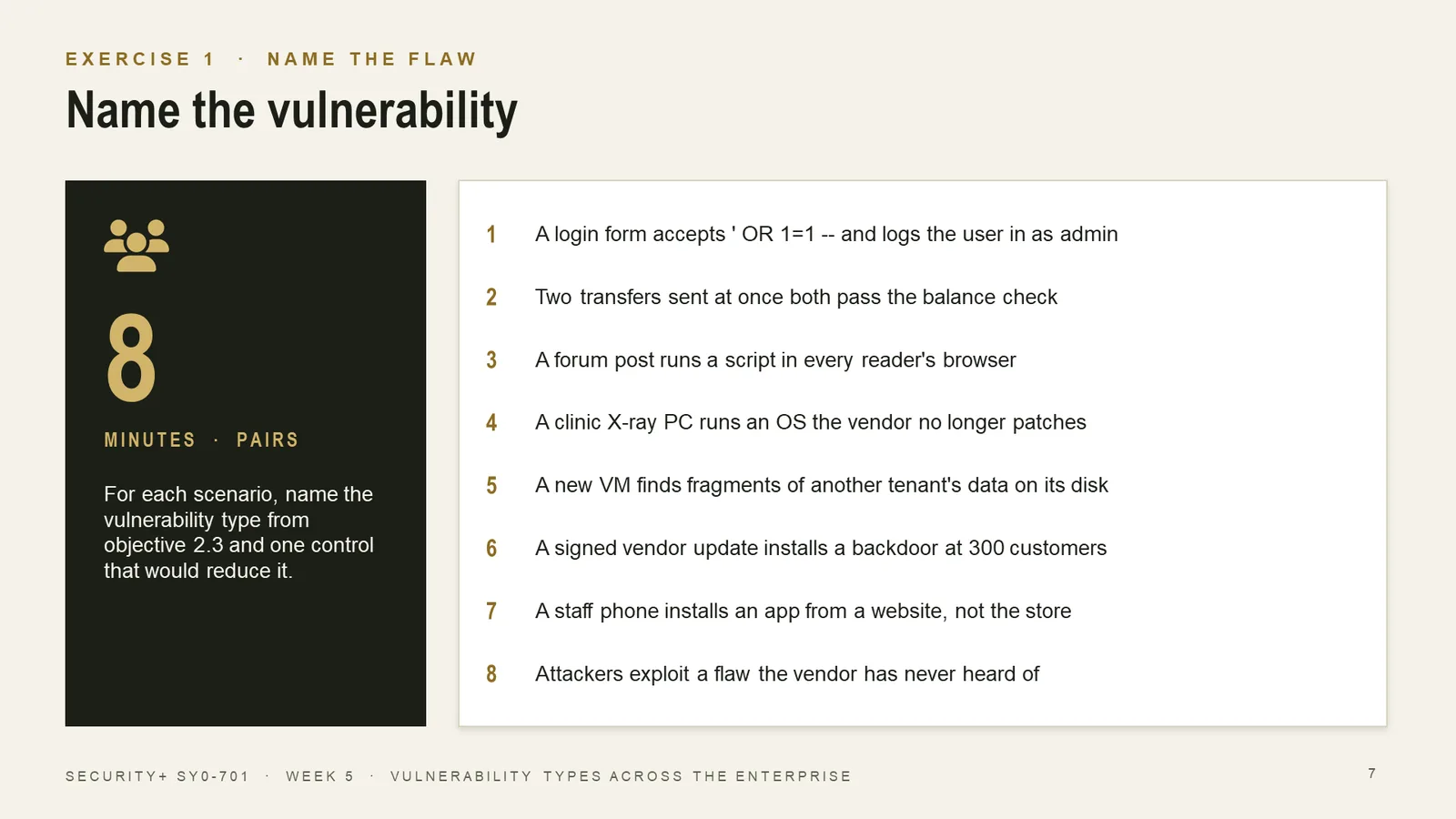
Work with a partner for eight minutes. For each scenario, name the vulnerability type as objective 2.3 words it, and one control that would reduce it. Use the most precise term you can.
' OR 1=1 -- and logs the user in as admin.7 min
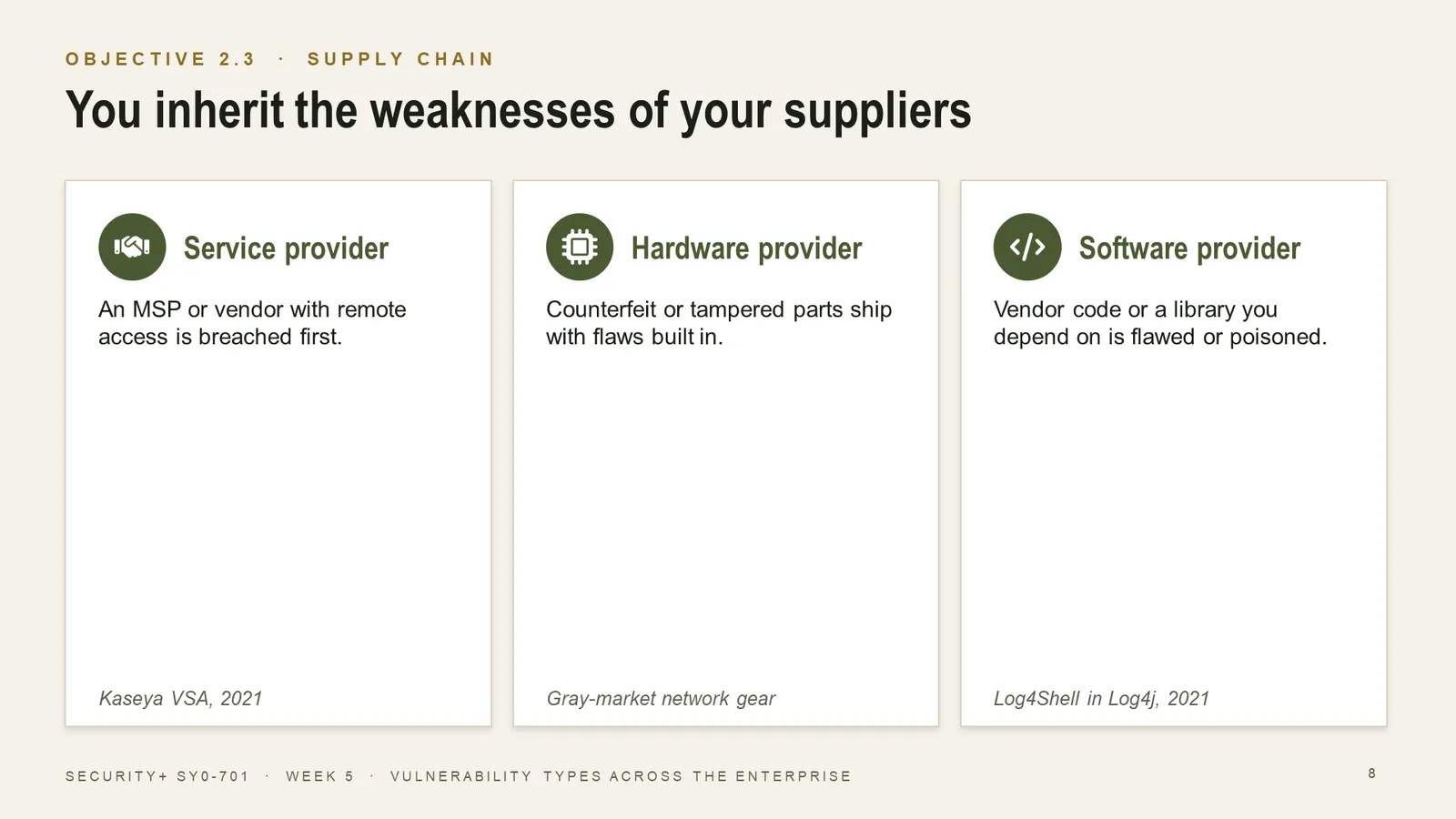
Every organization depends on others. A supply chain vulnerability is a weakness that enters through one of those suppliers. Security+ names three kinds of provider.
Controls fall into two groups. Before you buy: vendor risk assessments, security questionnaires, contract terms that require breach notice and patching, and a software bill of materials (SBOM) listing every component in a product. After you buy: least privilege for vendor access, remote access that is turned on only when needed, monitoring of vendor sessions, and staged testing of updates.
Tip
An SBOM is how you answer "are we affected?" in an hour instead of a week when the next Log4Shell lands.
8 min
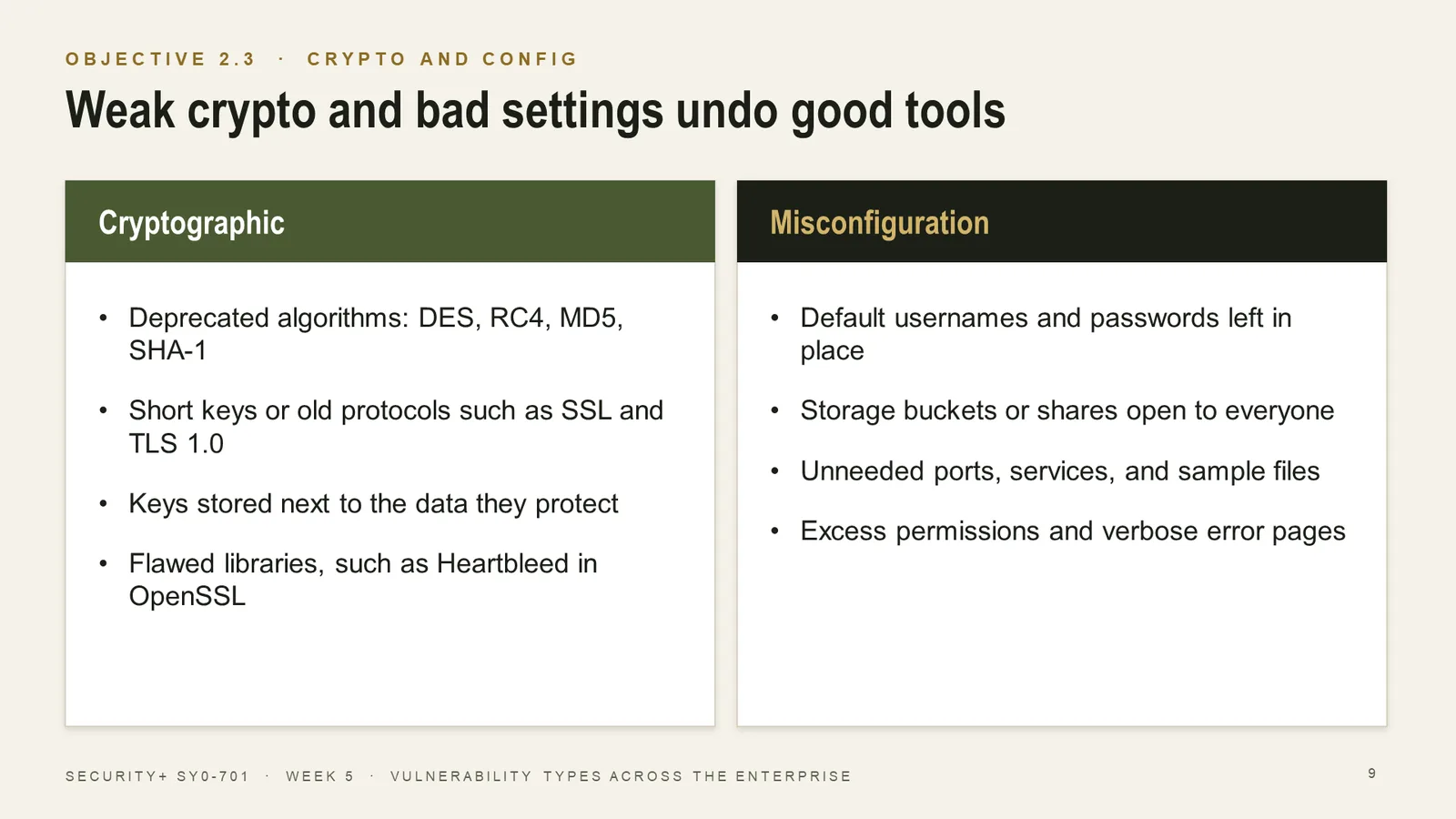
Cryptographic vulnerabilities make encryption or hashing weaker than it looks. They come in three forms.
Misconfiguration is a secure product set up insecurely. It is the most common class of finding in real assessments.
The cure is a secure baseline for each system type, such as a CIS Benchmark, applied automatically and checked by scans. You will harden a host against a benchmark in week 11.
Watch out
Encryption with a hardcoded key is a cryptographic vulnerability even if the algorithm is AES-256. The key is part of the system's strength.
7 min
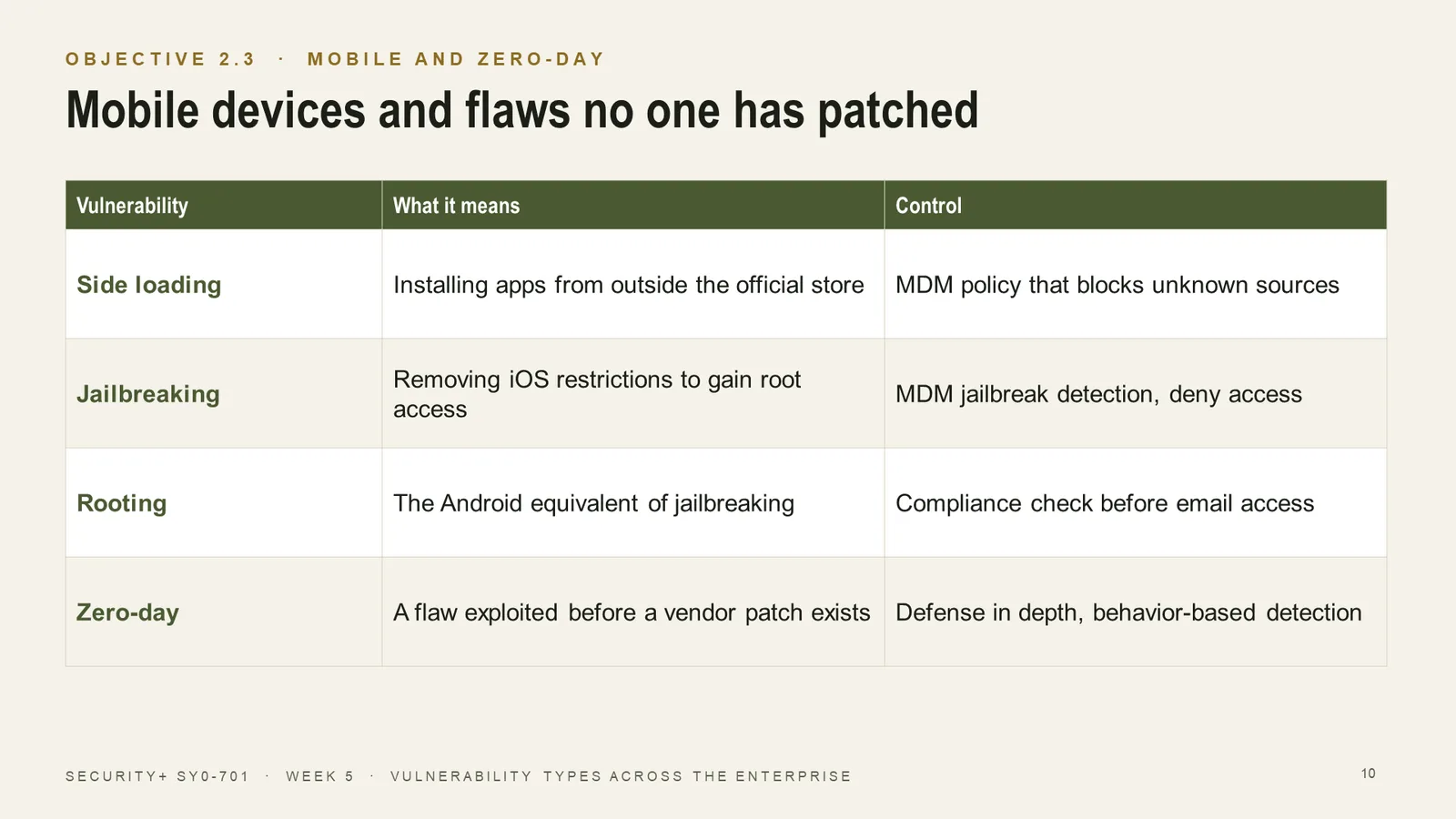
Phones and tablets hold email, patient messages, and MFA apps, and they leave the building every night. Two mobile vulnerabilities on the exam are created by the device's own user.
The control is mobile device management (MDM): policies that block unknown sources, detect jailbroken or rooted devices, and deny them access to company email and data until they comply.
A zero-day is a vulnerability that is unknown to the vendor, or known but without a patch, when attackers exploit it. The name comes from the defenders having had zero days to fix it. Signature-based tools cannot catch an exploit no one has seen, so defense relies on layers:
5 min
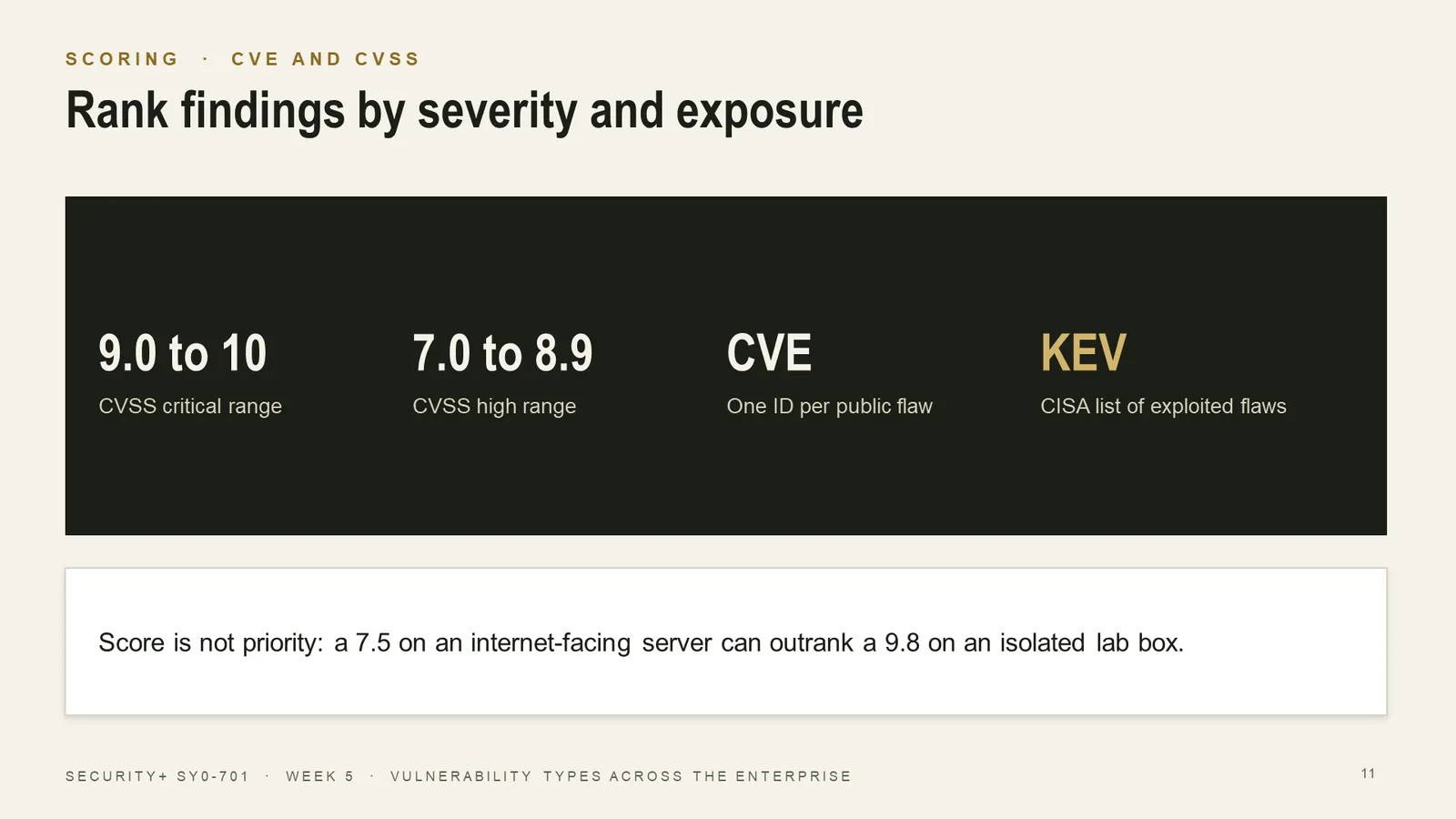
Scanners speak a shared language, and you need it to read a report.
The base score describes the flaw in general. It knows nothing about your network. To set priority, add your own context: is the system reachable from the internet, how valuable is the data on it, and is the flaw on the KEV list? A 7.5 on Lakeside's internet-facing patient portal should be fixed before a 9.8 on a lab VM that has no network access.
Tip
Scanners also make mistakes. A false positive reports a flaw that is not there, often because the scanner guessed from a version banner. A false negative misses a flaw that is there. You will judge both in Lab 5.
9 min
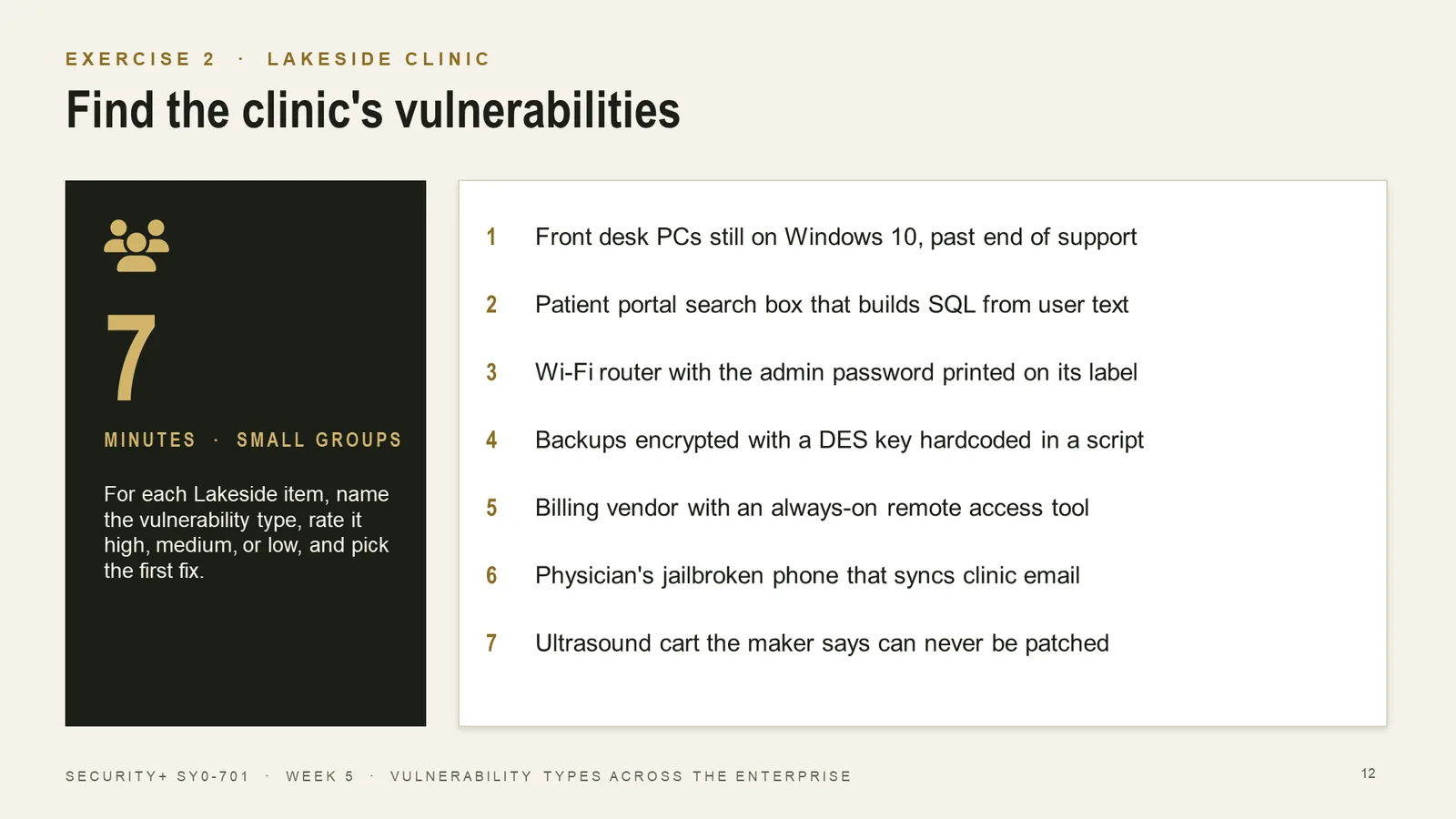
Lakeside Family Clinic has asked for a quick review before its first real scan. In groups, take each item, name its vulnerability type, rate it high, medium, or low for this clinic, and choose the first fix. Then rank your top two.
| # | Item |
|---|---|
| 1 | Front desk PCs still run Windows 10, which reached end of support in October 2025 |
| 2 | The patient portal search box builds its SQL query from what the user types |
| 3 | The Wi-Fi router still uses the admin password printed on its label |
| 4 | Backups are encrypted with DES, using a key hardcoded in the backup script |
| 5 | The billing vendor keeps a remote access tool running on the file server all the time |
| 6 | A physician uses a jailbroken phone that syncs clinic email |
| 7 | The ultrasound cart's maker says its embedded OS can never be patched |
Most groups rank 2 and 3 first: 2 because it is exposed to the internet, and 3 because it is serious and free to fix.
3 min
You can now name the vulnerability types in objective 2.3 and connect each to a typical fix.
Finally, severity is not priority. Combine the CVSS score with exposure, the value of the asset, and whether the flaw is being exploited. Answer the five review questions, then take the quiz.
Write your answers to the five review questions first, then open each one to check it.
A race condition, specifically TOC/TOU (time of check to time of use). The fix is to make the check and the use one atomic operation.
Parameterized queries, also called prepared statements, which keep user input separate from the query code. Input validation and a least-privilege database account are supporting controls.
The vendor no longer issues patches, so any flaw found in the future stays open. Contain it with isolation and monitoring, and plan to replace it.
Memory or storage released by one VM or tenant is assigned to another without being cleared, so the new owner may read leftover data.
CVSS rates the flaw in general. Priority adds local context: exposure to the internet, the value of the asset, and whether the flaw is actively exploited, for example on the CISA KEV catalog.
60 min
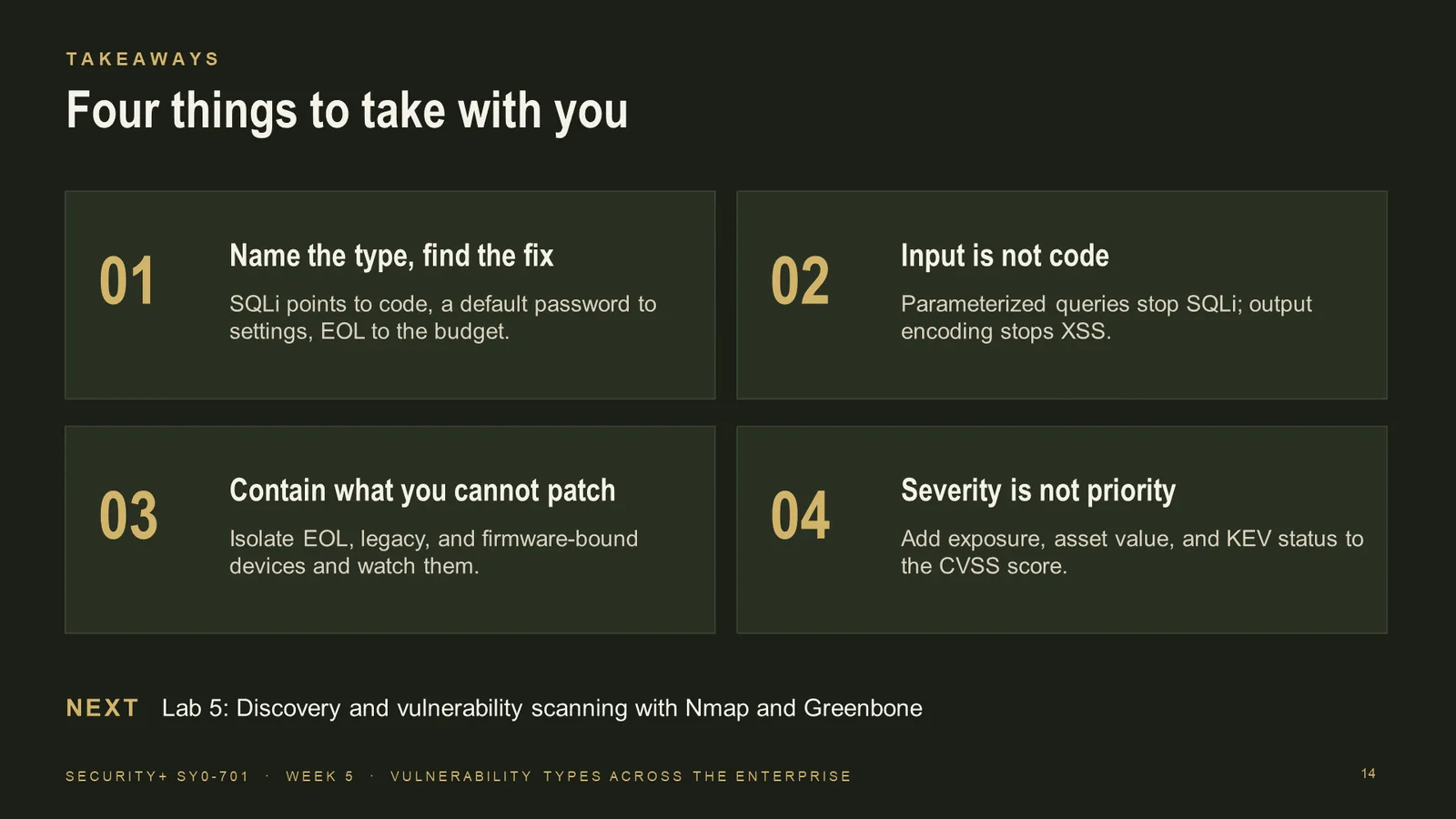
01 Name the type, find the fix
SQLi points to code, a default password to settings, EOL to the budget.
02 Input is not code
Parameterized queries stop SQLi; output encoding stops XSS.
03 Contain what you cannot patch
Isolate EOL, legacy, and firmware-bound devices and watch them.
04 Severity is not priority
Add exposure, asset value, and KEV status to the CVSS score.
Week 5 interactive lab
Warhawk Division Vulnerability Lab (Nmap 7.94)
Authorized target subnet: 10.20.1.0/24. Follow Step 1 in the Guide or click a command below.
You need the week 1 lab plus a scanner VM. Before class, build a Kali Linux VM on the NAT adapter, run sudo apt update && sudo apt install -y gvm and then sudo gvm-setup (the feed download can take an hour or more), then move it to your host-only network; your week 1 Ubuntu and Windows VMs are the targets. Scan only hosts on your own lab network. Scanning systems you do not own, or lack written permission to test, can break the law, including the Computer Fraud and Abuse Act, and school and employer networks are off limits.
Lab steps · 0 of 8 complete (0%)
A two to three page lab report with screenshots of the Nmap discovery and service scans and the Greenbone report summary, a table of your top three findings with their CVSS scores and vulnerability types, and answers to the lab questions.