
Loading
Warhawk Division is a gaming community. This is a unit document, not a government or military publication.Warhawk Division is an independent gaming community, for entertainment purposes only. It is not affiliated with, sponsored by, or endorsed by Bohemia Interactive, the United States Department of Defense, or any military organization. Arma Reforger is a trademark of its respective owner. Printed from warhawkdivision.com.
Week 16 content
0 of 12 done
Slide 1 of 13
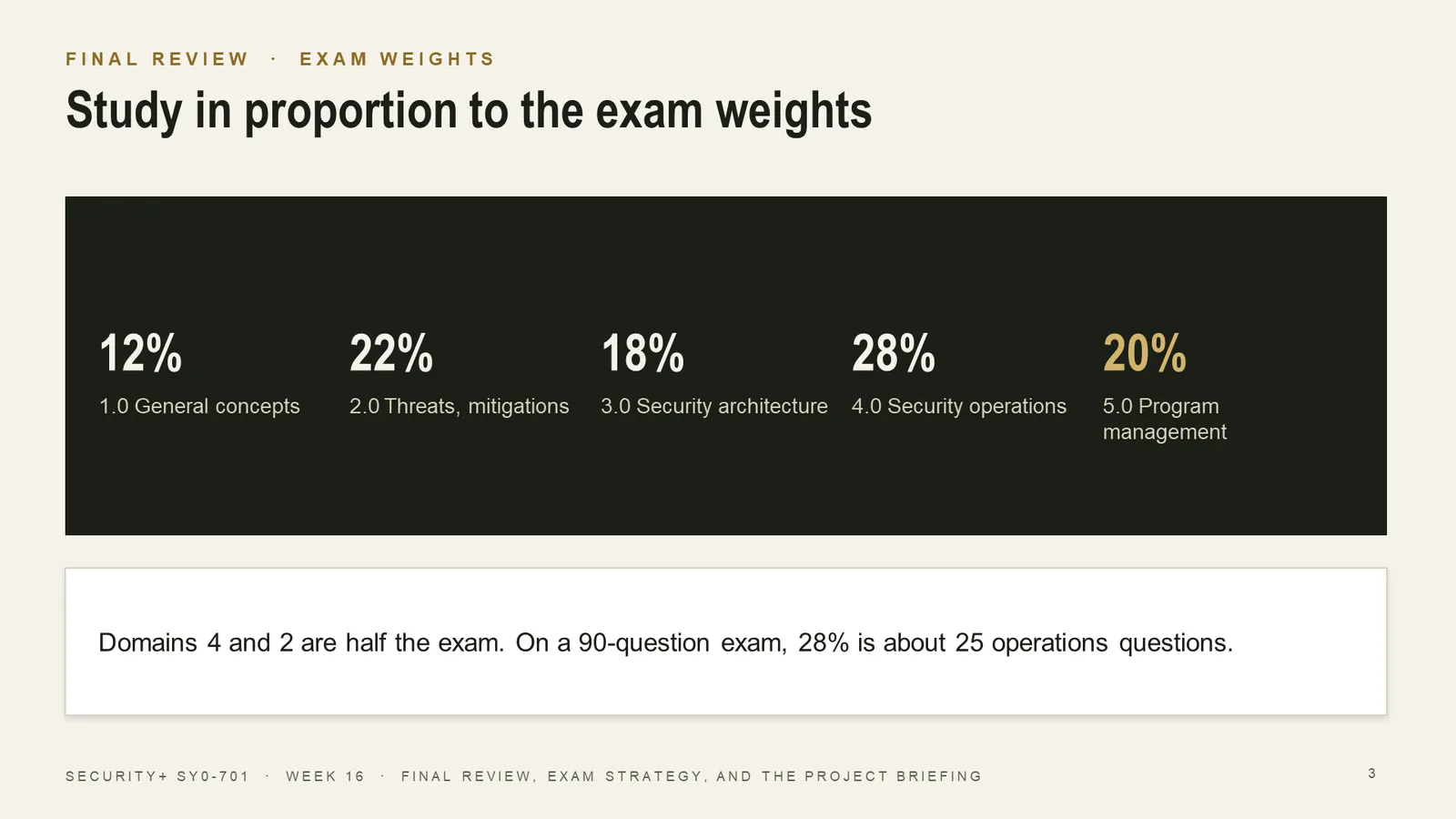
Exam objectives: 1.0 General Security Concepts (12%) 2.0 Threats, Vulnerabilities, and Mitigations (22%) 3.0 Security Architecture (18%) 4.0 Security Operations (28%) 5.0 Security Program Management and Oversight (20%)
3 min
This week pulls the whole course together. The real exam weights its five domains unevenly, and your study time should follow the same weights.
| Domain | Weight | About this many of 90 questions |
|---|---|---|
| 1.0 General Security Concepts | 12% | 11 |
| 2.0 Threats, Vulnerabilities, and Mitigations | 22% | 20 |
| 3.0 Security Architecture | 18% | 16 |
| 4.0 Security Operations | 28% | 25 |
| 5.0 Security Program Management and Oversight | 20% | 18 |
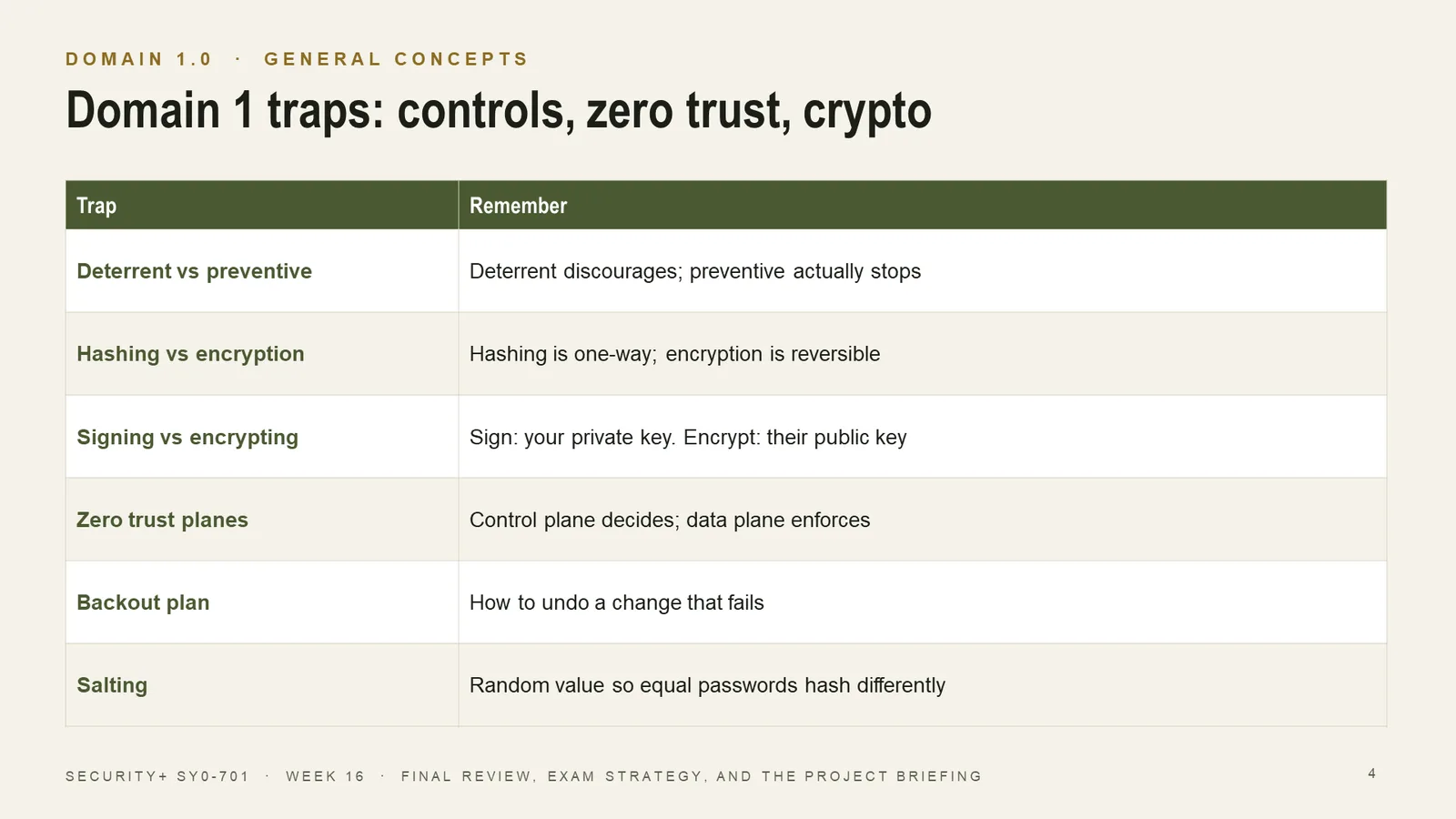
Each domain section below gives a short summary and the traps that cost students the most points. Read each one, then cover the right column of the slide table and see whether you can state the rule from memory. Anything you cannot state is on your study list.
The practice final at the end has 30 questions in the same proportions: about 4, 7, 5, 8, and 6 per domain. Take it timed, at one minute per question, and score it by domain, not just in total. A total of 80 percent can hide a domain at 50 percent.
The last part of the lesson turns to your project briefing. Security staff who can explain risk to leadership get their recommendations funded; those who cannot often do not.
8 min
Domain 1 is the vocabulary the rest of the exam assumes. It has four objectives.
1.1 Security controls. Categories (technical, managerial, operational, physical) say how a control is carried out; types (preventive, deterrent, detective, corrective, compensating, directive) say what it does. A control has one category and can serve several types.
1.2 Fundamental concepts. The (confidentiality, integrity, availability), , and (authentication, authorization, accounting). A gap analysis compares where you are with where you need to be. separates a control plane (adaptive identity, threat scope reduction, policy-driven access control, the , and the ) from a data plane (subjects and systems, implicit trust zones, and the ). Physical security includes bollards, access control vestibules, fencing, lighting, and sensors. Deception uses , honeynets, honeyfiles, and honeytokens.
1.3 Change management. Approval, ownership, stakeholders, impact analysis, test results, a backout plan, a maintenance window, and an , plus technical effects such as allow and deny lists, restarts, downtime, legacy applications, dependencies, and updated documentation.
1.4 Cryptography. Symmetric encryption uses one shared key and is fast (). Asymmetric encryption uses a key pair (, ) and solves key exchange. Hashing is one-way and proves integrity; defeats precomputed tables, and key stretching slows guessing. A is made with the sender's private key and verified with the sender's public key. Certificates bind a public key to an identity, and revocation is checked with a or . A is a chip in one device; an is a dedicated device that protects many keys. Obfuscation includes , tokenization, and data masking.
Watch out
To send someone a confidential message, encrypt with their public key. To sign, use your private key. Mixing these up is the most common Domain 1 miss.
12 min
Domain 2 is 22 percent of the exam and covers who attacks, how, and what stops them.
2.1 and motivations. Nation-states have the most resources and seek espionage or disruption. Organized crime wants money. Hacktivists want attention for a cause. already have access. Unskilled attackers use other people's tools. is staff using unapproved systems. Motivations include data exfiltration, financial gain, espionage, revenge, and disruption.
2.2 Threat vectors and attack surfaces. Message-based vectors (email, , instant messaging), voice calls, removable devices, vulnerable or unsupported software, unsecure networks, open ports, default credentials, and the supply chain. Human vectors: , (voice), (SMS), , pretexting, impersonation, attacks, brand impersonation, and .
2.3 Vulnerabilities. Memory injection, , race conditions (), malicious updates, and , firmware and hardware, escape and resource reuse, cloud misconfiguration, supply chain, weak cryptography, and , and .
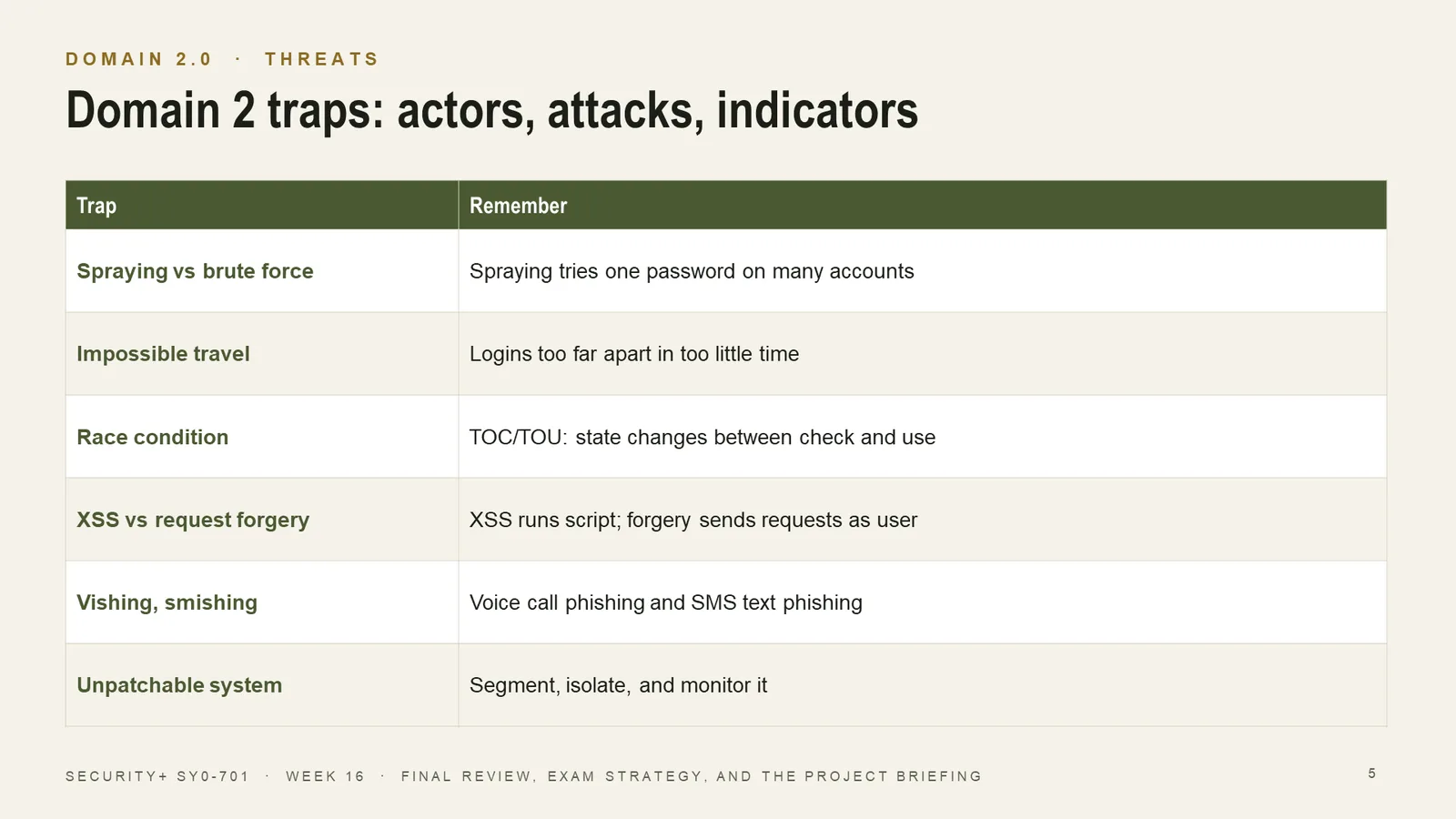
2.4 Indicators of malicious activity. Malware (, , , , , , keyloggers), network attacks (, attacks, , credential replay), application attacks (injection, , request forgery, ), and password attacks: tries a few common passwords against many accounts, while tries many passwords against one. Indicators include account lockouts, concurrent sessions, , unusual resource consumption, out-of-cycle logging, and missing logs.
2.5 Mitigation techniques. Segmentation, and permissions, , isolation, patching, encryption, monitoring, , configuration enforcement, decommissioning, and hardening: disable unused ports and services, change default passwords, and install endpoint protection, host-based firewalls, and .
Tip
When a question describes a system that cannot be patched, look for segmentation or isolation plus monitoring. Those are the compensating answers.
10 min
Domain 3 asks you to design environments that resist attack and recover from failure.
3.1 Architecture models. Know the cloud responsibility matrix: the provider secures more in , the customer more in . Know , , , , virtualization, , /, embedded systems, and . networks are physically isolated; and segment logically. Weigh availability, resilience, cost, scalability, ease of recovery, and whether a system can be patched at all.
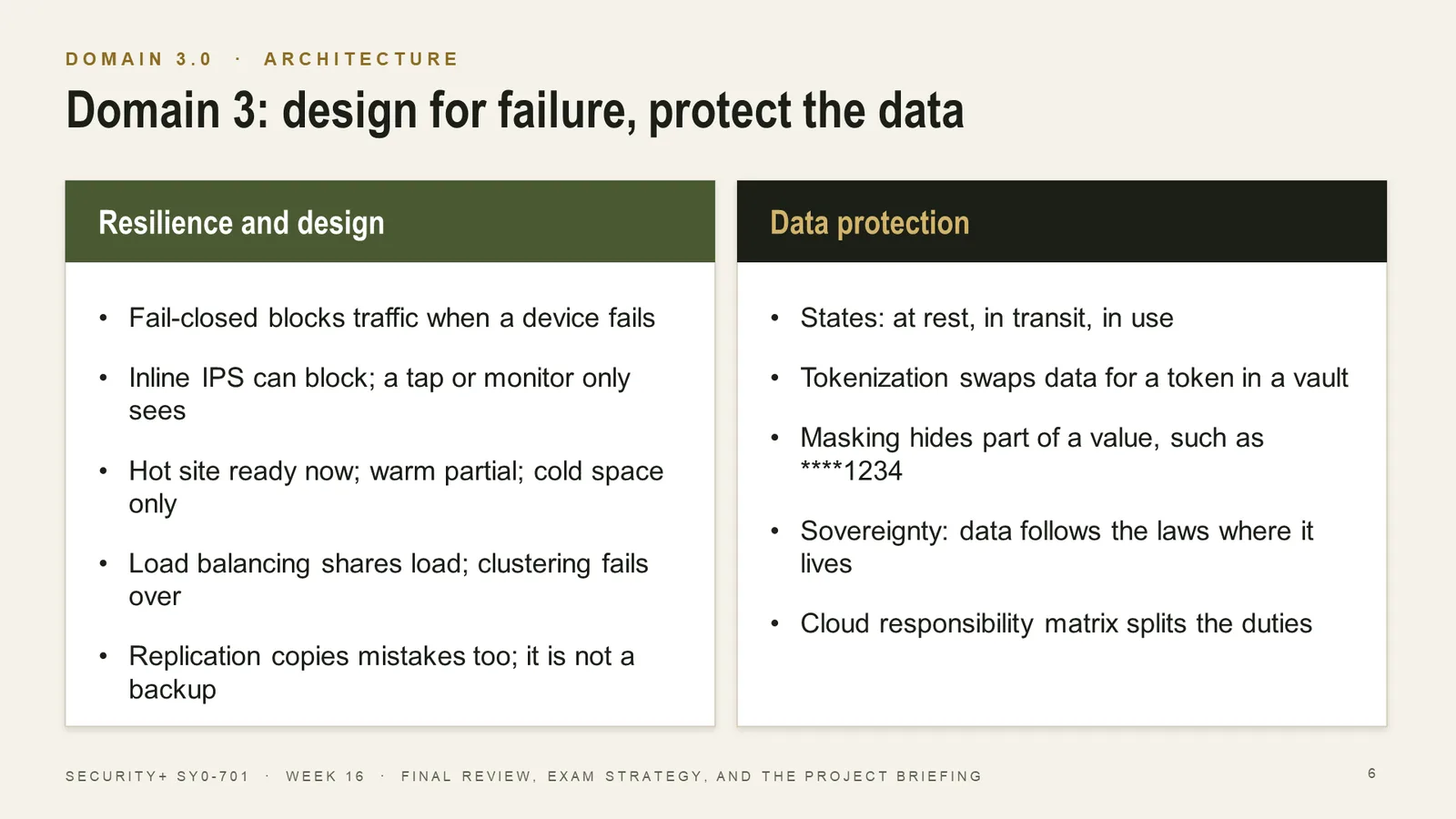
3.2 Secure infrastructure. Place devices by security zone and attack surface. A device lets traffic through when it fails, which favors availability; fail-closed blocks it, which favors security. An inline can block; a tap or monitor sensor only sees copies. Know , proxies, , with for port security, , , (layer 7), with or IPsec, , and .
3.3 Data protection. Data types (regulated, , , legal, financial) and classifications (sensitive, confidential, public, restricted, private, critical). States: at rest, in transit, in use. means data is subject to the laws of the country where it is stored. Methods: geographic restrictions, encryption, hashing, masking (hide part of the value), tokenization (swap the value for a token mapped in a secure vault), obfuscation, segmentation, and permission restrictions.
3.4 Resilience and recovery. through load balancing (sharing load) or clustering (standby nodes take over). Sites: hot (ready now), warm (equipment in place, needs data and setup), cold (space and power only). Geographic dispersion, platform diversity, multi-cloud, , and capacity planning for people, technology, and infrastructure. Test with tabletops, failover, simulation, and parallel processing. Backups: onsite and offsite, frequency, encryption, snapshots, replication, and journaling. Power: a for short gaps, generators for long ones.
Watch out
Replication copies mistakes and ransomware almost instantly. It improves availability, but it is not a backup.
15 min
Domain 4 is 28 percent of the exam, the largest. It has nine objectives, so study it in chunks.
4.1 Baselines and hardening. Establish, deploy, and maintain secure baselines, often from . Harden workstations, servers, network devices, mobile devices, cloud, ICS, and IoT. Wireless: , with 802.1X, site surveys and heat maps. Mobile: with , , or . Applications: input validation, secure cookies, static code analysis, code signing, sandboxing.
4.2 Asset management. Acquisition, assignment of owners and classification, inventory, and disposal: media you will reuse, destroy media you retire, and get a certificate of destruction from vendors.
4.3 Vulnerability management. Identify (scans, static and dynamic analysis, , pen tests, bug bounties), analyze (confirm, rule out , prioritize with and ), respond (patch, insure, segment, add , or grant an exception), validate by rescanning, and report.
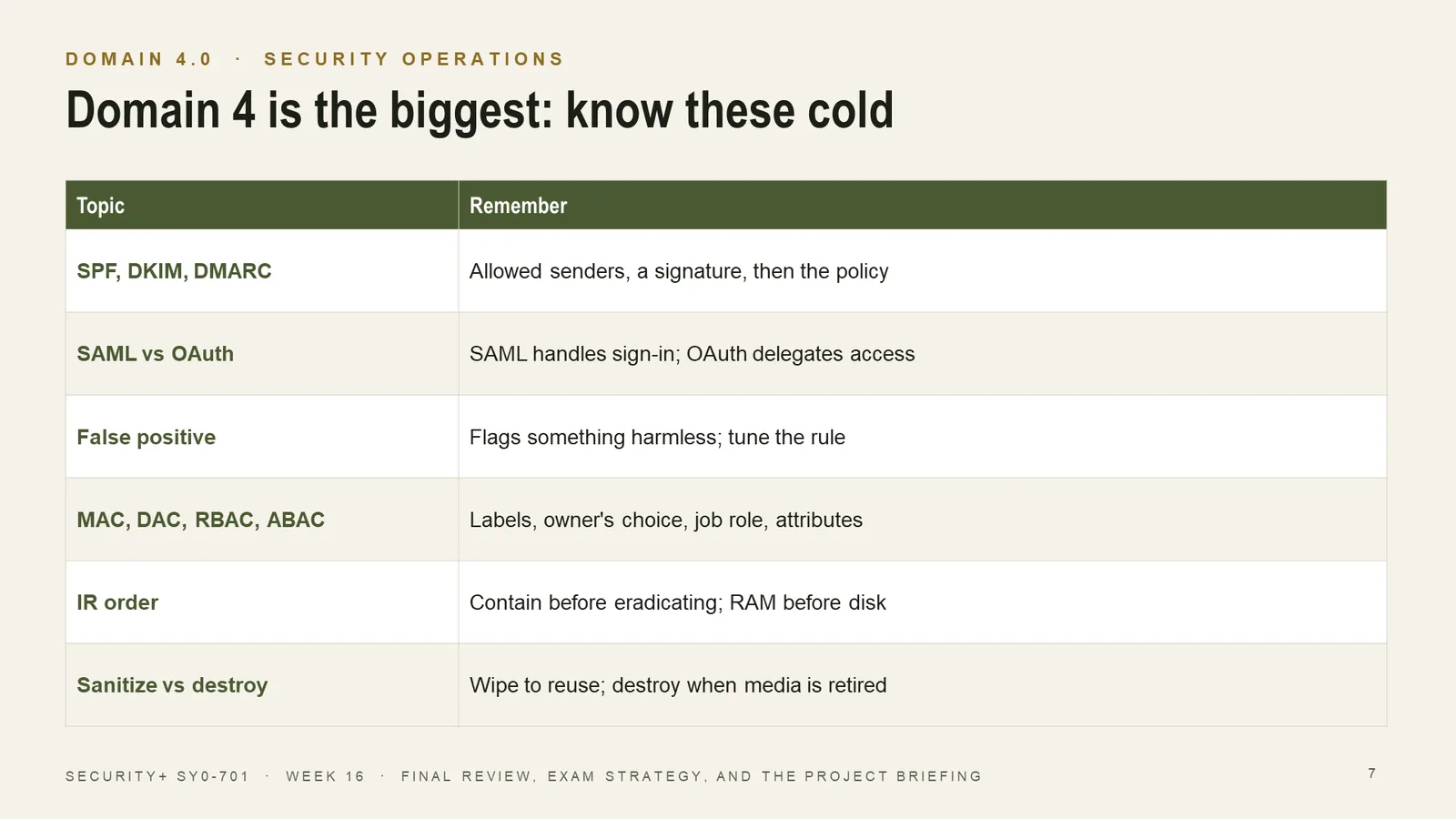
4.4 and 4.5 Monitoring and enterprise capabilities. Log aggregation, alerting and alert tuning, , , agent and agentless tools, NetFlow, , . Firewall rules and ACLs, , /IPS, web and DNS filtering, Group Policy and , , , /, and . Email: lists allowed sending servers, signs messages, tells receivers what to do when checks fail.
4.6 Identity and access management. Provisioning and deprovisioning, , federation, with , , and , , passwordless, and with access, vaulting, and ephemeral credentials. Access models: (labels), (owner decides), (job role), rule-based, (attributes), time-of-day restrictions, and least privilege.
4.7 Automation and orchestration. Provisioning, guardrails, ticketing, and /. Benefits are speed and consistency; risks are complexity, cost, a single point of failure, and .
4.8 and 4.9 Incident response and data sources. The seven phases, tabletops and simulations, root cause analysis, threat hunting, legal hold, , , and matching each log to the question it answers.
Tip
FIRST in an incident question usually means containment once the incident is confirmed, and before disk when collecting evidence.
11 min
Domain 5 is 20 percent of the exam and the least technical, which makes it easy to underestimate.
5.1 Governance. Policies (, information security, business continuity, disaster recovery, incident response, , change management), standards (password, access control, physical security, encryption), procedures (change management, onboarding and offboarding, playbooks), and guidelines. Boards, committees, government entities, and centralized or decentralized structures. Owners, controllers, processors, and custodians or stewards.
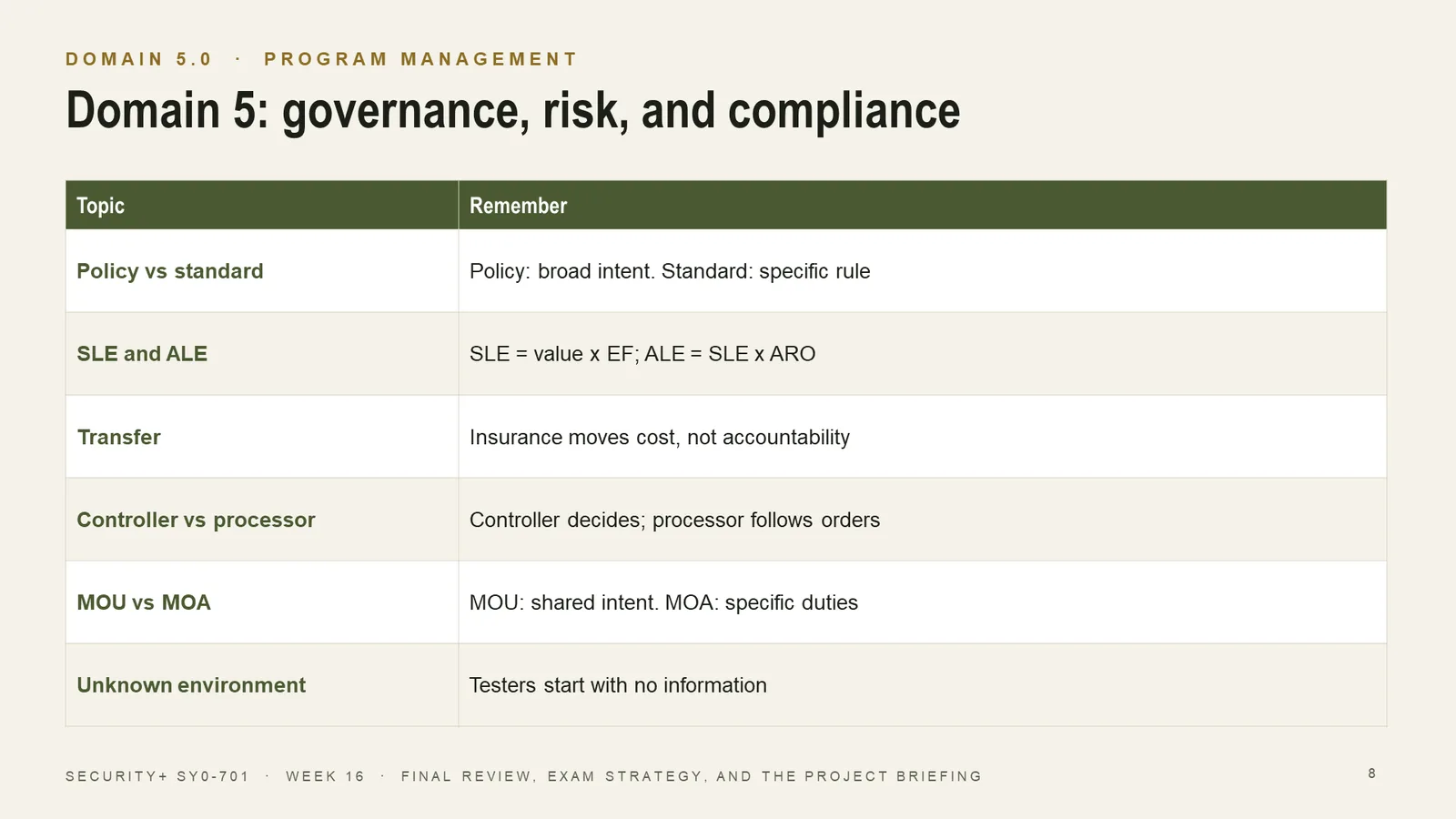
5.2 Risk management. Identification; assessments that are ad hoc, recurring, one-time, or continuous; qualitative and quantitative analysis. = asset value x and = SLE x . The with owners, , and thresholds. Appetite (expansionary, neutral, conservative) and tolerance. Strategies: transfer, accept (with exemptions and exceptions), avoid, and mitigate. metrics: , , , and .
5.3 Third-party risk. and conflicts of interest; right-to-audit clauses, evidence of internal audits, independent assessments, and supply chain analysis; questionnaires, , and ongoing monitoring. Agreements: , , , , /SOW, , and .
5.4 Compliance. Internal and external reporting; fines, sanctions, reputational damage, loss of license, and contractual impacts. Due diligence and , and acknowledgement, and automation. Privacy: the , controller vs processor, ownership, data inventory and retention, and the .
5.5 Audits and assessments. Internal (compliance, audit committee, self-assessments) and external (regulatory, examinations, assessments, independent third-party audits). Penetration tests: physical, offensive, defensive, and integrated; known, partially known, and ; passive and active reconnaissance.
5.6 Security awareness. Phishing campaigns, recognizing and reporting phishing, risky, unexpected, and unintentional behavior, user training topics, initial and recurring training, and program development and execution.
Watch out
Transfer moves the financial impact, not accountability. If cyber insurance pays after a breach, regulators still hold the clinic responsible.
12 min
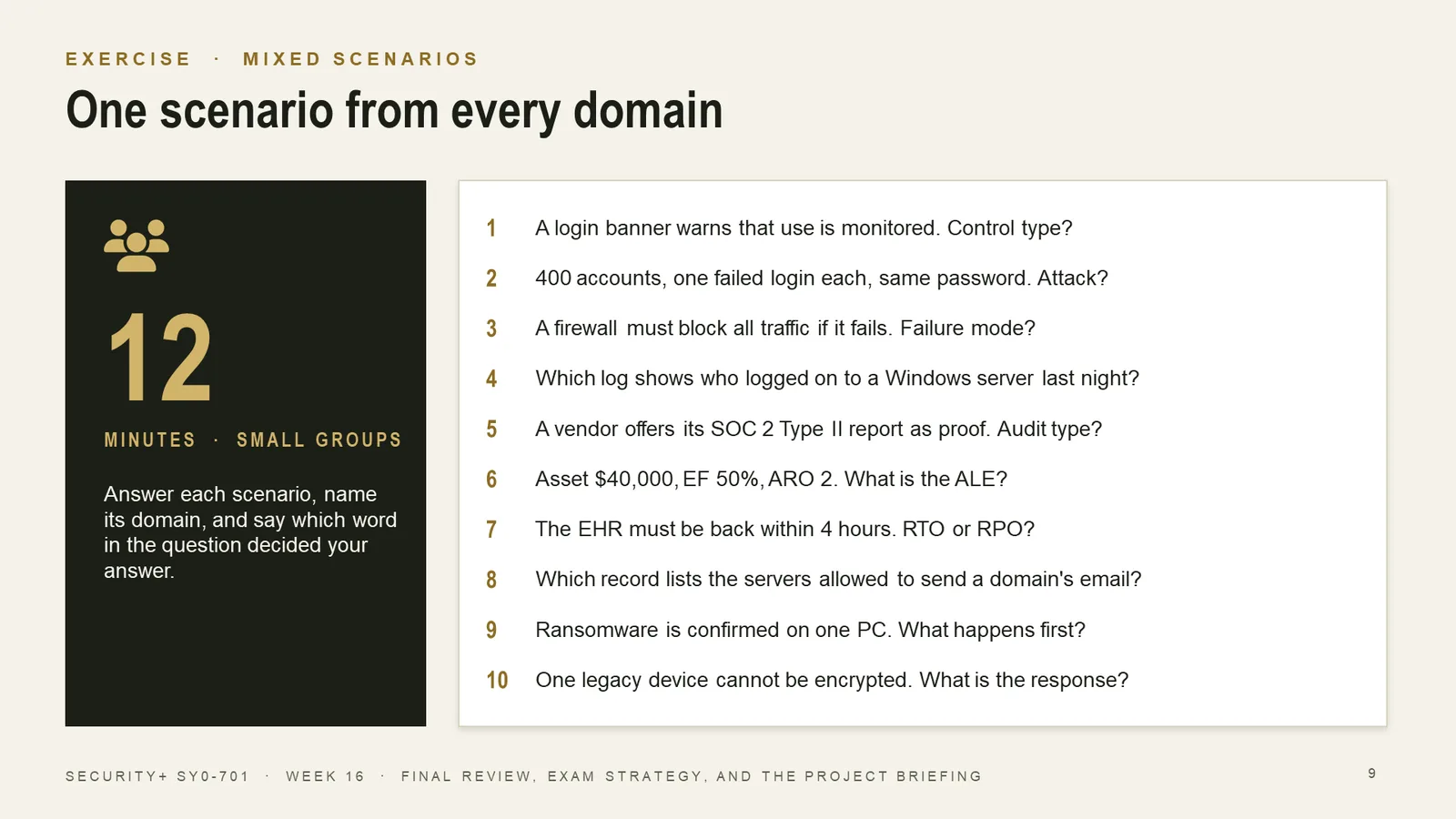
Work in small groups for twelve minutes. Each scenario comes from a different part of the exam. For each one, give the answer, name the domain, and identify the word in the question that decided it.
| # | Answer | Domain | Deciding word |
|---|---|---|---|
| 1 | Deterrent (also directive) | 1.0 | "warns": it discourages but cannot stop anyone |
| 2 | Password spraying | 2.0 | "many accounts, same password" |
| 3 | Fail-closed | 3.0 | "block all traffic" |
| 4 | -specific security log (Windows Security log, event 4624) | 4.0 | "logged on" |
| 5 | Independent third-party audit; the report is an attestation | 5.0 | "SOC 2" from an outside firm |
| 6 | SLE = $40,000 x 0.5 = $20,000; ALE = $20,000 x 2 = $40,000 | 5.0 | "ALE" |
| 7 | RTO | 3.0 and 5.0 | "running again within": time to restore |
| 8 | SPF, published as a DNS record | 4.0 | "allowed to send" |
| 9 | Isolate the PC from the network and leave it powered on | 4.0 | "confirmed" and "first": containment |
| 10 | A compensating control, such as isolating the device and adding monitoring, recorded as a documented exception | 1.0 and 5.0 | "cannot be" |
Debrief points.
8 min
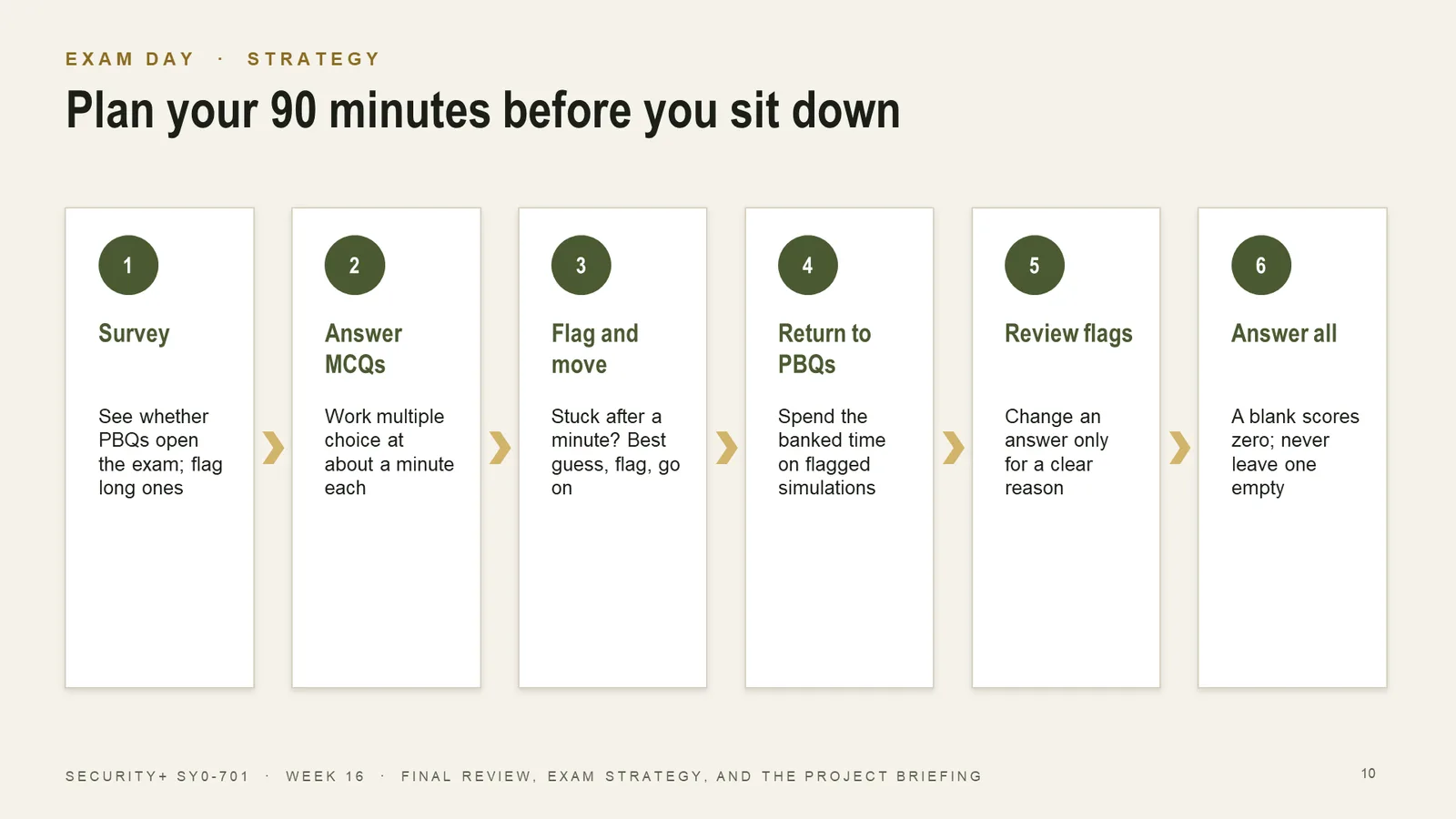
The exam has at most 90 questions in 90 minutes, and the passing score is 750 on a scale of 100 to 900. Some questions are performance-based questions (): you drag items into place, build firewall rules, read logs, or match attacks to controls. They often appear at the start and can take five to ten minutes each.
A plan that works for many students:
Read like an examiner. In a long scenario, read the last sentence first so you know what you are looking for. Watch the keywords: BEST means more than one answer may work, so pick the most complete; FIRST asks about order; MOST likely asks about probability. Answer the way the exam objectives describe the topic, not the way your own workplace happens to do it.
Before exam day. Book the exam for two to four weeks after this course. Check the testing center or online proctoring rules, have the required ID ready, and sleep the night before. Last-minute cramming hurts recall more than it helps.
Tip
Do one full timed run first: 90 questions, 90 minutes, no notes. Score it by domain to see where your last study hours should go.
9 min
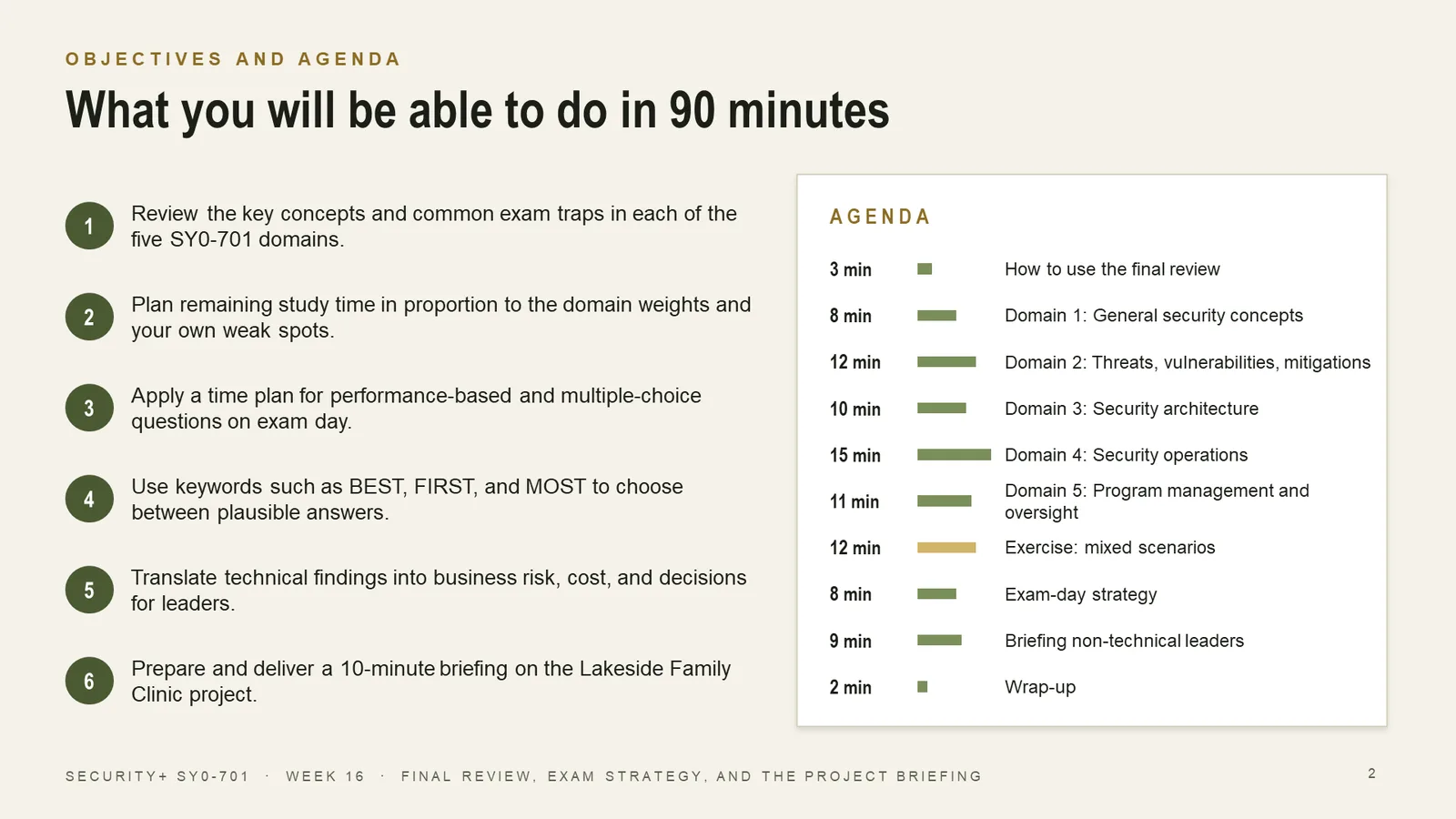
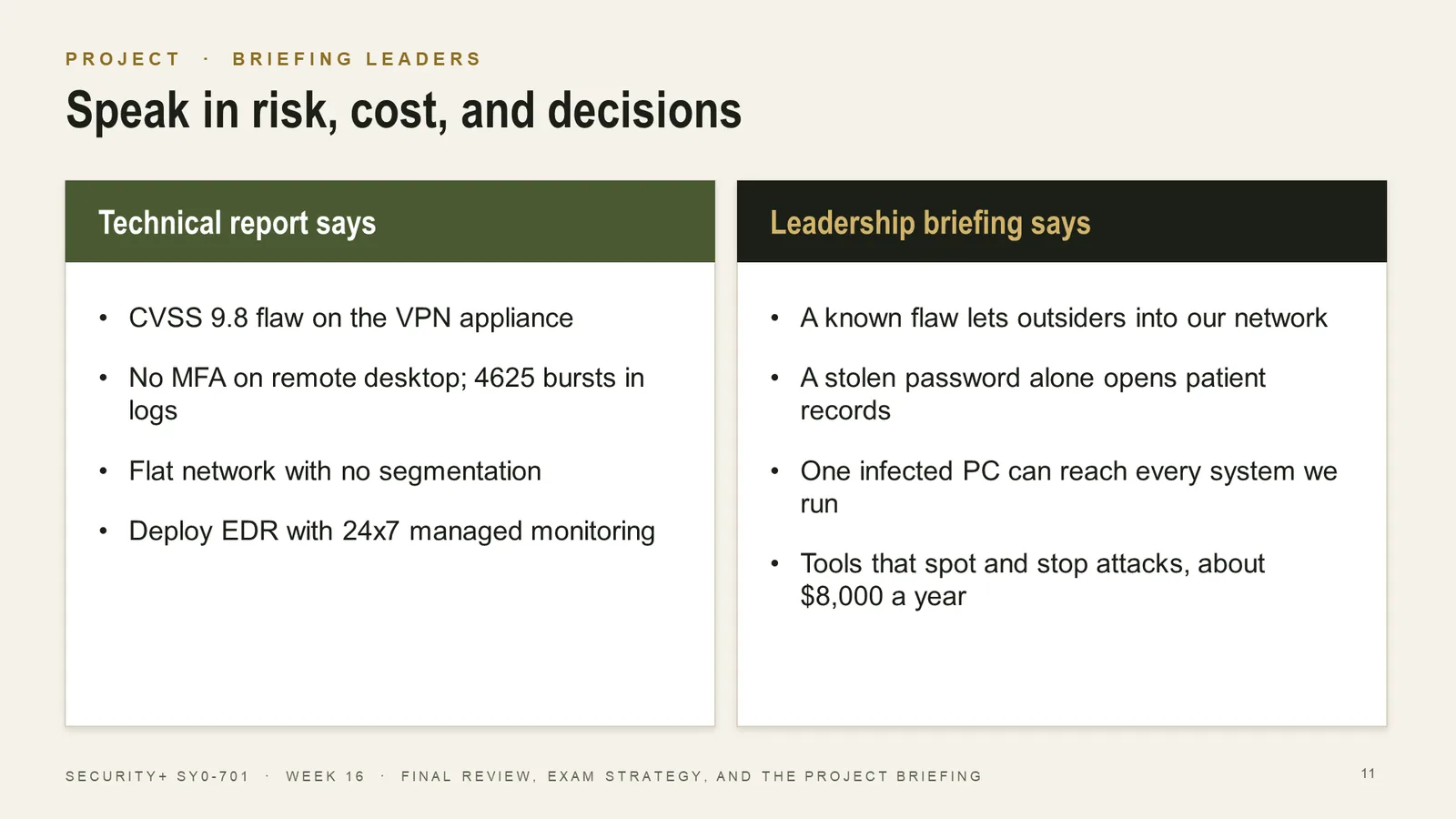
Your project ends with a 10-minute briefing to Lakeside's leadership: the owner-physicians and the practice manager. They are smart, busy, and not technical. They want answers to four questions: how bad is it, what will it cost, what do you need from us, and what happens if we do nothing?
Start with the bottom line. The first minute states your conclusion and your request. For example: "The clinic's biggest risk is a ransomware attack that would stop patient care for days. Three changes costing about $22,000 in the first year sharply reduce that risk. We are asking for your approval today."
Translate every finding into business terms.
Limit the asks. Present three to five prioritized recommendations, each with its cost, effort, owner, and the risk it reduces. Offer options where they exist: do it now, phase it in, or accept the risk with a signed exception.
Prepare for questions. Expect "Has this happened to clinics like us?", "What does our insurance cover?", and "What is the cheapest thing we can do this month?" If you do not know an answer, say so and promise a follow-up. Never bluff.
Avoid unexplained acronyms, tool names, fear-based language, and blame. Leaders tune out alarms and act on clear trade-offs. Your report holds the technical evidence; the briefing exists to get a decision.
Tip
Try your slides on someone outside the field. If after two minutes they cannot tell you the top risk and the decision you need, simplify.
2 min
You have now covered every objective in the SY0-701 exam. The pattern across all five domains is the same: name the concept precisely, recognize it in a scenario, and choose the control or action that fits the situation best.
In the time before the exam, study by weight and by weakness. Domains 4 and 2 together are half the exam, and your practice final, scored by domain, shows where your own gaps are. For each weak domain, go back to that week's review questions and quiz, and redo the exercises without looking at the answers first.
For the project, the report and the briefing are the same work for two audiences. The report gives the evidence; the briefing asks for a decision. Keep the briefing short, plain, and honest about cost and risk.
The skills you practiced in this course, from writing a risk register to running a tabletop exercise, are the daily work of entry-level security staff. Book the exam while the material is fresh.
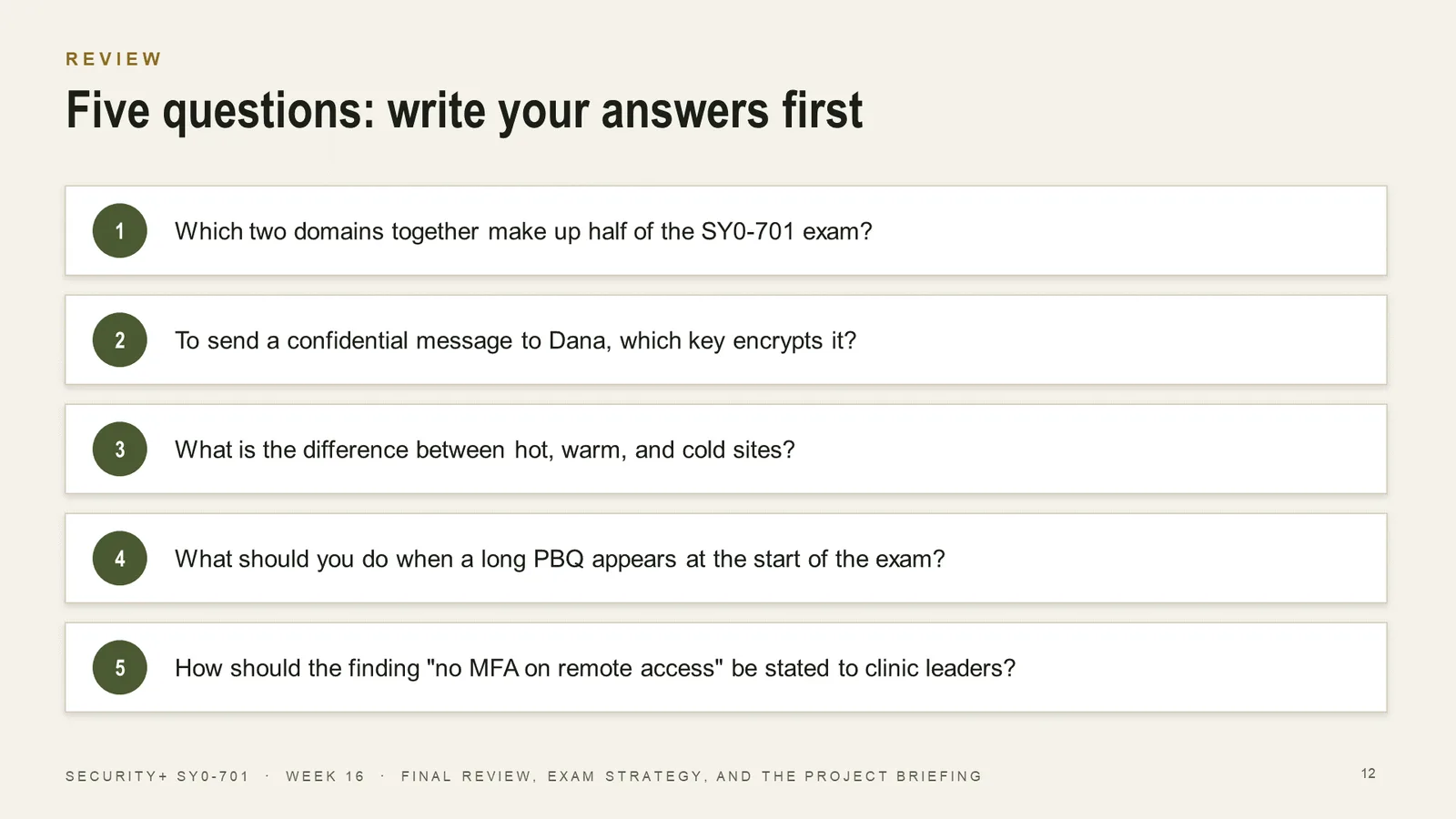
Write your answers to the five review questions first, then open each one to check it.
Domain 4.0, Security Operations (28%), and Domain 2.0, Threats, Vulnerabilities, and Mitigations (22%).
Dana's public key. Only Dana's private key can decrypt the message.
A hot site is ready to take over almost immediately. A warm site has some equipment in place but needs current data and setup. A cold site has space and power only.
Flag it, answer the multiple-choice questions, and return with the time you banked. Do as much of it as you can and never leave it blank.
In business terms: a stolen password alone lets an outsider reach patient records from anywhere, followed by the cost to fix it and the decision you need from them.
60 min
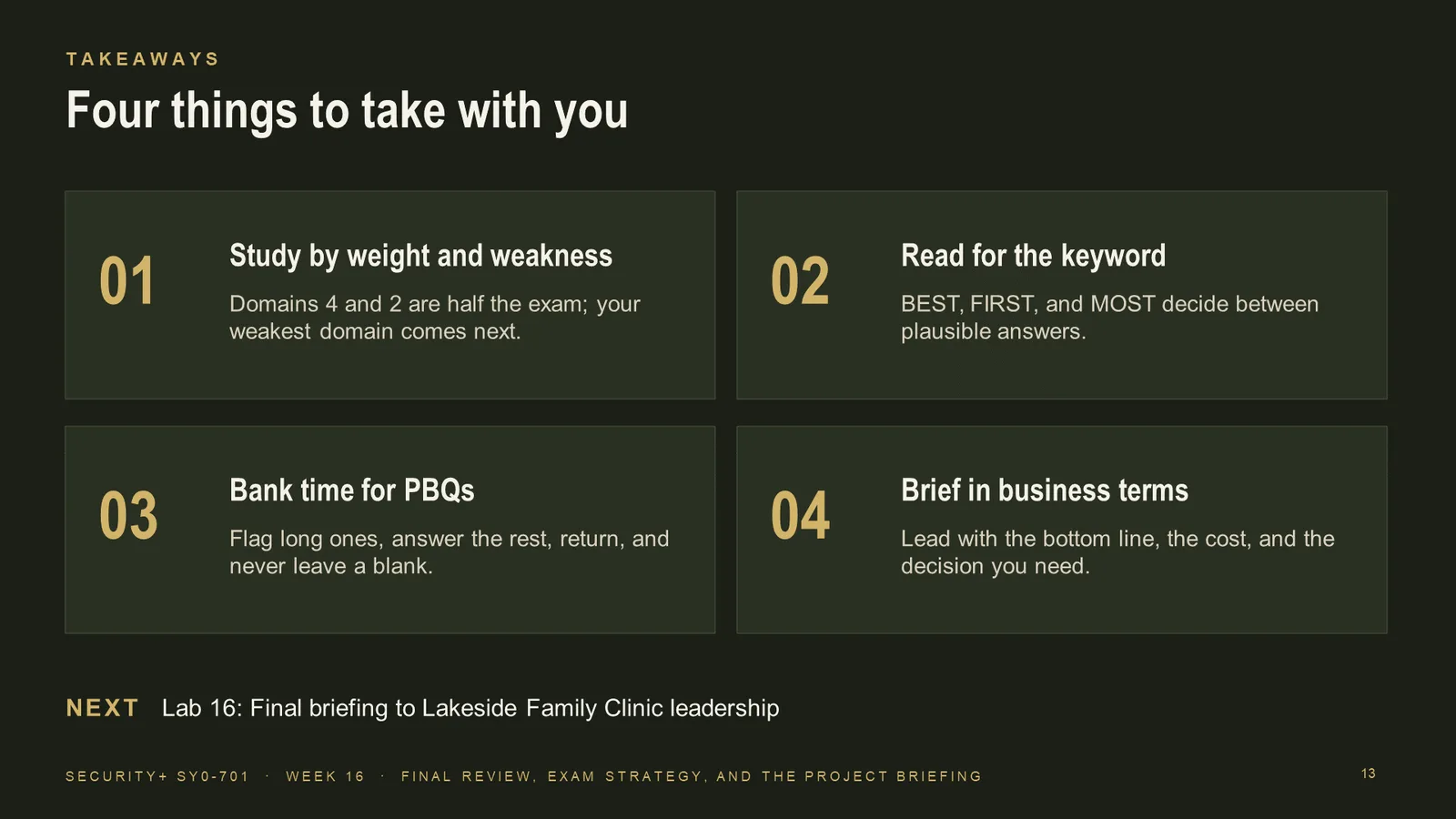
01 Study by weight and weakness
Domains 4 and 2 are half the exam; your weakest domain comes next.
02 Read for the keyword
BEST, FIRST, and MOST decide between plausible answers.
03 Bank time for PBQs
Flag long ones, answer the rest, return, and never leave a blank.
04 Brief in business terms
Lead with the bottom line, the cost, and the decision you need.
You need your final project report, presentation software, and a timer. The instructor and two classmates act as the clinic's leadership panel: an owner-physician, the practice manager, and the clinic's outside accountant.
Lab steps · 0 of 8 complete (0%)
Your slide deck (eight slides or fewer), a one-page leave-behind summary for the panel, and a half-page reflection on the questions you received and what you would change. Submit them with your final project report.